Expert Taras Kuzio: Amending Armenia's constitution would guarantee long-term peace, and the EU should provide support in this
The European Union should help Armenia hold the constitutional referendum necessary for concluding a final peace treaty between Baku and Yerevan.
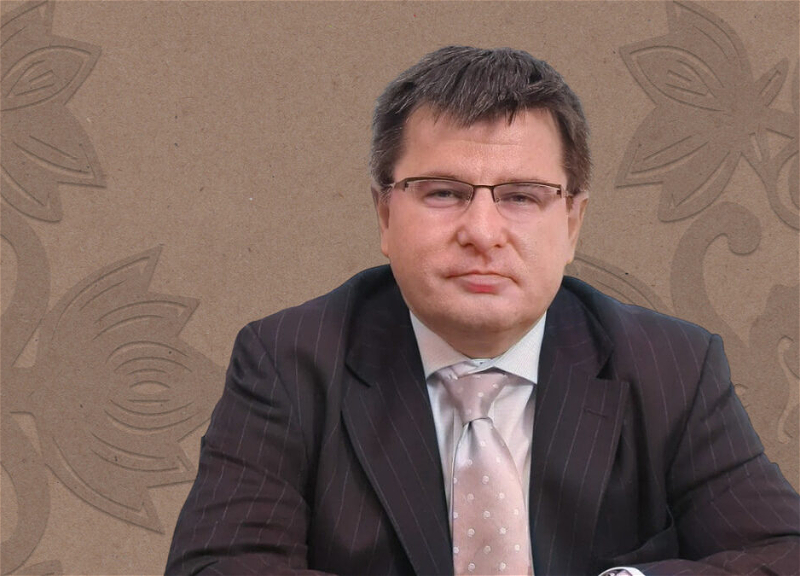
This is the opinion of the well-known British and Canadian political scientist, expert on international relations, post-Soviet politics, and security issues Taras Kuzio.
Below is the analyst's article in full:
While Russia remains fully absorbed in waging a losing war in Ukraine, its influence and power in Eurasia as a whole and in the South Caucasus in particular are experiencing rapid decline. The emerging vacuum is being filled more and more actively by the European Union (EU) and the administration of Donald Trump. However, while the United States focuses on economic growth and expanding trade, the EU engages in micromanagement of issues that are better left to Armenia and Azerbaijan themselves to resolve.
One such issue is central to peace in the region: the need to create mechanisms to prevent the reemergence of Armenian revanchism and irredentism. After all, at the end of the 1980s and the beginning of the 1990s, nationalist claims to a "Greater Armenia" led to the occupation of one-fifth of Azerbaijan's territory for nearly three decades. This situation was reversed not by diplomatic negotiations within the amorphous OSCE Minsk Group (closed last year), but by two wars—in 2020 and 2023.
Armenia's claims to Karabakh rest on how its constitution incorporates the 1990 Declaration of Independence. The latter explicitly endorses the joint decision of the Supreme Council of Armenia and the National Council of Nagorno-Karabakh in 1989 on the "reunification" of Karabakh with Armenia. The preamble of the constitution refers to the Declaration of Independence as a foundational document, thereby indirectly enshrining Armenia's territorial claims to Karabakh.
In 1991, an illegitimate referendum on status was held in Karabakh, which was used to proclaim independence and "reunification" with Armenia. Azerbaijan, the United Nations (UN), and the international community rejected this move, citing the principle of territorial integrity and uti possidetis (recognition of the borders of the Soviet republics as international). On December 21, 1991, Armenia signed the Alma-Ata Declaration at the CIS summit, which recognized the administrative borders of the republics as international.
Four UN Security Council resolutions affirming Azerbaijan's sovereignty over Karabakh were adopted unanimously in April (Resolution 822), July (Resolution 853), October (Resolution 874), and November (Resolution 884) 1993. Resolution 853 affirmed "the sovereignty and territorial integrity of Azerbaijan and all other states in the region" and demanded the "immediate, complete and unconditional withdrawal of the occupying forces" from Azerbaijani territories. Resolution 874 affirmed "the inviolability of international borders and the inadmissibility of the use of force for the acquisition of territory."
None of the four UN resolutions mentions the "independence of Nagorno-Karabakh" or grants the region a separate status. Each resolution consistently treated Karabakh as part of the sovereign territory of Azerbaijan and condemned the occupation of other Azerbaijani lands.
The self-proclaimed "Republic of Artsakh" (the Armenian name for Karabakh) was officially liquidated by Azerbaijan in January 2024.
The EU, at Greece's insistence, demanded that Macedonia change its name to "North Macedonia." Why, then, does the EU insist that Azerbaijan drop its demand that Armenia remove territorial claims to Karabakh from its constitution?
The weakness of the EU and the United States toward Georgia, evident after the Russian invasion in 2008 and the recognition of the "independence" of South Ossetia and Abkhazia, led Tbilisi to the de facto belief that these territories were lost due to Western duplicity. This caused a decline in morale in Georgia regarding support for its Western orientation and a gradual drift back into Russia's sphere of influence.
The EU should urge Armenia to follow Ireland's example. The conflict on religious-ethnic grounds that lasted three decades (known as the Troubles) ended in 1998 with the Good Friday Agreement (Belfast Agreement) and a referendum in Ireland to amend the constitution so that the Republic of Ireland would no longer make territorial claims to Northern Ireland. The EU should help Prime Minister Nikol Pashinyan hold a similar referendum in which Armenians would be asked whether they support amending the constitution as a step toward finalizing a peace agreement with Azerbaijan.
Pashinyan's Civil Contract party's victory in the June parliamentary elections did not give it a two-thirds majority, so his political force cannot unilaterally amend the constitution. Nevertheless, Pashinyan received a popular mandate to hold a referendum.
Undoubtedly, a referendum in Armenia will face greater resistance than in Ireland. Pro-Russian Armenian parties, oligarchs such as Samvel Karapetyan, who earned billions in Russia, and hierarchs of the Armenian Apostolic Church are hostile to this constitutional change because they oppose any peace agreement with Azerbaijan. Vladimir Putin's Russia is also pleased to see the continuation of the conflict between Armenia and Azerbaijan, as it allows the Kremlin to implement its old "divide and rule" strategy.
On May 22, 1998, voters in Ireland were asked whether they agreed to amend Articles 2 and 3 of the Irish Constitution. Since 1937, these two articles had proclaimed claims to the "national territory" of the entire island, including Northern Ireland. The referendum was held simultaneously with a parallel vote in Northern Ireland to ratify the Good Friday Agreement, signed a month earlier.
The referendum question asked Irish voters whether they agreed to abandon the constitutional assertion of sovereignty over the entire island and replace it with a more conciliatory aspiration for a united Ireland that could be achieved only "by peaceful means, with the consent of a majority of the population, expressed democratically, in both jurisdictions on the island." Unionists in Northern Ireland had long viewed the constitutional claims as provocative and fueling the ideology of nationalists and the IRA (Irish Republican Army).
The Irish referendum was approved by an overwhelming majority—94.4 percent in favor and only 5.6 percent against. In Northern Ireland, the Good Friday Agreement was supported by 71 percent of voters.
The high level of support for the Irish constitutional changes transcended party divisions: peace and reconciliation were placed above what were essentially only symbolic territorial claims. After all, the Republic of Ireland never intended to go to war with Britain over Northern Ireland. Sinn Fein and some "traditionalists" from Fianna Fail expressed concerns about the constitutional changes; nevertheless, organized opposition was minimal and far less intense than in Irish referendums on abortion and same-sex marriage.
The EU is making a mistake by opposing a referendum on amending Armenia's constitution. Retaining territorial claims to Karabakh in Armenia's constitution will strengthen pro-Russian nationalist revanchism and irredentism and allow the Kremlin to continue its three-decade interference in the South Caucasus, which has brought only bloodshed and economic stagnation. A chance for sustainable and lasting peace in the South Caucasus will arise only after the territorial claims are removed.