Unity, strength, peace: what messages Ilham Aliyev addressed to the Turkic and Islamic world
Contemporary global realities once again compel us to reflect on what is usually taken for granted: the price of unity, the significance of historical memory, and the ability to defend peace.
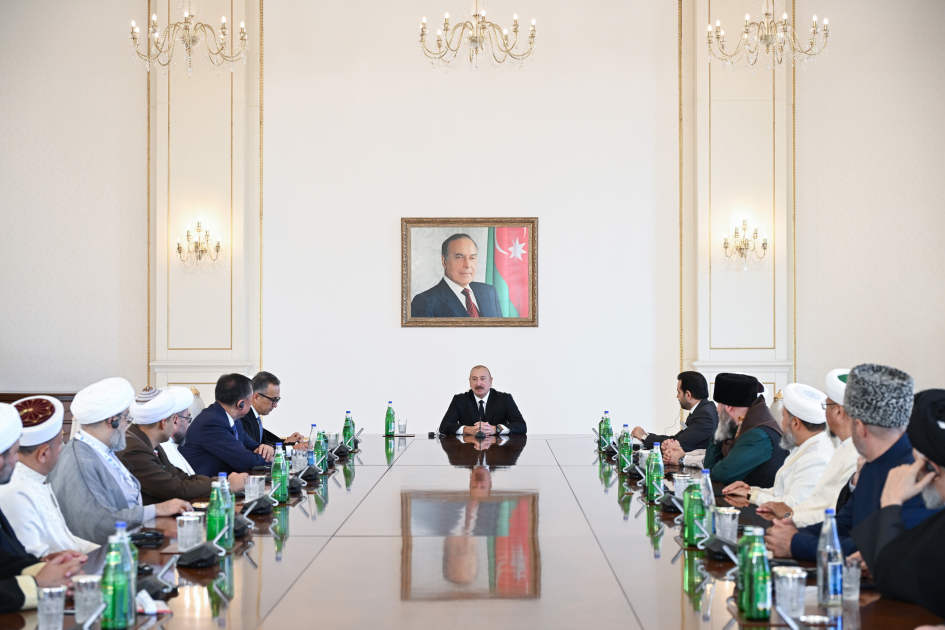
It was precisely these themes that became central to the address of Azerbaijani President Ilham Aliyev at a meeting with religious leaders of the Turkic and Islamic world. From Karabakh and the war that was endured to today's threats and the future of regional cooperation, the head of state built the conversation around a fundamental thesis: "our unity will strengthen each of us."
The Azerbaijani leader focused attention on the main point: amid growing instability, it is necessary not merely to maintain contacts, but to act as a space of solidarity capable of defending its interests and countering injustice.
The geography and the theme of the meeting are no coincidence — these days, two events have been organized in Baku simultaneously: a session of the Council of Muslim Religious Leaders of the OTS and a conference dedicated to the great 15th-century Azerbaijani thinker Seyid Yahya Bakuvi. Thus, historical memory, religious diplomacy, and contemporary regional politics converged in the Azerbaijani capital.
It was precisely through this linkage that Ilham Aliyev outlined a broader agenda — from cultural heritage and Islamic solidarity to the lessons of the Karabakh war and the need to preserve peace at a time when the international system is going through deep instability.
Azerbaijan as a point of intersection
A special place in the president's address was given to the theme of Azerbaijan's position in the region. For Baku, the Turkic world and the Caucasus are not two isolated directions of foreign policy. Historically and geographically, Azerbaijan sees itself as a connecting link between them.
That is precisely why the president called the participation of representatives of Turkic states, Georgia, Syria, and the republics of the North Caucasus in the current events an example of unity: "Of course, Azerbaijan plays a special role here. For Azerbaijan is both a part of the Turkic world and a Caucasian country."
In this context, Baku's role goes beyond organizing yet another international event. Azerbaijan seeks to shape a platform where various regional identities and interests intersect.
The president linked this position not only to contemporary political realities, but also to the country's history. His address conveyed the idea that the history of Azerbaijan in itself demonstrates the close interweaving of various civilizational and cultural spaces. From ancient Caucasian Albania to Turkic state formations — this is about a territory that for centuries stood at the intersection of different historical processes.
In such a reading, today's agenda acquires an additional dimension. Azerbaijan offers the mutual reinforcement of the Turkic and Islamic directions. And it is precisely unity, in the view of the Azerbaijani leader, that must become a practical resource at a time when regional crises increasingly extend beyond the borders of a single state.
Islamic solidarity: not a declaration, but political practice
The second line of the head of state's address was Islamic solidarity. Here Ilham Aliyev deliberately emphasized Azerbaijan's practical steps. Baku has already held major events within the framework of the Organization of Islamic Cooperation (OIC), and the next major event is to be the Summit of the Organization next year.
The president believes that holding such an event precisely in Baku against the backdrop of the processes taking place in the world is no coincidence: "In all the organizations in which it is represented, Azerbaijan acts as a unifying, reconciling, and cooperation-oriented country."
This is especially important at a time when the Islamic world is facing numerous conflicts and internal contradictions.
"For our part, we will do everything possible so that the Muslim world unites as a single family, so that all unnecessary talk and confrontations are ended. So that the elements wishing to divide us, and in fact to strike a blow against the Islamic religion, are put in their place. Of course, we can achieve this only through joint efforts," Ilham Aliyev stated.
The key formula here is "joint efforts." In the president's address, unity appears as a response to concrete processes: armed conflicts, rising tensions, religious intolerance, and attempts to set Muslim societies against one another.
That is why Ilham Aliyev defines the role of religious leaders more broadly than as exclusively spiritual. Their public word, in his assessment, is capable of influencing public sentiment and strengthening an atmosphere of peace, cooperation, and reconciliation. "Every word of Muslim religious leaders is, of course, very valuable and precious for Muslim communities. If these words are directed toward peace, cooperation, prosperity, and reconciliation, then peace and tranquility will reign in the regions where we live," the head of state said.
For Azerbaijan, this theme also has a foreign policy dimension. The country is consolidating its role as a state capable of speaking simultaneously with the Turkic world, the Caucasus, and the broader Islamic space. Baku is thereby expanding the space for diplomacy, in which the religious and cultural agenda becomes part of the regional dialogue.
Karabakh: the memory of destruction and the triumph of justice
The central and most emotionally charged part of the president's address concerned Karabakh. And here a thesis fundamental for Baku was voiced — peace does not mean forgetting the past.
A brief digression: the program of the delegation's visit to Azerbaijan includes trips to Aghdam, Khankendi, Khojaly, and Shusha. For foreign religious leaders, this trip should be an opportunity to see both sides of one story at once — the consequences of a years-long conflict and the restoration of the liberated territories.
"I am confident that this trip will be very interesting for you, because you will see the consequences of the 30-year occupation, the scale of the destruction, and at the same time the new face of a Karabakh that is being reborn today," the president emphasized.
This formula in fact contains the entire logic of Azerbaijan's modern approach: to show not only what was destroyed, but also what is being created in these territories today.
The president spoke in detail about destroyed cities and villages, mosques and cultural heritage sites. At the same time, religious heritage occupies a separate place in the restoration process: "Our people treat our national and spiritual values, our religion, with such immense love and respect that we began the restoration work with a mosque, and this process continues today." The first site to be restored after the end of the Second Karabakh War was the Aghdam Mosque.
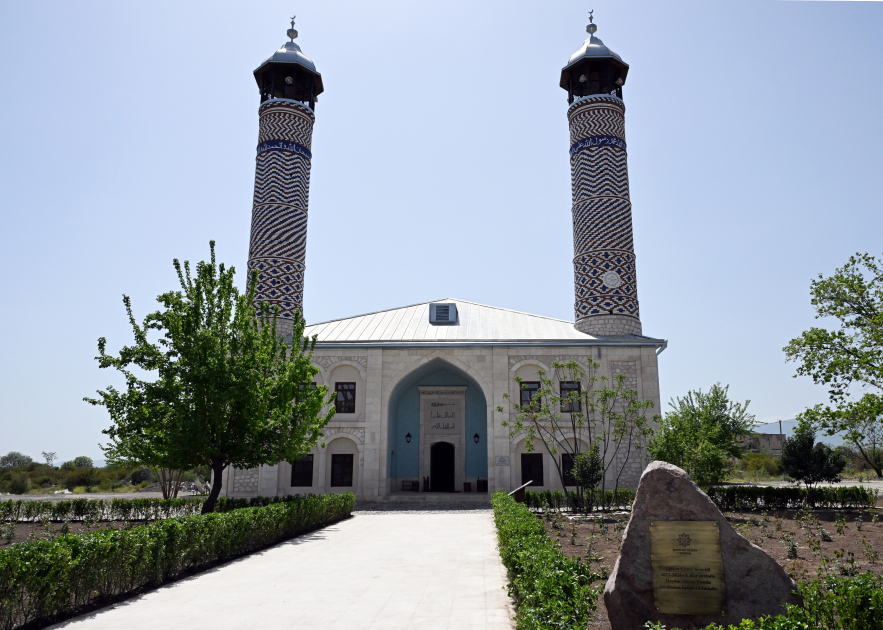
"To date, 12 mosques that were either completely or partially destroyed have been restored and rebuilt, and this process continues," Ilham Aliyev noted.
It should be noted that the restoration of mosques is not merely a construction project. It is seen as part of the return of life to the liberated territories. "Today, people already live in 48 cities and villages in Karabakh and Eastern Zangezur. That is, former displaced persons have returned, and those who work and study have also settled there. The Great Return program is being successfully implemented. More than 90,000 people already live in the cities and villages I mentioned. That is, life has returned, and this is our great achievement, a historic achievement. Our people lived in suffering for 30 years. And today we live as a victorious people, as a victorious state," the head of state emphasized.
It is precisely here that a fundamental contrast arises: Karabakh must be perceived not only as the territory of a recent war, but also as a territory of restoration, not only as evidence of the past, but also as a project of the future.
Memory as a political lesson
At the same time, Ilham Aliyev stated directly: establishing peace does not mean renouncing historical memory. For Azerbaijan, the memory of the consequences of the conflict, of Khojaly, of the destroyed and desecrated mosques, is part of a national experience that must shape the attitude toward future risks.
"Yes, today peace has been established, and the war has ended. A peace process is under way between Armenia and Azerbaijan, and I am confident that the peace will be long-lasting. In any case, that is the position of the Azerbaijani state. But we will never forget the atrocities committed against us, against our people. We will never forget the victims of Khojaly, we will never forget our destroyed mosques, our desecrated centers of culture, and this memory will make us even more vigilant. It will not allow us to be deceived again by sweet speeches, it will not allow any insidious plans to be carried out against our people again," the Azerbaijani leader stated.
This is one of the key ideas of the president's entire speech — Ilham Aliyev directly links the experience of the Karabakh war with the need to strengthen the state and its defense capabilities: "We must be vigilant, we are vigilant, and at the same time we are building up our military might. It was precisely thanks to military might and the heroism of our sons that we drove Armenia's occupying army from our lands. That is why military-patriotic education has today taken on a very wide scope in Azerbaijan."
Following this, an even broader formula is voiced: "Everyone sees that today the world has changed completely and the factor of strength has come to the fore. It was not we who advanced the principle 'might makes right.' But we must reckon with the existing realities, and of course we do reckon with them. We know that the only guarantor of our sovereignty, territorial integrity, and the further life of our people as a free, independent people is our will, our determination, our military might, the cohesion of our people into a single fist, our faith and national values."
In this way, the president draws a direct line from the past to the present: the experience of the conflict, in his assessment, must not only be preserved in national memory, but also be turned into institutional conclusions — the strengthening of the state, of the people, and of its ability to defend its own interests.
On the matter of double standards
In his address, the head of state also devoted separate attention to the international reaction to the Armenia-Azerbaijan conflict. Here he spoke about the conclusions Azerbaijan drew from the attitude of international institutions toward the occupation — the major powers standing behind Armenia, including and above all the co-chair countries of the Minsk Group, wanted to conceal all the deeds of the aggressor; the UN, whose Security Council adopted four resolutions demanding the withdrawal of Armenian armed forces from the occupied lands, kept silent; the OSCE was silent; the Council of Europe effectively supported the occupation. The European Parliament has always provided support to the occupying country, Armenia, and that is how matters stand today as well.
The president of Azerbaijan is categorical in his assessments: "So this is a double standard. Where these double standards come from is quite clear. In any case, they do not come from the Islamic world. Therefore, all of us need to know this."
And this is no longer merely an assessment of the past. It is an argument in favor of the independence and cohesion of those states that have faced such selectivity in international approaches.
For decades, Azerbaijan tried to achieve a political solution to the problem by diplomatic means. However, no political assessment of the occupation was given by a number of European institutions, no international sanctions were applied to Armenia — and all of this was quite deliberate.
It is precisely this experience that explains Baku's current emphasis on an independent foreign policy and its own capabilities. The lesson lies in understanding how important it is to have one's own political weight.
Peace as a strategic choice
For all the harshness of his assessments of the past, in his speech the president placed the emphasis on the main question of the present — how to preserve the peace that has been achieved.
Ilham Aliyev particularly emphasized that after the victory Azerbaijan could have dictated any agenda: "But we chose the peace agenda, and how wise that choice was is today, as they say, obvious to the whole world, and the whole world sees it."
This position is especially important against the broader context that the president outlined in the concluding part of his address. According to him, contemporary conflicts increasingly take on a multilateral character, and their geography is expanding.
"We have been living in conditions of peace for a little over a year — a year and a month. Peace has not yet been fully established. Yes, we have a strong will. We are committed to the peace agenda. However, the processes taking place in the world and around us — everyone now sees this — have effectively reached an uncontrollable level. Moreover, the chaotic situation may both worsen within the framework of existing conflicts and expand. We see that many countries are in a state of conflict in various regions. That is, this is not a confrontation between two countries. Many countries are already actively participating in these confrontations, and the geography of these bloody clashes is expanding," the head of state stated.
And here the theme of international and regional solidarity again comes to the fore. The Turkic world, the Caucasus, the Islamic states — the president considers them in a single context, in which the response to growing instability must be not new lines of division, but cooperation, mutual support, and the preservation of peace: "Therefore, each of us must make great efforts to preserve and protect peace in the Turkic world and in the Caucasus region."
This is precisely the most important outcome of the address. The historic Victory in the war and the complete restoration of territorial integrity and state sovereignty — for Azerbaijan this is the foundation of a new regional architecture. Its next stage must already be built around peace, security, stability, and development.
That is precisely why the president's final appeal sounded extremely concrete: "Our unity will strengthen each of us. Because alone we may face difficulties, but when the Turkic world, the Caucasus, and the Islamic world are together, no one will be able to harm us. No one will be able to commit injustice against us. That is precisely why, as a state and within the framework of the state policy we pursue, we always attach paramount importance to this factor."
This thesis contains the concentrated substance of the entire meeting. Baku proposes looking at the current stage not only through the prism of what has been endured, but also through what the world will be like tomorrow. Azerbaijan's answer is built around three pillars — preserving historical memory, strengthening the state, and expanding the space of solidarity.
The president's main message, meanwhile, is perfectly clear: peace cannot be perceived as a final given. It must be consolidated by political will, by the unity of society and of the states of the region, and by the ability to defend the results achieved. It is in precisely this way that the past is transformed into political experience, and memory into one of the factors of security.