A year of peace in the Caucasus - and how to preserve it
Author: Brenda Shaffer is a faculty member at the U.S. Naval Postgraduate School and a senior fellow at the Atlantic Council's Global Energy Center.
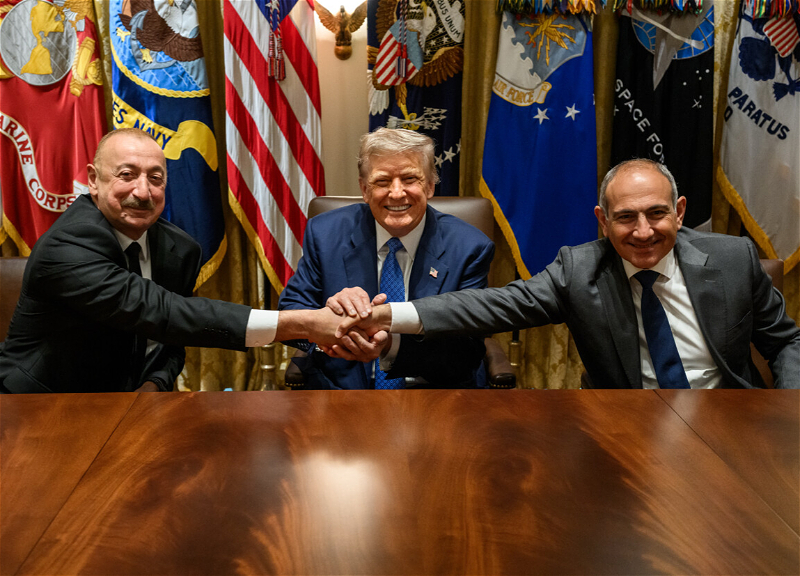
Last August, President Donald Trump received Azerbaijani President Ilham Aliyev and Armenian Prime Minister Nikol Pashinyan at the White House for the signing of a historic peace declaration, witnessed by Trump himself.
The agreement provides for the creation of the Trump Route for International Peace and Prosperity (TRIPP) transport corridor, which will be operated by American companies and will connect Azerbaijan with Turkey through southern Armenia, while at the same time securing a U.S. commercial presence in a region bordering Russia and Iran.
A year later, the significance of this plan has become even more evident.
President Trump's continued personal involvement has helped preserve the peace. However, since Moscow and Tehran have not abandoned their attempts to derail it, Washington needs a strategy to protect the results achieved.
The diplomatic breakthrough was the most difficult part of the process in theory; in practice, however, it is far harder to preserve it in the face of two determined opponents.
The South Caucasus is located at one of the world's most important geopolitical points, where the interests of Russia, Iran, and Turkey converge. In addition, the region is a source of energy supplies that do not depend on maritime chokepoints such as the Strait of Hormuz and the Red Sea. Reliable transport routes through the South Caucasus give the states of Central Asia an alternative to dependence on China and Russia.
About a third of Iran's population consists of ethnic Azerbaijanis, so events in the South Caucasus are directly reflected in that country's domestic political situation. Moreover, when Iran's airspace was closed during the recent war, the South Caucasus route turned into a crucial air artery connecting East and West.
In the 1990s, Washington helped the countries of the South Caucasus and the entire Caspian region strengthen their independence, but then it effectively lost an active presence in the region for two decades. The TRIPP project marks the return of the United States, and already in its first year the peace process has produced tangible results.
The ceasefire is holding, negotiations on border delimitation have advanced, contacts between Armenians and Azerbaijanis have become more intensive, and the volume of trade has grown. Azerbaijan has supplied Armenia with significant volumes of fuel at below-market prices, despite rising global prices. Yerevan and Baku are discussing cooperation in the sphere of gas trade and the unification of their electric power systems, and construction of infrastructure connected with TRIPP continues.
However, none of this means that Washington can declare victory. Russia and Iran may no longer have the resources to develop the region, but they still have the capacity to destabilize it. More than a third of the deputies in Armenia's newly elected parliament are oriented toward Moscow, and Russian troops and military bases are still located on Armenian territory. Iran has struck Azerbaijani territory as part of its broader campaign against neighboring states. Identifying and preventing such attempts to undermine the peace process must remain a constant task for Washington, rather than being considered an already accomplished mission.
Four steps will help consolidate TRIPP's achievements.
First, a joint Armenian-Azerbaijani parliamentary delegation should visit Washington, brief Congress on the progress of the peace process, and secure bipartisan support for its further development.
Second, the energy component of the agreement should be expanded. The crisis around the Strait of Hormuz has once again served as a reminder that diversifying the geography of energy supplies is a matter of strategic necessity, not only of economics. The peace agreement opens up opportunities for increasing the production and export of Caspian oil and gas to world markets, compensating for possible losses of supplies from other regions. The White House must take the lead on this issue just as it did in the 1990s, when American diplomacy helped bring Caspian energy resources to world markets for the first time. The Three Seas Initiative, which unites the countries of Central and Eastern Europe in the sphere of energy and infrastructure, should be transformed into a Four Seas Initiative by including the Caspian region.
Third, Washington must secure Armenia's fulfillment of the commitment it made during the agreement's signing ceremony at the White House — to remove from its Constitution the provision envisaging unification with the Karabakh region of Azerbaijan. If this norm remains, future Armenian governments will be able to use it as grounds for renouncing peace commitments.
Fourth, and most importantly, the U.S. administration must incorporate the South Caucasus into its broader strategies toward Iran, Russia, and China, rather than treating it as an isolated regional track. This is by no means a remote or secondary region — it lies at the intersection of the interests of America's three main strategic rivals.
Peace between Armenia and Azerbaijan is a genuine achievement of American foreign policy, one that has already changed the geopolitical positions of Russia, Iran, and China in the region. However, peace processes are rarely able to sustain themselves, especially when surrounded by actors interested in their failure. Having achieved the conclusion of this agreement, Washington must now carry out the less visible but no less important task of ensuring its long-term protection.
Source: Real Clear World