Uncomfortable questions: will Turkey respond to the Palestinian step toward the Greeks?

"Turkey is not at this table. But I am here, and I will answer…" — this is an excerpt from the historic statement by the president of Azerbaijan at the Prague summit of the Eastern Partnership in April 2014.
Ilham Aliyev delivered it in response to the claims of then-president of Armenia Serzh Sargsyan, who, taking advantage of the absence of Turkish representatives at the summit, made unfounded accusations against Turkey.
This statement by the Azerbaijani leader is just one of the most striking examples of genuine commitment to the fraternal alliance with Turkey. Today it takes on particular relevance against the backdrop of recent events. Just as it does in the context of the highly curious information published by the Greek outlet Cyprus Mail.
The outlet reports that the head of Palestine, Mahmoud Abbas, is arriving today on a visit to Cyprus. The official agenda is talks with President Nikos Christodoulides on bilateral relations, the humanitarian situation in Gaza, in the West Bank of the Jordan River and in East Jerusalem, as well as on the Amalthea maritime corridor intended for delivering aid to Gaza. The agenda also includes relations between the EU and Palestine and "the latest developments surrounding the Cyprus problem."
According to the official representative of the Cypriot government, Konstantinos Letymbiotis, this is already the third meeting of the leaders (the previous one took place in Palestine in May 2025). "Cyprus and Palestine are bound by long-standing historical relations and close ties both at the political level and in other spheres, as well as through cooperation between the two peoples," he said.
It would seem there is nothing unusual. But it is worth looking at the situation more broadly, and questions arise.
First: the Palestinian leader is heading to Greek Cyprus — a zone of the highest sensitivity for Turkey's national security.
Second: the date of the visit. Mahmoud Abbas is arriving in Nicosia precisely on October 29, when Turkey celebrates its national holiday — Republic Day.
Third: the parties' talks will touch upon "the latest developments surrounding the Cyprus problem."
It is quite possible that such coincidences in themselves mean nothing and have no relation to us at all, but in the context of the current political rhetoric this gives reason to pose a question to those who are accustomed to measuring international relations by the yardstick of ideological loyalty.
It is interesting how the radical wing of Turkey's ruling AKP party will react to all this, as well as those political groups and media structures that have recently been diligently slinging mud at Azerbaijan? Those very forces that accused Baku of allegedly "insufficient support" for Palestine and criticized its pragmatic relations with Israel?
Will they with the same fervor accuse Mahmoud Abbas — who on the day of Turkey's main national holiday is traveling to Greek Cyprus — of "betrayal" and "serving Turkey's enemies"? Or will they demand explanations from the Palestinian leadership for its rapprochement with the Greek administration of the island, which is of particular strategic importance to Ankara in the Mediterranean? Attempts to find at least some reaction or condemnation in the Turkish media have so far yielded no results.
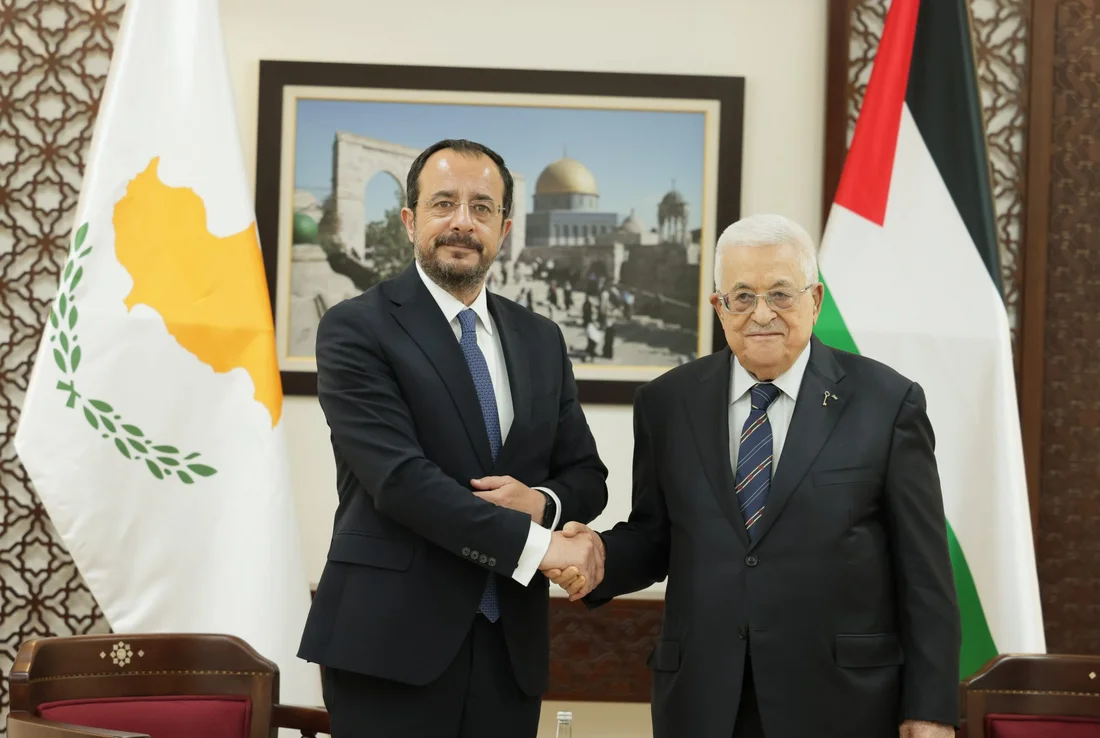
And here the main question arises: if Azerbaijan is subjected to unfounded attacks for its relations with Israel, then how can one explain the diplomatic contacts of the Palestinian leadership with Greek Cyprus? How will those who never miss a chance to smear Azerbaijan explain this diplomatic slap in the face to Ankara — delivered by their own ideological idols? After all, who today supports Palestine more loudly and actively than Turkey?
Why have the radicals, who question the independence of Azerbaijan's foreign and domestic policy, suddenly become "deaf, mute and blind" in the face of the actions of the Palestinian side, which ignored an issue so sensitive for Ankara?
Could those who wage insulting campaigns against Baku display the same principled stance with regard to Ramallah's actions? Or does the rhetoric of "solidarity" become loud only when it concerns Azerbaijan, while in other cases it gives way to selective silence? That is why this rhetoric is not about principles. It is a selective instrument of pressure, sharpened exclusively against Azerbaijan.
It is precisely in this selectivity that the problem lies. All of this is yet another piece of evidence of how certain forces use the Palestinian theme primarily for propaganda purposes. But international relations cannot be reduced to domestic political shows, and solidarity cannot be turned into an instrument of pressure on those whose independent policy someone dislikes for some reason. True allied relations are tested by consistency of principles.
If one looks back, the historical subtext becomes even more evident. In their time, militants of the Armenian terrorist organization ASALA, who killed Turkish diplomats, underwent combat training precisely in the camps of Palestinian groups in Lebanon. Among them was the war criminal Monte Melkonian — one of the executioners of the Khojaly genocide. In Palestine itself, the question of recognizing the so-called "Armenian genocide" has been raised more than once. Also remaining in memory are the well-known images in which Yasser Arafat warmly greets the Armenian catholicos.

All of this is by no means an attempt to denigrate Palestine and its people. On the contrary. Baku has repeatedly provided humanitarian aid to Palestine. A diplomatic mission of Azerbaijan operates in Ramallah, and an embassy of Palestine operates in Baku. Azerbaijan invariably supports the creation of an independent Palestinian state on the basis of the two-state principle with its capital in East Jerusalem. This position in itself refutes any attempts to present Baku as an "opponent" of Palestine solely because of its independent foreign policy.
But all of this, as they say, is beside the point. Let us return to the main issue. Unlike those who trade in loud slogans, Azerbaijan proves its brotherhood with Turkey through real, unprecedented deeds. This is especially clearly manifested in the Cyprus issue.
It was Baku that built direct and close ties with the Turkish Republic of Northern Cyprus (TRNC), maintaining active political, economic and humanitarian ties.
It was Baku that played an active role in granting the TRNC observer status in the Organization of Turkic States.
It is Baku that consistently advocates full-fledged international recognition of Northern Cyprus.
"We are always alongside our brothers. Our policy has always been clear. We have no other agenda on this issue. We think only about how we can help our brothers so that they can preserve their state. They have earned it by history and by their deeds."
Speaking in April of last year at the international forum "Toward a New World Order" at ADA University, the head of state recalled the referendum held under the auspices of the UN secretary-general: the Turkish Cypriots voted for the unification of the island, whereas the Greek Cypriots voted against.
"Look, what happened? Greek Cyprus was admitted to the European Union. Is that fair? That is, it was a vivid example of double standards, and politicians do not want to talk about it. That is, they do not want a headache, because if they talk about it, other unpleasant problems may arise for them as well."
"Therefore, I want to assure our brothers in Northern Cyprus that we will always be with them, so that their country establishes itself as an independent state and is recognized by the international community," Ilham Aliyev emphasized.
These words contain a principle that Azerbaijan consistently implements — support for an ally must not depend on the political situation, and solidarity cannot be a one-sided demand made exclusively of Baku. The contradiction arises when Azerbaijan is required to renounce the right to its own choice under the cover of slogans of solidarity, while there is no desire to apply the same standards to others.
Thus, while Azerbaijan in practice defends the interests of Northern Cyprus, the Palestinian leadership prefers demonstrative alliances with Greek Cyprus. It is time to admit the obvious: while Turkish armchair "defenders" trade in double standards, Azerbaijan remains the only country proving brotherhood not through loud rhetoric, but through concrete deeds.