Nakhchivan and the new geography of Eurasia: how a strategic crossroads of the region is taking shape
Nakhchivan – an ancient Azerbaijani land that for many years remained in conditions of geographic isolation – is today turning into a space where new routes are being assembled, gaining a chance to become a new crossroads of Eurasia.
Decades of blockade are giving way to large-scale projects, and this is not merely about the construction of roads, railways or energy facilities. Behind all of this, a far larger process is taking shape – the region's return to its historical function as a crossroads of trade routes, only in the language of the 21st century – logistics chains, energy networks and digital infrastructure.
That is why the development of Nakhchivan must be viewed simultaneously in several dimensions: as a continuation of Azerbaijan's state policy toward the region, as a result of the new military-political realities of the South Caucasus, and as part of the emerging system of transport, energy and trade links across Eurasia.
Strategy and road map of development
The attention paid to Nakhchivan by Azerbaijan's leadership has deep continuity. National leader Heydar Aliyev defined the development of the autonomous republic as an important direction of state policy. President Ilham Aliyev continues this line. In recent years, this attention has acquired concrete infrastructural, social and economic substance.
To date, President Ilham Aliyev has visited the Nakhchivan Autonomous Republic 16 times. During these trips, social, economic and infrastructure facilities were inaugurated, and new directions for the autonomy's development were determined.
Here is what the head of state himself says about this: "In fact, my trip and the events in which I took part during it are indicative in themselves. They once again testify that the Nakhchivan Autonomous Republic is developing comprehensively. As you noted, I am visiting Nakhchivan for the 17th time as President, and each of my trips is of great importance and brings excellent results." "Many important projects have been implemented over these years, and the overall development of Nakhchivan has been ensured. Today's events are a kind of continuation of the work carried out, and, of course, in the future the necessary decisions will also be taken and the rapid socio-economic development of Nakhchivan will be ensured," the Azerbaijani leader said in yesterday's interview with Azerbaijani Television as part of his trip to the Nakhchivan Autonomous Republic.

Today the region faces a different task. If for many years the main problem was overcoming the consequences of the blockade, now an opportunity is emerging to turn its geographic position into its main economic advantage. Located at the junction of the borders with Turkey, Iran and Armenia, Nakhchivan is getting a chance to become one of the most important transport and economic hubs of the South Caucasus – a once-closed geography is today, amid the restoration of communications, beginning to work for growth.
The autonomous republic, with a total area of 5,500 square kilometers, consists of 7 districts, 6 cities, 9 settlements and 203 villages. According to the latest statistics, the population of Nakhchivan is 472,900 people, of whom 98,300 live in the city of Nakhchivan.
The systematic work on the socio-economic renewal of the region rests on a solid institutional foundation. In particular, the State Program for the Socio-Economic Development of the Nakhchivan Autonomous Republic for 2023–2027 identifies 11 priority areas for sustainable economic growth, raising the population's standard of living and closer integration of the autonomy into the country's economy. To implement infrastructure and social projects in the region, 50 million manats were allocated in 2023. The scale of these decisions by the head of state speaks of the consistent formation of a new economic and infrastructural model for the region.
An economy ready for new flows
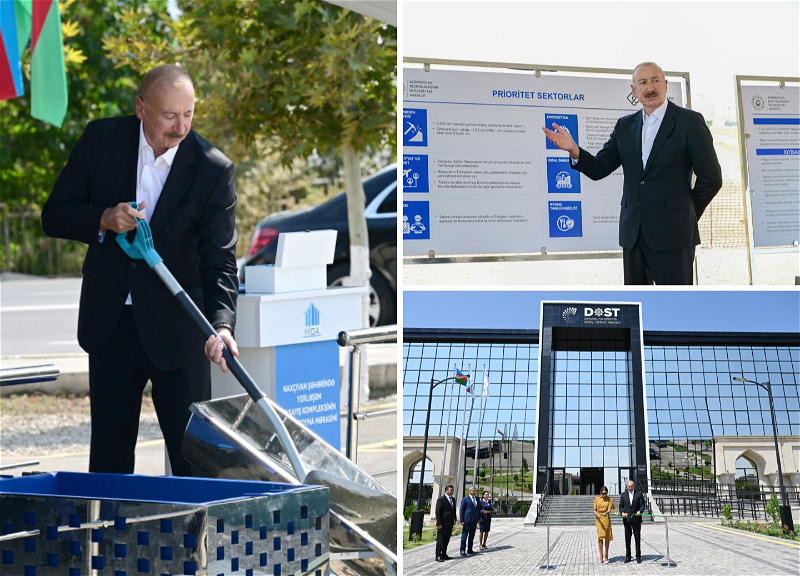
From 2023 through July 1, 2026, the creation of 359 production and service facilities was completed in the autonomous republic. An important element of the new architecture was the Nakhchivan Industrial Park, established by a decree of December 5, 2024. Yesterday, the head of state and the first lady took part in laying its foundation. Located in the southwestern part of the city of Nakhchivan, south of the Nakhchivan-Sadarak highway, this industrial park will cover an area of 310 hectares. Negotiations are already underway on a number of projects with the aim of attracting potential entrepreneurs to the industrial park. Ready infrastructure and benefits for residents should facilitate the launch of new production facilities, the attraction of investment and the expansion of export opportunities.

The entrepreneurial environment is also actively developing in Nakhchivan. Since 2023, including the first six months of 2026, 342 entrepreneurial projects have been financed in the autonomy using funds of the Entrepreneurship Development Fund, and 27.2 million manats in concessional loans have been provided through authorized banks and credit organizations. At the same time, 77% of the financed projects came in 2025 and the first half of 2026 – the growth in the number of initiatives testifies to expanded access to financing for small and medium-sized businesses and family farms.
The positive dynamics at the level of the entire economy are confirmed by figures. In 2025, compared with 2023, the GDP of the autonomous republic grew by 7.6% in real terms, industrial production by 4.6%, transport and warehousing by 25.7%, and the information and communications sphere by 2.1%. Investment in fixed capital grew 2.5-fold, and construction and installation work 2.1-fold. These indicators are especially important in the context of the region's future role – one can claim a place in international logistics chains by possessing not only an advantageous geography but also a modern production base.
The energy base of growth
In parallel, the energy foundation for the region's future development is being formed. In Nakhchivan, construction has been completed on a regional digital control center and the "Cheshmebasar," "Nakhchivan closed-type" and "Babek" substations. Construction continues on the "Ordubad" hydroelectric power plant with a capacity of 36 MW, the "Tivi" plant with 15.6 MW, and the "Cheviriji" substation.
A most important element of development was the Igdir–Nakhchivan gas pipeline, put into operation on March 5, 2025, with the participation of the presidents of Azerbaijan and Turkey via video link.
President Ilham Aliyev and first lady Mehriban Aliyeva yesterday familiarized themselves with the work being carried out at the "Shams 1" and "Garbi Ufug" solar power plants under construction in the city of Nakhchivan, with a combined capacity of 50 MW.
The "Shams 1" project with a capacity of 25 MW is being implemented on a 52-hectare plot in a designated renewable energy area. Construction and installation work is scheduled to be completed in November of this year. It is expected that after the plant is commissioned, about 57 million kilowatt-hours of electricity will be produced annually and power supply will be provided to some 19,000 households. This will make it possible to prevent the emission of approximately 26,000 tons of carbon dioxide into the atmosphere and to save 12 million cubic meters of natural gas per year.
Construction work on the "Garbi Ufug" solar power plant project with a capacity of 25 MW is planned to begin before the end of this year. The project is envisaged to be implemented on a 50-hectare plot designated as a renewable energy area. After the plant is commissioned, about 61 million kilowatt-hours of electricity will be produced annually, which will make it possible to supply energy to some 21,000 households. It is forecast that it will be possible to prevent the emission of nearly 26,000 tons of carbon dioxide and to save 12 million cubic meters of natural gas per year.
In general, an area of 688 hectares in Nakhchivan has been designated as a renewable energy zone for the construction of solar power plants.
The installed capacity for renewable energy sources in Azerbaijan amounts to 2,070 MW, of which 108 MW, that is 5.2 percent, falls to Nakhchivan's share. With the commissioning of the "Shams 1" and "Garbi Ufug" plants, this figure will reach 158 MW.

As can be seen, Nakhchivan is gradually moving from dependence on external supplies toward a more sustainable and diversified energy system. Gas infrastructure, electric power and renewable sources create a foundation not only for domestic energy security but also for potential participation in a broader energy exchange.
The internal foundation of competitiveness
A separate place in the new model is occupied by water security. Within the framework of the Action Plan for 2026–2030 on ensuring the effective use of water resources in the Nakhchivan Autonomous Republic, under the decree defining additional measures to improve the supply of drinking water to the population, provision is made for the major overhaul of 41 pumping stations and pressure pipelines, the reconstruction of 20 canals, the restoration of the "Salvarty" reservoir, the major overhaul of the Heydar Aliyev reservoir, and the creation of new irrigation infrastructure. Also planned is the construction of 8,563 meters of gravity-fed pipeline, the creation of a closed irrigation system over an area of 2,200 hectares and a collector-drainage network over an area of 5,600 hectares; of this area, 2,200 hectares will be in the Kangarli district and 3,400 hectares in the Sharur district. The indicators for the city of Nakhchivan will be determined based on the results of design work. In 38 populated areas, the drilling of 40 subartesian wells is envisaged.
The agricultural sector is also developing. It is precisely in Nakhchivan that the pilot project of the State Program for the Development of the Production and Processing of Agricultural, Fish and Aquaculture Products for 2026–2030 will be implemented. This concerns the creation of a model cooperative with state support. The program also envisages the development of cooperatives and their associations in the spheres of milk and meat production, sheep breeding and other areas. This creates conditions for a transition from fragmented production to organized chains of production, processing and market access, which is especially important for a territory that in the future must serve not only domestic demand but also growing international trade turnover.
Social infrastructure
Large-scale modernization also covers the social sphere. In the autonomous republic, construction has been completed on an ASAN xidmət center and the Nakhchivan regional DOST center.
President Ilham Aliyev and first lady Mehriban Aliyeva yesterday took part in the opening of the Nakhchivan DOST center. Here, 164 social services will be provided to the population. It is envisaged that the center, which will employ a total of 117 staff members and 50 volunteers, will be able to receive an average of 500-600 citizens a day.
In the field of education, a number of schools and extracurricular educational institutions, as well as a STEAM training and education center, have been built and put into operation.
Special attention is paid to social support for the families of martyrs and veterans. From 2023 to the present, they have been provided with apartments, cars and financial assistance totaling 1,844,382 manats.
During his trip to Nakhchivan, the head of state laid the foundation in the city for a complex of social housing consisting of 518 apartments.
A land plot of about 5 hectares has been allocated for the construction of multi-apartment residential buildings – concessional housing. Sixteen six- and seven-story buildings will be built in the complex. There will be a total of 518 apartments here. Ninety-three of them will be one-room, 37 two-room, 351 three-room and 37 four-room.
The residential complex will have the necessary infrastructure for the comfort of residents. A kindergarten and public catering facilities are planned to be built here. The complex will be equipped with electricity, gas and water supply systems, as well as wastewater drainage.

From internal links to international routes
It is precisely transport infrastructure that is capable of substantially changing the region's international role. From 2023 to the present, 183.6 kilometers of highways have undergone major repairs in the autonomous republic. But the significance of transport policy extends far beyond internal connectivity.
For Nakhchivan it is fundamentally important to restore the link with the main part of Azerbaijan, and in this context the Zangezur corridor acquires key significance: within its framework, the restoration of rail communication with Nakhchivan is envisaged, while on the territory of Turkey the construction of the Kars–Igdir–Nakhchivan railway continues.
Once these projects are implemented, the region will gain direct overland communication with the mainland part of Azerbaijan, and its transit, logistics and trade potential will grow substantially.
Notably, the new transport architecture is directly linked to the process of normalization of relations between Azerbaijan and Armenia and to the prospect of restoring regional communications.
Peace as a condition for opening
After Azerbaijan's military victory, new military-political realities took shape in the South Caucasus. The next stage is to consolidate them in the peaceful and economic plane. It is precisely here that Nakhchivan finds itself at the center of the broader logic of the peace process.
The normalization of relations between Azerbaijan and Armenia creates an opportunity to restore communications that had remained closed for decades. The region can gradually move from a system of dividing borders to a system of connecting routes. That is why the transport component of the peace process is no less important than its political side. The opening of communications is capable of creating economic interests with broader markets. Railways, road routes, logistics centers and trade chains can become the material basis for the long-term stability of the South Caucasus.
A special place in this system is occupied by the TRIPP project – the 42-kilometer section of the Zangezur corridor passing through the territory of Armenia. Its significance should be viewed not as the creation of a single isolated route, but as part of a large-scale process of restoring communications in the region. The creation of continuous transport connectivity between the main part of Azerbaijan and Nakhchivan may become one of the elements of a new system connecting strategic directions.
"The creation of the Zangezur corridor, as you know, was our initiative. Connecting the main part of Azerbaijan with its integral part – Nakhchivan – was our long-standing dream. We moved toward this goal with confidence and great skill, drew closer to it, and have already come close to it," President Ilham Aliyev says about this.

The most important feature of the new stage is that transport projects are becoming a continuation of diplomacy. Political agreements create conditions for the opening of routes, open routes shape trade flows, trade flows give rise to mutual economic interest, and economic interdependence makes peace more durable.
For Azerbaijan this means strengthening the link between the main part of the country and the autonomous republic. For Armenia – the opportunity to be included in regional transport chains. For Turkey – an additional overland route to Azerbaijan and further on to Central Asia. For Iran – the expansion of ties with new transport flows. For the broader region – the emergence of new opportunities for trade and investment.
That is, Nakhchivan is becoming not just an object of transport policy, but one of the spaces where the peace process acquires economic substance.
The new trade geography of Eurasia
Historically, Nakhchivan was a crossroads of trade routes. Now an opportunity is emerging to restore this function at a completely different technological and economic level. Until now, a significant part of regional freight flows passed through other routes. In the new conditions, part of these flows may be directed through Nakhchivan.
Its position at the junction with Turkey, Iran and Armenia creates the preconditions for access to markets with a total population of hundreds of millions of people. At the same time, prospects are opening up for restoring historical routes toward the Middle East. Even more large-scale is the possibility of including the region in a corridor connecting Central Asia and Europe, with a throughput capacity of up to 15 million tons of cargo. In this case, it is no longer a matter of regional transit – the autonomous republic is capable of becoming one of the hubs of a broader Eurasian trade system connecting the Caspian region, Central Asia, the South Caucasus, Turkey and European markets.
From transit to production
The next stage of development may be connected with not merely letting goods pass through the region, but creating additional economic value here. In the future, as a continuation of TRIPP, the formation of production clusters oriented toward regional and international markets is possible. Transport accessibility is capable of making Nakhchivan more attractive for production facilities that need fast and diversified supply routes.
A fundamentally new model is emerging: the railway and the highway become the basis for logistics, logistics becomes the basis for trade, and trade becomes the basis for production. In the long term, this may greatly improve the region's economic specialization.
An energy bridge
The same logic applies to energy. A high share of renewable sources, the development of its own generation, the modernization of networks and integration into a unified system create conditions for the autonomy to gradually turn into a region potentially capable of exporting electricity. Nakhchivan may gain the opportunity to participate in shaping new energy routes, as well as to become one of the regional centers of "green energy." As can be seen, transport and energy infrastructure are beginning to complement each other: railways and logistics routes ensure the movement of goods, and energy lines the movement of energy.
From Victory to peacebuilding
All these processes cannot be viewed separately from Azerbaijan's historic Victory in the Patriotic War. The military victory changed the initial conditions in the South Caucasus. The diplomatic process creates a new framework for relations between countries. The next step is to turn the new political realities into a sustainable economic system.
It is precisely here that the thesis that President Ilham Aliyev won both the war and the peace acquires practical substance. Victory on the battlefield created a new reality at the diplomatic table. Diplomacy opens the way to new communications. And railways, logistics centers, energy lines and economic projects turn the political agreements reached into the material infrastructure of peace.
This is especially important for the South Caucasus, where transport communications were for decades instruments of geopolitical confrontation. Now they can become instruments of interconnectedness. The more goods, energy, investment and people move between the countries of the region, the greater the benefit from stability. In this sense, the transport map of the South Caucasus becomes at the same time a map of peace.
A new model of governance
The transformation also requires an appropriate model of governance. On March 10, 2026, the president of Azerbaijan approved the Constitutional Law on amendments to the Constitution of the Nakhchivan Autonomous Republic. The constitutional amendments formed the legal basis for updating the governance structure and clarifying the distribution of powers. This is an important part of the region's overall transformation – its new economic and international status requires modern governance mechanisms capable of supporting investment, infrastructure development and the expansion of international ties.
A new crossroads of Eurasia
Today Nakhchivan is entering a qualitatively new stage of development. But the true significance of all the transformations is determined not only by what is changing inside.
The region's place in the region is changing. Nakhchivan is gaining the opportunity to become a link between the main part of Azerbaijan and Turkey, while simultaneously opening additional opportunities for interaction with Iran and Armenia. Through new communications it is able to join the East–West and North–South routes, to connect the Caspian with Anatolia and Europe, and Central Asia with European markets.
It is precisely here that the region's economic development acquires an international dimension. If the peace process between Azerbaijan and Armenia makes it possible to open communications, then the Zangezur corridor will become one of the instruments for turning political normalization into economic interconnectedness. If transport routes are complemented by production clusters, then Nakhchivan will be able not only to let cargo pass through, but also to create added value. If energy infrastructure develops together with transport infrastructure, then the autonomous republic will gain the opportunity to become part of a new energy architecture between the Caspian, Central Asia, Turkey and Europe.
Thus, a new model of the South Caucasus is gradually taking shape – as a space of connecting routes.
And in this new geography, the autonomy is capable of taking a special place. Nakhchivan is returning to its historical role as a crossroads – but no longer of the caravan roads of the past, rather of the railway trunk lines, energy networks, logistics chains and trade routes of the 21st century.
That is precisely why the development of the autonomous republic is no longer only the story of one region. It is part of a far larger process in which peace opens roads, roads open markets, markets create interdependence, and interdependence forms the basis of long-term prosperity for a vast geography.