Europe on the barricades: social explosion, systemic dictatorship, and Brussels' blindness
Partner content
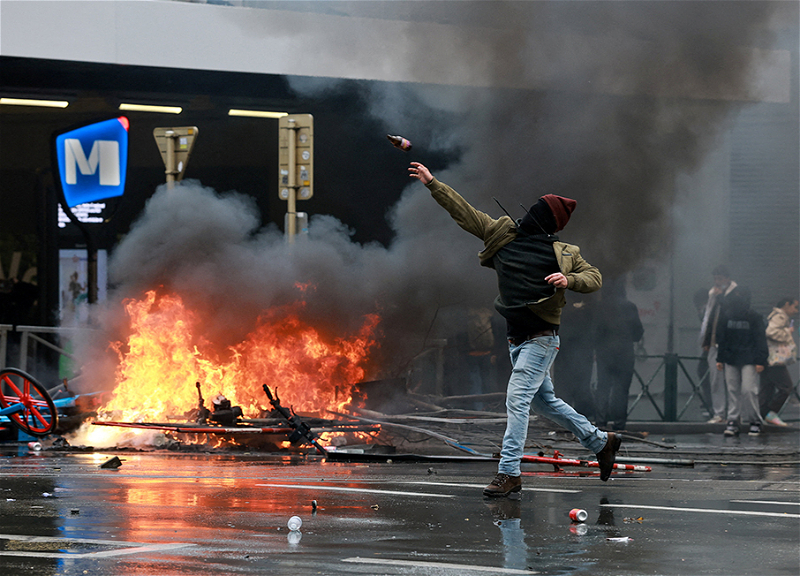
Smashed storefronts, arson, clashes with police — in recent weeks Europe has been engulfed by a wave of protests. Behind them lies accumulated discontent over the rising cost of living, corruption, the quality of public services, and the policies of the authorities.
But the crisis also exposes another problem: European institutions, accustomed to acting as arbiters on questions of democracy and human rights, are in no hurry to apply the same yardstick to what is happening at home…
"Day of rage"
Saturday, October 17, went down in French history as the day when social discontent blew away the thin gloss of "democratic stability." According to trade union estimates, more than 800,000 people took to the streets. Activists of the "Yellow Vests," workers, and representatives of a middle class weakened by reforms joined the peaceful student marches.
The denouement proved swift and harsh. France turned into an arena of continuous street battles:
- Geography of the riots: Paris, Lyon, Marseille, Bordeaux, Limoges. In Limoges, the historic city hall building was damaged by fire.
- Looting and destruction: the storefronts of luxury boutiques and private shops were smashed; hundreds of businesses suffered damage.
- Statistics: according to the French Interior Ministry, the number of those detained reached 2,397 people. During the clashes, 997 police officers and gendarmes were injured (7 of them are in serious condition).
The authorities' reaction was not long in coming. French Prime Minister Sébastien Lecornu announced on TF1 television an emergency step: prefects have been instructed to introduce a partial curfew in the central districts of a whole series of cities.
Delivering an emotional address to the nation, President Emmanuel Macron declared: "Looking at the scenes of what was happening, we ask ourselves: what on earth was going on in their heads? How can the French do such a thing to France... Tonight we all feel anger and shame." Labeling what is happening "a revolt of the ultra-left and criminals," the head of state promised harsh punitive measures.

However, behind the Élysée Palace's indignation lies a banal unwillingness to acknowledge the obvious. The current social explosion is by no means a chance flare-up, but the natural outcome of many years of what is essentially Macron's own authoritarian policy, consistently ignoring society's social demands. It is enough to recall the first wave of protests by those same "Yellow Vests," the large-scale demonstrations against pension reform, and other actions. Under these conditions, a new social explosion was only a matter of time.
Behind the scenes of the "technology of chaos"
The chronology of events raises a logical question: how and why did peaceful student protests turn into a bloody bacchanalia within a matter of hours? The answer to it leads to extremely alarming conclusions. According to some data, the special services and the agents of the ruling elite deliberately employed "controlled chaos" technologies. Well-prepared radical groups that had undergone the appropriate briefing were brought out onto the streets. Their task was to instantly shift a peaceful rally into a phase of arson, looting, and the smashing of storefronts. The meaning of this cruel strategy is simple:
- discreditation: to compromise and overshadow the just protest of workers and students, turning it in the eyes of the average person into a "criminal rampage."
- intimidation: to instill in the population a fear of the protesters and to generate a demand for a "firm hand."
- legitimization of violence: to create the perfect legal and moral justification for police arbitrariness, the use of water cannons, tear gas, and the clearing of the streets.
Why does Macron need this right now? The French presidential campaign is just around the corner, and the ratings of the incumbent head of state have fallen to historic lows. The authorities are effectively pushing the country into chaos, preparing the ground for the introduction of a state of emergency or even martial law. By taking advantage of the special powers of emergency regimes, the Élysée Palace gains a convenient opportunity to "clean up" the political arena: to suppress opposition political forces, student movements, and independent media through mass arrests.
In addition, large-scale riots are the perfect informational noise, making it possible to divert society's attention from the corruption scandals, financial machinations, and opaque spending of the budget of which the elite close to Macron is increasingly being accused.
"The Duomo syndrome"
The illusion that the protest could be localized within one country collapsed in the very first weekend. The social fire instantly spread from France to Italy, where the consequences of inflation, a declining standard of living, and difficulties in providing basic social guarantees are also acutely felt
In Milan, Turin, and Bologna, street marches instantly turned into fierce clashes with the police:
- Epicenter in Milan: Around 5,000 people came out onto Duomo Square — mostly young people and teenagers. In the area of Via Broletto, security forces were pelted with stones, firecrackers, and bottles.
- Result of the crackdown: According to the newspaper La Repubblica and the Ansa agency, more than 270 people have been detained in Milan (22 individuals have already been charged under serious criminal articles for looting and assaults). The most shocking fact is that about 80% of those detained are minors.
- Financial damage: The preliminary damage in Italy is estimated at €1.1–1.6 million (on average €1.3 million). About three quarters of this sum consists of wrecked catering establishments, looted shops, and lost revenue for entrepreneurs.

Italian Prime Minister Giorgia Meloni urgently convened an emergency government session on security issues. Rome's position duplicates that of Paris: an emphasis on force and the ignoring of the underlying causes that are driving 15-year-old teenagers out "onto the barricades."
A parade of double standards
But the most striking element of this European drama is the deathly silence and absolute inaction of the institutions of the European Union.
The European Parliament, the European Commission, and the army of Brussels Eurobureaucrats have long grown accustomed to operating in the mode of the planet's supreme judges. They tirelessly churn out tons of resolutions, reports, and menacing statements about "human rights violations," "police violence," and "authoritarianism" the moment even a minimal incident occurs somewhere outside the EU — in Asia, Africa, or the Middle East.
However, when outrageous things happen right in the heart of "democratic Europe," the Eurocrats seem to lose their hearing and sight:
- In France, water cannons and tear gas are being used mercilessly against schoolchildren and students.
- Data have emerged about how security forces literally rammed a crowd of demonstrators with heavy SUVs.
- Hundreds of minors, often beaten by the police, have ended up behind bars.
So where are the emergency sessions of the European Parliament? Where are the tough ultimatums from Ursula von der Leyen? Where are the special rapporteurs on human rights investigating the facts of police arbitrariness on French and Italian squares?
All these institutions seem not to exist when it comes to the sins of their own governments. Brussels demonstrates an extremely cynical approach: human rights, as it understands them, are merely an instrument of geopolitical pressure. But when it comes to the harsh suppression of protests inside the European Union, the use of tear gas is justified by the need to maintain public order.
The Brussels bureaucrats have preferred "not to notice" how the European space is suffocating from systemic problems — from flourishing xenophobia and Islamophobia to the complete failure of migration policy and police violence.
November 5: A temporary lull
Starting Monday, scheduled holidays begin in French schools and universities. The ruling elite in Paris is frantically hoping that the two-week break will make it possible to reduce the intensity and grant it a long-awaited respite.
But this is an illusion. The social explosion, whose sparks have already scattered across all of Southern and Central Europe, cannot be extinguished with police batons and a curfew. Opposition groups, trade unions, and student associations have already announced the date of a new, even larger nationwide action — November 5.
Emmanuel Macron and the Brussels leadership have less and less room for maneuver. The attempt to silence popular protest with mass arrests and the introduction of a security-force regime only winds up the spring of popular anger even tighter. If Europe continues to live by double standards, ignoring its own citizens and hiding behind authoritarian methods, the autumn riots of 2026 will seem to the Eurocrats merely a light warm-up before the real collapse of the entire Brussels system.