The price of a rupture: the EAEU has calculated what the European choice will cost Armenia

A report by the countries of the Eurasian Economic Union warns of large-scale economic losses in the event that Armenia's participation in the bloc is suspended.
For Yerevan, the question now is not only where to move politically, but also what price will have to be paid for changing its integration course.
On October 20, Russia, Belarus, Kazakhstan and Kyrgyzstan presented a report on the possible consequences of suspending Armenia's participation in the Eurasian Economic Union (EAEU). The document appeared against the backdrop of Yerevan's consistent steps toward the European Union and contains not only an assessment of potential economic losses, but also a warning about legal contradictions between the two integration models.
The Armenian authorities are seeking to bring the republic closer to the EU while preserving the advantages of membership in the EAEU. However, this is precisely where the main contradiction arises: deepening integration with one bloc may require a revision of obligations to the other. And while political statements make it possible to postpone the final choice, the economic and legal consequences of such maneuvering are gradually becoming the subject of concrete calculations.
In March 2025, Armenia's parliament passed a law on launching the process of accession to the EU. In itself, this step means neither the submission of an official application nor imminent membership in the European bloc. Nevertheless, it indicated the direction in which Yerevan intends to move.
Armenia's partners in the EAEU, judging by the content of the report, are not interested in its withdrawal from the union. The document examines the measures taken by Yerevan to draw closer to the EU, the compatibility of the legal regimes of the two blocs, possible risks and the consequences of suspending Armenia's membership.
One of the authors' main conclusions is that fulfilling the requirements necessary for joining the European Union could lead to a violation of Armenia's obligations to the EAEU. At the same time, as the report claims, Yerevan does not inform the Eurasian Economic Commission and its partner states about work to bring national legislation closer to EU law.
As a possible response, the suspension of Armenia's participation in the EAEU is being considered until a referendum is held in the country on retaining membership in the union or joining the EU. The report is scheduled to be submitted to the heads of state of the Eurasian "five."
Thus, the dispute goes beyond diplomatic polemics. The issue is how long Armenia will be able to combine two courses if their further convergence requires different and, in certain areas, incompatible rules.
A customs border inside the union
The authors of the report call customs policy one of the most sensitive issues. A single customs area is not a formality and not merely the absence of additional procedures at borders. It ensures the movement of goods under common rules, reduces business costs and allows members of the union to count on predictable trading conditions.
Armenia's introduction of European standards in the customs sphere, the document's authors warn, could disrupt this order. If the republic begins to apply norms that differ from EAEU rules, its partners will have to additionally verify the legality of the import of goods from third countries entering the common customs territory through Armenia. In that case, it may become necessary to restore customs controls, the collection of corresponding payments, sanitary inspections and taxation procedures. In other words, the advantages of a single area would be called into question: goods that today move under simplified rules could face additional barriers.
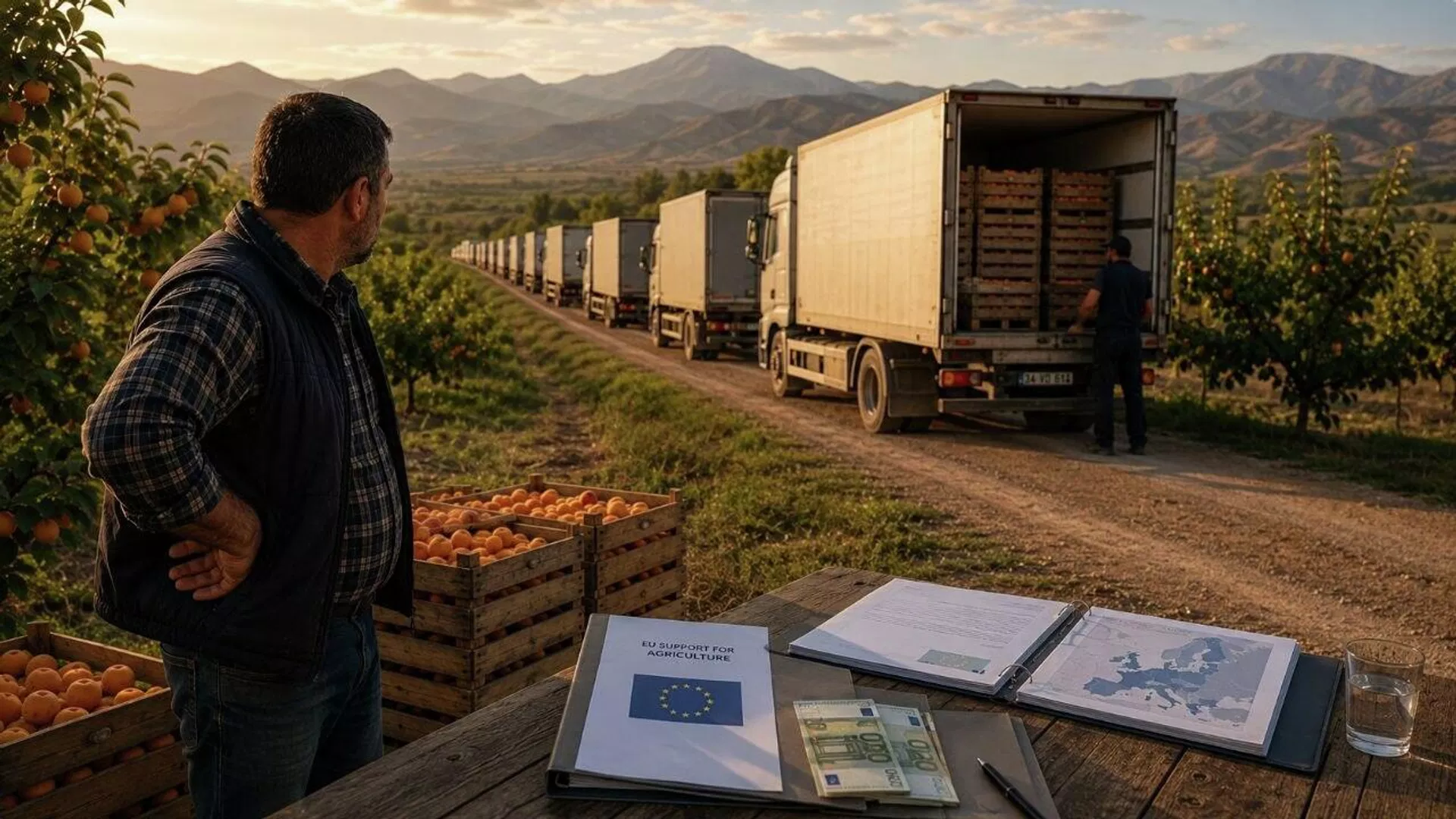
The consequences would not be limited to the work of customs services. New procedures could increase delivery times, logistics costs and final prices. At the same time, producers and suppliers from EAEU countries could lose part of their competitive advantages, while participants in the common market could face a decline in revenues.
For Armenia, this risk is especially significant — the issue is not a single trade agreement that can be replaced by another, but a revision of the terms of access to a market on which the republic has already built a considerable part of its economic ties.
The scale of the losses
The most substantial part of the report is a forecast of the economic consequences of a possible suspension of Armenia's membership. According to the calculations provided, the country's GDP could shrink by 15.6%, or by $4.6 billion, while inflation could rise by 14.9 percentage points relative to the baseline level.
These indicators should be viewed precisely as a scenario-based estimate; nevertheless, the scale of the projected changes shows how significant a role the document's authors assign to Armenia's current trade ties with its EAEU partners.
Today the states of the union account for 37.8% of the republic's foreign trade: 38% of exports and 37.7% of imports. If membership is suspended, Armenia's total trade turnover with them, according to the report's authors, could decrease by 55.6% — from $7.99 billion to $3.55 billion. In monetary terms, the reduction would amount to about $4.44 billion relative to the 2025 level.
Exports of Armenian goods to EAEU states are expected to decline by more than 65%, and imports from there by almost half. Total imports of goods and services into the republic could fall by 27.1%, or by $4.8 billion. Consumption, according to the forecast, would decrease by 14.6%, which corresponds to approximately $3.5 billion.
Behind these figures lies not only a possible deterioration in trade statistics. A contraction of sales markets means for enterprises the risk of losing orders and revenue, while a reduction in imports means the need to restructure familiar supply chains. If alternative routes turn out to be more expensive or unable to quickly replace existing ones, the additional burden will shift to businesses and consumers.
Exports without their former advantages
The authors of the report divide Armenian exports to the EAEU into two groups. The first consists of goods directly linked to domestic production: food and agro-industrial products, alcohol, light industry goods, tobacco products, certain industrial and raw materials, including copper concentrates, ferroalloys and aluminum foil, as well as jewelry. For this category, a 39.6% decline in export revenues relative to 2025 is projected.
Here the consequences of a possible rupture would manifest themselves primarily in a deterioration of market access conditions for Armenian producers. They would have to look for new buyers, compete in other markets and take into account a possible increase in transport and trade costs. How quickly the losses can be offset will depend on demand in alternative markets and on enterprises' ability to restructure their sales.
The second group consists of goods that Armenia mainly imports from third countries and then supplies to its EAEU partners. In this case, the important role is played not so much by its own production capacities as by the trade and logistics advantages of membership in the union. It is here that the forecast looks the harshest — if the current scheme is lost, revenue losses from the corresponding supplies could reach 91.6%.
This is a fundamental difference. In the first case, Armenia risks complicating the sale of its own products. In the second, it risks losing a significant part of operations whose value is largely determined by the ability to use a single economic space. If the rules of access to it change, the previous trade model may lose its economic rationale.
At the same time, re-exports cannot be considered a guaranteed irreplaceable source of income, since part of these operations could theoretically be redirected to other markets. But such a restructuring would require new routes, agreements and expenses. Therefore, the main question is not only whether part of the current supplies will disappear, but also whether they can be replaced without a substantial decline in profitability.
Money transfers and labor migration
Trade indicators are only one side of the possible consequences. The report separately examines money transfers, exports of services and labor migration. It is precisely these areas that make it possible to see how changes in relations with the EAEU could affect the everyday life of the population.
According to the forecast of the report's authors, imports of goods from the union's states into Armenia could decrease by 48.8%, or by $2.35 billion: from $4.82 billion to $2.47 billion. Exports of Armenian services to EAEU countries, in turn, could shrink by 41.7%, or by $540.4 million, to $754.6 million. Total turnover of services with partners in the bloc could decline by 37.7%.
Another sensitive indicator is money transfers. In 2025, the volume of transfers from Russia to Armenia amounted to $3.88 billion. If membership is suspended, it could, according to the calculations, fall by more than half — to $1.8 billion. Total transfers from all EAEU states are projected at $1.85 billion, compared with $3.95 billion a year earlier.
If such a scenario materializes, the consequences will affect not only financial flows between countries. For households that rely on the incomes of relatives working abroad, a reduction in transfers could mean less money for everyday expenses. For the domestic market, this is an additional risk of declining consumer demand.
In addition, the report points to the likelihood of tighter labor migration conditions for Armenian citizens. The specific consequences will depend on the rules applied and the decisions of the respective states, but the risk itself matters — labor mobility remains one of the channels of economic ties between Armenia and its Eurasian partners.
The gas question
By global standards, Armenia receives very cheap gas from Russia. Only Belarus buys the blue fuel more cheaply.
The scenario-based estimate proceeds from a price of $300 per thousand cubic meters while maintaining the physical volume of supplies from EAEU states. By comparison, the current base price indicated in the document is $177.5 per thousand cubic meters. Thus, the calculated increase reaches approximately 69%.
Under these conditions, the cost of Armenia's annual gas imports could rise from $389 million to $657.5 million. Moreover, the report's authors stipulate that the estimate is indicative in nature — the real price, taking market conditions into account, could prove higher. For comparison: on the TTF platform — the main virtual natural gas trading hub in Europe — 1,000 cubic meters currently cost more than $550. Raising prices to market levels would strike hardest, first of all, at the Armenian population through higher tariffs for gas, electricity and automotive fuel. In Armenia, 43% of electricity is generated at gas-fired thermal power plants; in addition, the country has one of the most gasified vehicle fleets in the world — 15% of all gas is used by cars.
A higher cost of gas does not mean that the economy will automatically offset losses through an increase in the nominal value of imports. On the contrary, if supply volumes are maintained, the additional costs will fall on the buyers of the energy resource. For enterprises this means rising costs, and for the economy as a whole — additional pressure on the cost of goods and services.
Ultimately, the possible changes affect several interconnected spheres at once: trade, energy, household incomes and employment. Even if individual losses can be offset through new partners, the cumulative effect will depend on how quickly the republic is able to restructure its economic ties.
Asymmetry of losses
For all the scale of the projected consequences for Armenia, the damage to its EAEU partners, according to the report, would be incomparably smaller.
Armenia's share in Russia's total foreign trade turnover for 2025 is estimated at 0.91%. The projected reduction in total exports to Armenia would amount to 0.08% for Belarus, 0.01% for Kazakhstan, 0.008% for Kyrgyzstan and 0.55% for Russia.
The decline in total imports from Armenia is estimated at 0.26% for Belarus, 0.07% for Kazakhstan, 0.057% for Kyrgyzstan and 0.65% for Russia.
Of course, average indicators for national economies do not reflect all the consequences for individual companies and industries. Some enterprises could face a noticeable reduction in orders, and specific trade routes could encounter serious difficulties. Nevertheless, the calculations cited point to a substantial asymmetry — for Armenia the EAEU represents a significant part of its foreign trade space, whereas its share in its partners' trade is relatively small.
It is precisely this difference that strengthens the argumentation of the report's authors. If Armenia's status changes, the union will probably be able to redistribute part of the trade flows with relatively limited losses at the overall economic level. For the republic itself, a similar restructuring could prove far more painful.
However, asymmetry does not mean that the other EAEU members are not interested in keeping Armenia in the bloc. Economic ties are determined not only by a share of trade turnover, but also by long-term contracts, logistics, investment and the predictability of rules. Therefore, minimal calculated damage does not rule out the partners' interest in continuing cooperation.
Brussels without guarantees
Against the backdrop of these assessments, a natural question arises: what can Armenia receive in return if its European course leads to a weakening of ties with the EAEU?
For now, this question remains open. The aspiration to integrate with the European Union does not in itself guarantee membership, access to specific economic advantages or automatic compensation for possible losses in other markets.
This spring, Armenian Prime Minister Nikol Pashinyan again identified the European direction as a political goal of the authorities. At the same time, he pointed out that holding a referendum on joining the EU is premature at this stage, since the republic has not yet submitted an accession application. At the same time, Pashinyan acknowledged that a vote will be required in the future.
Moscow, for its part, insists on holding a referendum on the question of Armenia's accession to the European Union. Thus, the discussion about the future integration course is gradually moving from the realm of political statements to the question of when and in what form Armenian society will have to express its position.
The results of a Gallup International Association poll conducted at the end of September show that there is no unequivocal public consensus on this issue. Almost 60% of respondents favor holding a referendum on joining the EU. At the same time, 35.1% support European integration, slightly less than 30% consider it necessary to retain membership in the EAEU, and 24.7% say they will not take part in the vote.
These indicators reflect different sides of public sentiment — a willingness to speak out in a referendum is not equivalent to support for a specific foreign policy course. However, they show that the issue of integration has already become a subject of domestic political debate and is not reduced to government decisions.
At the same time, the European path itself should not be viewed exclusively through the prism of economic losses. For part of Armenian society, rapprochement with the EU is associated with political, institutional and social expectations. But precisely for that reason, the authorities will have to explain not only the presumed advantages of the new course, but also its costs, timeframes and real prospects.
For now, a distance remains between political intention and practical result. A law on launching the EU accession process is not equivalent to membership, and rapprochement with European institutions does not mean that in the foreseeable future the republic will receive all the advantages of an EU member.
Under these conditions, the main risk for Yerevan is that obligations to one integration bloc may begin to be revised before the guaranteed advantages of the other appear.
A choice without simple answers
The report by the four EAEU countries does not prove that any step by Armenia toward the European Union will inevitably lead to an economic crisis. The estimates cited depend on the scenario, the conditions of a possible suspension of membership and the country's ability to restructure its trade ties. However, they point to specific vulnerabilities of the Armenian economy: the significant share of the EAEU in foreign trade, the dependence of a number of supplies on the advantages of the common market, the scale of money transfers and sensitivity to the cost of energy resources.
Therefore, the question is what Armenia will be able to use to offset possible losses. Today the EAEU provides it not only with a sales market for its own goods, but also with conditions for re-export operations, significant financial flows and access to energy resources under current price terms. Giving up these advantages would require not merely a political reorientation, but a deep restructuring of economic ties.
And here the main question of the European direction arises: will the European Union be able to offer Armenia comparable economic opportunities — and within what timeframe? Rapprochement with Brussels in itself guarantees neither EU membership, nor immediate access to all the advantages of the single European market, nor compensation for lost revenues. New trade ties, investment and production chains require time, whereas the costs of changing the previous conditions may appear considerably earlier.
It is precisely this gap between possible losses and as yet unguaranteed gains that makes Yerevan's choice economically difficult. If the scenarios cited in the report are at least partially realized, Armenia will have to find a replacement not for a single market, but for an entire system of established ties. And the more significant the losses in the former direction prove to be, the more acute the question of the real capabilities of the new partner will become.
Ultimately, the price of the European course will be determined not by declarations about a strategic choice, but by concrete results: new markets, investment, jobs, energy affordability and household incomes. Armenia has the right to choose its direction of development, but it is important for society to understand not only what the country is striving for, but also what it will have to pay for this path.
The EAEU has already indicated the possible price of a rupture. Now the question is whether Europe will be able to offer Armenia something comparable in return.