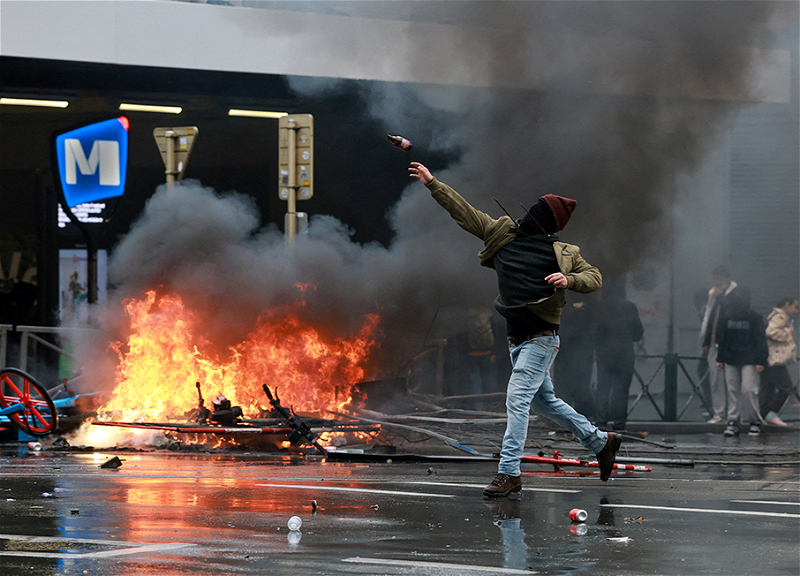
A right turn: are the rules of the game changing in Europe?
Europe is going through one of the most notable political shifts of recent decades.
Parties of the radical right and national-conservative persuasion, which until recently were perceived as peripheral forces, are today becoming major players, winning elections, entering governments, and forcing traditional parties to reconsider their own agendas.
The latest and one of the most high-profile examples is Germany.
But Germany is only part of a broader process.
Germany: “Deep shock”
One of the biggest successes of far-right nationalist forces in Germany since World War II became one of the main political news stories of recent days.
In the elections in the federal state of Saxony-Anhalt on September 6, the Alternative for Germany party (AfD) won a confident victory, taking about 44% of the vote — a record result for the party in state elections. Just five years ago this party was considerably weaker. But already in the federal elections of February 2025 the AfD received 20.8% of the vote — twice as much as in the 2021 elections — and became Germany's second-largest political force.
Support for the ruling Christian Democratic Union (CDU) was cut in half. German Chancellor Friedrich Merz called it the heaviest defeat in decades. “We are all deeply shocked. We did not expect things to turn out this way. Of course, we must accept this result. But yesterday was a turning point not only for Saxony-Anhalt, but for all of Germany. And this result will have international consequences,” said the leader of the German conservatives, promising to draw conclusions from the CDU's defeat. “We must try — and I include myself in this — to reach people more effectively, appealing to the entire spectrum of their emotions,” the chancellor emphasized. “We know that many fear for their own future, economic stability and social security,” Merz stated.
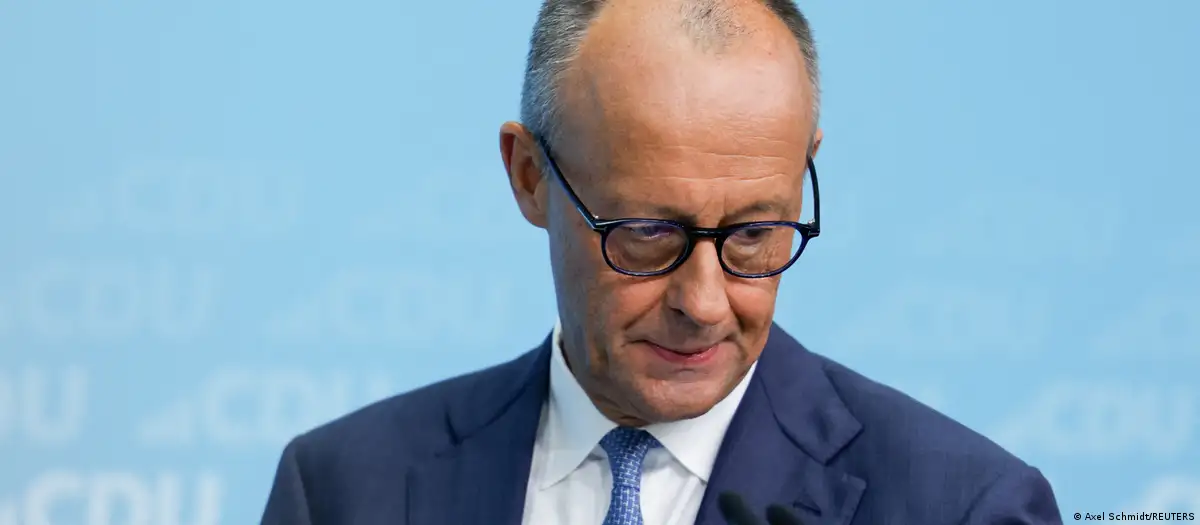
The result in Saxony-Anhalt is particularly important not only because of its scale. It shows how far a party that until recently remained isolated from Germany's main political forces has advanced in recent years. Now observers are asking whether the Alternative for Germany will be able to repeat this success in elections in other regions of the country. At the same time, the party is already leading in nationwide polls, and is supported by almost a third of German voters.
It would be premature to speak of the Alternative's immediate rise to power — the AfD fell three seats short of an absolute majority in the Saxony-Anhalt parliament, and it will now need the support of other deputies to form a coalition, which may prove a difficult task given that Germany's leading parties oppose such an alliance.
But the problem for the traditional parties is becoming increasingly obvious: maintaining a political barrier around the AfD is considerably harder when the party is backed by almost half the voters of an entire federal state.
And Germany is far from an exception here. The AfD's success was welcomed by its European like-minded allies, who saw in the result of the German elections another sign of the changing political landscape of Europe.
“If the AfD succeeds in Germany, my friend Marine Le Pen wins the presidential election in France, and if Geert Wilders achieves even greater success in the Netherlands, then I believe we will be on the right path to finally changing Europe for the better,” said the speaker of the Czech parliament, Tomio Okamura.
France: the right is not yet in power, but is already changing the agenda
Incidentally, the Alternative's victory in Germany revealed a split among the French far right.
The radical party Reconquête!, which stands to the right of the National Rally and belongs to the same group as the AfD in the European Parliament, welcomed the victory of its German like-minded allies. And this only underscored the political disagreements on the far-right flank of French politics.
The main symbol of the rise of the right in France — the National Rally — responded to the AfD's victory with notable silence, which testifies to the complex nature of interparty relations. “From revisionist statements about the SS to Chinese espionage cases, the German ally has become ‘too burdensome' for Marine Le Pen,” Euronews writes.
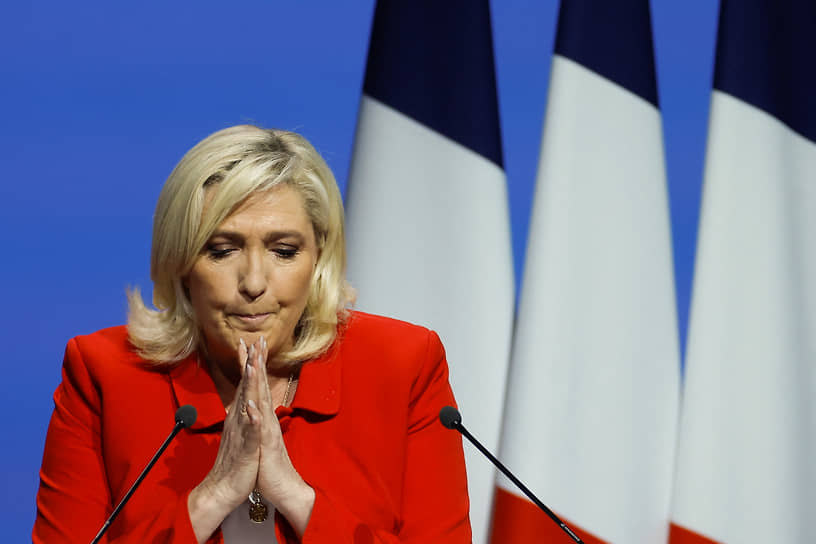
The party's silence is unsurprising, given that Marine Le Pen has for more than ten years been trying to normalize the image of the National Rally at home and abroad, distancing herself from the most radical views associated with the party in the time of her father, Jean-Marie Le Pen.
In recent years Marine Le Pen's party has substantially expanded its electoral base and has ceased to be perceived as a marginal political force. In the 2024 European Parliament elections it obtained one of the best results among French parties, and in the subsequent parliamentary elections it likewise found itself at the center of the political struggle.
Her party is currently leading in the polls: according to an IPSOS/BVA survey published on Saturday by the French newspaper Le Parisien, between 34 and 36% of respondents said they were ready to vote for her in the first round of the presidential election scheduled for April 2027.
The National Rally does not yet control the French government. But in order to influence the country's political course, an electoral victory does not necessarily have to be complete.
Migration, security, national sovereignty and border control are increasingly at the center of the French political agenda. Traditional parties are forced to respond to a public demand that until recently belonged largely to the right.
This is precisely one of the most noticeable effects of the current growth of right-wing forces — radical parties do not need to come to power at all in order to change the political course. Sometimes it is enough to get their competitors to start speaking on the same topic and offering similar solutions.
Italy: the right is already governing the country
The most obvious example of the fact that right-wing parties are capable of moving from opposition into power is Italy.
Giorgia Meloni and her Brothers of Italy party came to power after the 2022 parliamentary elections. Since then Meloni's government has pursued a tougher policy on migration and border control, while at the same time maintaining a pro-European and pro-Atlantic course.
For Europe this is an important example. It shows that right-wing parties can adapt to the traditional political system and turn from protest movements into parties of power.
Moreover, Meloni's government has proved unusually stable for a country known for its frequent changes of cabinet. On September 4, Meloni's cabinet marked its 1,413th day in power — almost four years. This is the longest term of a single government in Italy's postwar history.
The right-wing coalition that won the early parliamentary elections of 2022 thereby surpassed the previous record of Silvio Berlusconi's second government, which was in power for 1,412 days in 2001–2005.
Against the backdrop of domestic political instability in other large European countries, the stability of Meloni's government looks even more striking. Since she took office, France has gone through five prime ministers, and the United Kingdom four.
Austria: the largest party without a government
Austria demonstrates a different scenario.
In the 2024 parliamentary elections the far-right Freedom Party (FPÖ) took first place for the first time in the country's postwar history, receiving 29.2% of the vote.
However, despite the victory, forming a coalition government proved a difficult task for the FPÖ. Other parties long refused to enter into a coalition with the FPÖ, and in the end it remained outside the ruling coalition.
This example shows an important feature of contemporary Europe — the growth of right-wing parties does not always bring them directly to power.
But even while in opposition, they become so large that the other parties are forced to take their electoral base into account.
Northern Europe is no longer an exception
The shift is also noticeable in countries traditionally considered a stronghold of social democracy.
In Finland the Finns Party is part of the ruling coalition. In Sweden the government relies on the support of the Sweden Democrats — a party that just a few decades ago was on the political periphery. Although the party's representatives have not received ministerial portfolios, key bills, the budget and other important state decisions are coordinated with it.

This does not mean, however, that Scandinavia has become right-wing.
Social democrats and centrist parties still enjoy considerable support, so it would be premature to speak of a complete political turn of Scandinavia to the right.
Yet the very fact that right-wing populist parties take part in making key decisions shows how greatly the political balance of forces in Northern Europe has changed.
Central and Southern Europe
A similar picture is taking shape in other parts of the continent as well.
In Slovakia, Robert Fico returned to power after the 2023 parliamentary elections, campaigning with tougher positions on migration issues.
In Croatia the right-wing Homeland Movement party joined the ruling coalition after the 2024 parliamentary elections.
In Portugal the Chega (“Enough!”) party made an unprecedented electoral leap, breaking the long-standing dominance of the country's two main political forces and turning within a short period into one of the largest parties.
In Poland, after several years of rule by the national-conservative Law and Justice party, power passed to a broader pro-European camp. However, right-wing forces have not disappeared: Confederation retains considerable influence and remains an important player in Polish politics.
In the Czech Republic, right-wing forces have joined the ruling coalition. The ruling coalition includes Andrej Babiš's ANO, the right-wing Motorists party and the far-right SPD. The government has taken a more skeptical position toward further support for Ukraine and opposes a number of EU environmental initiatives.
Just today, the speaker of the lower house of the Czech parliament, Tomio Okamura, proposed reducing the state budget deficit, in particular by ending payments to Ukrainian refugees, who, in his words, “receive enormous conveniences in the Czech Republic.”
Okamura, who earlier came out against providing weapons to Ukraine, stated that more than 398,000 refugees from Ukraine live in the Czech Republic, and that there are 36 Ukrainian refugees per thousand inhabitants of the country — the highest figure among all EU countries: “I propose immediately canceling, ending all benefit payments to Ukrainians in the Czech Republic… The benefits for Ukrainians really are enormous: approximately 8 billion is humanitarian aid, plus another 4 billion that the state pays for health insurance for unemployed Ukrainians; in total — 12 billion.”
Reverse movement
But it is important to see the other side here as well.
A telling case of a rollback is the Netherlands, where Geert Wilders's far-right Party for Freedom (PVV) won the 2023 elections but lost ground in 2025.
In the 2025 elections the PVV received fewer seats and ended up merely on a par with the centrist D66. As a result, Wilders was unable to preserve his previous position, and other parties again began forming a centrist coalition without him.
This is an important warning against the overly simple formula “Europe is becoming far-right.”
As can be seen, the right can grow, but it can also lose votes at the same time. And this is fundamentally important from the point of view that the current European right-wing rise is not irreversible.
But there is a shift — how large is it overall? Here there is one especially interesting figure.
A study prepared by more than 150 political scientists across 31 European countries shows the scale of the changes that have taken place. In the most recent national elections in these countries, parties classified by the researchers as far-right received a combined total of more than 23% of the vote.
According to The PopuList — a research project that tracks populist and radical parties in Europe — almost every fourth vote in the most recent national elections in the countries examined was cast for a far-right party. At the same time, almost every third vote went to a populist political project, while far-left parties accounted for about 1% of the vote.
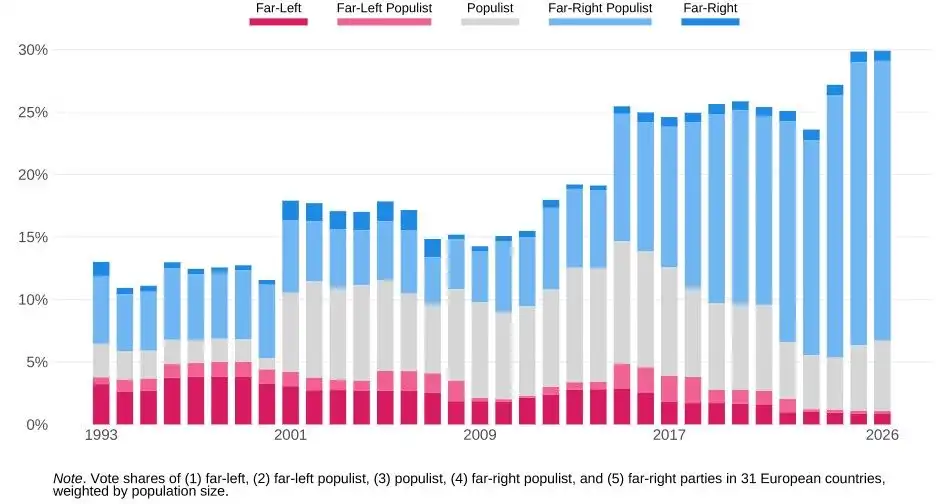
This, of course, does not mean that 23% of Europeans are “ultranationalists.” It concerns the results of voting in national elections and the classification of parties used by researchers.
In some places the right is already in power. In others it is the largest opposition force. In still other countries it forces traditional parties to toughen their own positions on migration, security and national sovereignty.
But the overall trend is noticeable.
Why are European voters voting “to the right”? The reasons differ from country to country, but several factors recur.
The first is migration.
The significant influx of migrants and refugees over the past decade has changed Europe's political agenda. Questions of border control, integration and security have become important for a much larger share of voters.
Right-wing parties turned out to be better prepared than others to turn these concerns into a political offering.
The second factor is the economy.
The rising cost of living, high housing and energy prices, as well as a sense of economic uncertainty, are intensifying dissatisfaction with traditional parties.
This effect is especially noticeable in regions that consider themselves losers from the economic transformations of recent decades.
Incidentally, Saxony-Anhalt is telling here. As a territory of the former GDR, it continues to face the consequences of the economic gap between eastern and western Germany. For part of the population, the feeling that the country's economic and political center is too far removed from their everyday problems is becoming an important voting factor.
The third factor is a crisis of trust in the traditional parties.
Christian Democrats, Social Democrats, liberals and Greens defined European politics for decades. Today, in a number of countries a significant portion of voters perceives them as representatives of one and the same political system, incapable of offering fundamentally new solutions. Against this backdrop, protest voting becomes more attractive.
The fourth factor is security.
The Russian-Ukrainian war, the energy crisis and debates about the future of European defense have made voters look at national security issues in a new way.
For right-wing parties this has created additional room for arguments in favor of a stronger nation-state and greater independence in decision-making.
Is Europe really becoming far-right? Not quite. This is perhaps the main nuance of the current political process.
One cannot put an equals sign between Meloni, Le Pen, the AfD, the FPÖ and the Sweden Democrats. Their programs differ, as does their attitude toward the EU, NATO, Ukraine, economic policy and state institutions.
In addition, right-wing forces are far from winning everywhere.
European politics remains competitive, and centrist, liberal, social-democratic and Green parties retain considerable influence.
Therefore, to say that “Europe has become far-right” would be too simple.
But something else can be said.
The right has changed Europe's political agenda itself.
Ten years ago, migration, national identity and limiting Brussels's powers were more often perceived as topics of the right-wing political flank.
Today they have become part of the central political discussion.
Traditional parties are increasingly forced to respond to voters' demands for stronger control over migration, protection of borders and increased spending on security.
And therein lies the paradox.
The stronger the radical right becomes, the more traditional parties try to take a tougher position on issues that were previously considered its exclusive theme.
Germany may become the main test
That is precisely why the AfD's result in Saxony-Anhalt matters far beyond a single federal state.
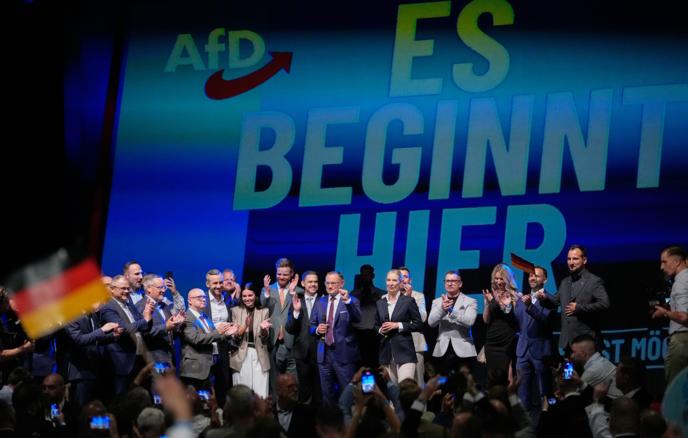
In the 2025 federal elections the party already showed that it is capable of turning into one of the central forces of German politics.
Now it is demonstrating that it can dominate at the level of an individual region.
The main question is not only whether it will be able to form a state government.
Something else is far more important: will the party remain an exception of East German politics, or will its success gradually spread to the federal level.
If the AfD continues to grow, traditional parties will face an increasingly difficult choice.
They can continue to maintain a political barrier around the party.
But the higher its support, the more voters will perceive such isolation as the exclusion of a significant part of the electorate from the political process.
The other option is to try to co-opt the AfD's topics.
However, in that case the opposite risk arises: traditional parties themselves contribute to radical ideas becoming part of the political mainstream.
What this means for Europe
The right turn is already affecting not only the domestic politics of individual states.
It is gradually changing the discussion within the European Union itself.
Migration policy is becoming tougher. Questions of national sovereignty are being voiced more loudly. Governments face growing pressure from voters on issues of security and defense.
At the same time, the dispute over what the EU itself should be is intensifying — a more integrated political union or an association of states retaining maximum independence.
It is precisely here that national elections begin to have pan-European consequences.
If the largest EU countries simultaneously face the growth of right-wing parties, it is not only domestic political competition that changes. The space of possible decisions at the level of the entire union changes.
The AfD's victory in Saxony-Anhalt is therefore important not so much as a separate German result. It fits into a broader process that continues from Italy and France to Austria, Scandinavia and Central Europe.
Europe is not becoming a single right-wing political system. But the European political center is definitely shifting. And the question today is no longer whether right-wing parties will be able to become part of European politics. They already have. The question is different: will they remain a strong opposition, will they turn into ordinary parties of power — or will they gradually change Europe's political center itself.

This is yet another signal that the political era that began in Europe after the end of the Cold War is drawing to a close. In its place a new Europe is taking shape — more nationally oriented, more skeptical toward traditional elites and far less confident that further integration of the continent is automatically the right answer to all crises.
The right turn has already become part of European politics. Now it is important to understand how far it will go.