Against the backdrop of Metsamor: COP17 in Yerevan discusses problems, Baku offers concrete solutions
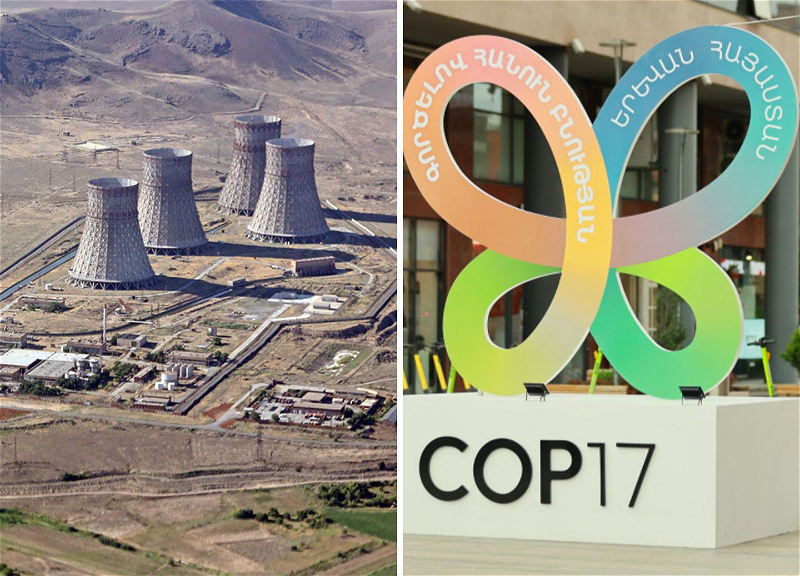
While Armenia hosts an international conference on the conservation of biodiversity, the fate of the Metsamor nuclear power plant remains an open question for the entire South Caucasus.
Can one speak of environmental responsibility if risks capable of extending far beyond the borders of a single country continue to exist?
Today, the 17th Conference of the Parties to the UN Convention on Biological Diversity — COP17 — opens in Yerevan. Until October 30, representatives of states, international organizations, the scientific community, and civil society will discuss how to halt the loss of natural diversity, restore ecosystems, and turn international commitments into concrete results. For the first time since the adoption of the Kunming-Montreal Global Biodiversity Framework, countries are to carry out a global assessment of its implementation.
The official slogan of COP17 is “Act for Nature,” yet such appeals make sense only when they are backed by real steps, and not merely by statements from international rostrums.
In Armenia’s case, a question arises that is hard to sidestep: how convincing is it to speak of environmental protection when, for example, a Soviet-generation nuclear power plant continues to operate on the country’s territory, its service life having been extended repeatedly, while its potential risks have a cross-border dimension?
This concerns the Metsamor nuclear power plant — a facility that has long gone beyond the scope of exclusively Armenian energy policy. Questions of its safety affect the interests of neighboring states, since the consequences of a possible nuclear accident are not confined by state borders. Radioactive contamination of air, water, and soil can lead to long-term environmental and humanitarian consequences, affecting territories far beyond the site of the incident.
That is precisely why holding COP17 in Yerevan is an occasion to raise the question not only of global nature conservation goals, but also of how states themselves manage environmental risks, for which, under certain circumstances, not only their own citizens have to pay.
The Metsamor nuclear power plant was built between 1969 and 1977. The first power unit was commissioned in 1976, the second in 1980. Both reactors were shut down after the devastating 1988 Spitak earthquake. The second power unit resumed operation in 1995 and today remains Armenia’s only operating nuclear power unit. Incidentally, the Metsamor plant itself is also located in an active seismic zone, and the probability of an earthquake in this area is very high. According to scientists, a strong earthquake could lead to a major catastrophe, which could become a tragedy for an enormous geographic area. This explains why the plant’s seismic resilience must remain one of the central issues in assessing its safety.
The original design service life has long been a subject of dispute. The Armenian authorities have taken the path of modernizing equipment and extending the plant’s operation. In 2023, the government approved a program providing for the operation of the second power unit until 2036. According to data from the World Nuclear Association, the latest extension is accompanied by additional technical work and state funding.

Yerevan explains this approach by the need to ensure a stable energy supply, since the nuclear plant plays a substantial role in the national energy system, and its immediate closure without preparing alternative capacity would create serious economic and infrastructure difficulties.
However, energy dependence does not cancel out safety questions. On the contrary, the more important a facility is to the national economy, the higher the requirements for its reliability, transparency of operation, and emergency preparedness.
The main question is not whether repair and modernization work has been carried out at the plant. The question is different: to what extent does such work make it possible to take into account the specifics of the original design, the age of the equipment, and the natural risks of the area in which the facility is located?
Modernization can improve equipment safety, replace individual systems, and enhance operating characteristics. But it does not mean the automatic elimination of all the design limitations of an old plant. Therefore, statements about extending the service life must be accompanied by information accessible to the international expert community on the condition of critically important systems, the results of inspections, and the implementation of safety recommendations.
It is precisely this approach that should be the norm for any nuclear facility where the potential consequences of an accident could affect several states.
A nuclear power plant must withstand not only ordinary operating loads but also extreme impacts, including earthquakes, which are capable of simultaneously disrupting the operation of several interconnected systems. In such circumstances, what matters is not only the strength of individual structures, but also the reliability of the power supply, reactor cooling, backup equipment, and systems for containing possible releases.
In expert and public discussions about Metsamor, the question of the plant’s design features has repeatedly been raised, including the absence of a full-fledged modern-type containment shell. Such features require professional assessment, taking into account the specific design and the modernizations carried out. Drawing one’s own conclusion about the inevitability of a catastrophe on this basis would be wrong, but it would be equally wrong to believe that the age of the facility and the features of its design cease to matter after certain technical work has been performed.
Armenia states that it cooperates with the International Atomic Energy Agency (IAEA), conducts safety assessments, and implements the recommendations of international experts. The country’s national statement for the 68th session of the IAEA General Conference in 2024 emphasized that work to enhance the plant’s safety is continuing. However, for neighboring states, what matters fundamentally is not only the fact of modernization itself, but also how fully and independently the remaining risks are assessed.
In the field of nuclear safety, trust cannot be built on assurances alone. It requires regular monitoring, open exchange of information, and a willingness to answer uncomfortable questions. The higher the potential consequences of an accident, the less justification there is for secrecy.
Nuclear safety differs from many other areas of environmental policy in one fundamental respect: a severe accident can turn into an international problem even before its consequences have been fully assessed on site.
The spread of radioactive substances depends on the nature of the accident, the volume of the release, weather conditions, and other factors. Therefore, it is impossible to state in advance, without a specific scenario, exactly which territories would be affected and how many people would suffer. But the very possibility of cross-border impact requires a joint assessment of risks and the readiness of states to cooperate.
For the South Caucasus, shared water systems are of particular importance. The Araz River and the water resources connected with it are of great economic significance for the region. Potential contamination of water, soil, or agricultural areas as a result of a major accident could entail consequences for water supply, food production, and public health.
At the same time, the environmental consequences are not limited to the direct impact of radiation. In the event of a major emergency, there could be a need to evacuate the population, restrictions on economic activity, crop losses, contamination of natural areas, and long-term recovery costs.
Therefore, Azerbaijan and other countries of the region have every reason to take an interest in the condition of the Metsamor nuclear power plant, the quality of oversight of its operation, and the readiness of the Armenian authorities for emergency situations. Such interest should not be regarded as a political dispute — these are issues directly related to the safety of the population and the environment.
At the international level, the problem of the Metsamor nuclear power plant has been discussed for decades. European institutions have repeatedly pointed to the need for the safe decommissioning of the plant and the preparation of alternative sources of generation. In particular, European Commission materials from 2015 noted that Metsamor cannot be upgraded to full compliance with recognized international nuclear safety standards and should be closed as soon as possible.
The Comprehensive and Enhanced Partnership Agreement between the EU and Armenia also provides for cooperation in the field of nuclear safety, the safe decommissioning of the Metsamor nuclear power plant, and the preparation of a corresponding road map, taking into account the need to replace its capacity.
Thus, the issue of closing the plant is not exclusively an initiative of neighboring states; it is also present on the international agenda, and in the context of an entirely concrete task: to find a balance between safety and Armenia’s need for electricity.
However, instead of ceasing operation of the plant, the Armenian authorities are seeking to extend its service life, citing the need to maintain a stable energy supply. To a certain extent, this position can be explained by economic circumstances. But economic expediency cannot be the sole criterion when it comes to a facility of heightened danger.
That is precisely why the international discussion must concern not only how successfully Metsamor is being modernized, but also whether there exists a realistic, transparent, and agreed plan for its subsequent decommissioning.
The question of Metsamor’s future once again came into focus after the talks between Armenian Prime Minister Nikol Pashinyan and Rosatom Director General Alexey Likhachev at the end of September this year. The Russian state corporation offered Armenia the construction of a new VVER-1000 power unit with a capacity of at least 1,000 MW. According to Likhachev, the project could be implemented in the format of an international consortium involving manufacturers from France, South Korea, and China, if Yerevan deems such an option suitable. The Armenian government, for its part, reported that it continues to consider proposals from international partners and will make a decision taking into account cost, quality, safety, timelines, and guarantees.
The search for new generation capacity is in itself logical. But here a fundamental question arises: will the discussion of a new nuclear power unit become a real step toward solving the problem of the old plant, or will it provide an opportunity to postpone the final decision on its closure even longer? According to Likhachev, by 2036 Armenia, given the growth in energy consumption, will require new capacity of this scale. At the same time, it is precisely 2036 that has been designated as the deadline to which the operation of Metsamor’s current second power unit is planned to be extended.
But a new plant, if its construction is approved, will not automatically eliminate the risks of Metsamor. And in this situation, it is important for the international community to see concrete stages in the implementation of decisions on the facility’s safety. The key criteria must be long-term safety, transparency of operation, the handling of radioactive waste, and the possibility of safely decommissioning the facility in the future.

President of Azerbaijan Ilham Aliyev, raising the problems of nuclear safety, emphasized that the Metsamor nuclear power plant in Armenia poses a major nuclear threat to Azerbaijan, Türkiye, Armenia, and the entire region. The head of state stated that this plant operates on old technology and has serious technical problems. In this context, the President of Azerbaijan emphasized that the illegal trade in certain nuclear materials from the Metsamor plant is a cause for concern.
Incidentally, Baku has already proposed a solution that goes beyond standard political disputes — not to endlessly prolong the life of an outdated reactor, but to create an energy alternative for Armenia by including it in a regional green energy corridor. This concerns the potential of the Zangezur corridor. The President of Azerbaijan spoke about it as follows: “Naturally, when we put forward the idea and initiative of the Zangezur corridor, the transport segment was primarily implied. But today we view it more broadly.” “For example, we have a ready project for laying power transmission lines from the main part of Azerbaijan to Nakhchivan through the territory of Armenia. A very large substation has been built in the Jabrayil district liberated from occupation. Its main function is the transmission of electricity. Such substations are called converter substations. It was built not for internal power supply, but for the transmission of large volumes of energy. It is ready. It was built specifically for the Zangezur electric power corridor,” Ilham Aliyev emphasized. The Azerbaijani leader noted that as a result of analysis conducted by our specialists on the territory of Armenia, the exact locations where electricity poles should be installed were even determined: “I hope that the Armenian side will also not delay this issue. Since this may be needed first and foremost by themselves, because their main source of energy today is the nuclear power plant, the management of which, moreover, is not in their hands. That is first. Second, this plant is outdated and represents a source of danger for the entire region. Azerbaijan and Türkiye have repeatedly expressed their concern on this issue at various international platforms. The extension of this plant’s service life cannot be an endless process; sooner or later it must be closed.”
“Naturally, if it closes, Armenia will plunge entirely into an energy crisis. Therefore, as they say, having an additional source can only be of benefit. For example, today our energy lines are connected with Russia, Iran, and Georgia, and through Georgia with Türkiye. Therefore, an energy corridor that will stretch through the territory of Armenia to Nakhchivan, then to Türkiye and Europe, will also allow Armenia’s energy system to withstand a crisis. And the sooner we implement this, the better. Of course, you are well aware that over the past five years we have installed poles in the snow in the mountains of Kalbajar at an altitude of 3,500 meters. That is, if we are to implement this project, it will take a maximum of six months.
But Armenia, of course, must do this itself. Therefore, I believe it is necessary to bring clarity to this issue as soon as possible. This will be an integral part of the Zangezur corridor, TRIPP. Because this project is not only a railway, a highway. Even a fiber-optic cable, power transmission lines, and in the future, if necessary, oil and gas pipelines could pass through here. Because the more alternatives there are, the better it is for everyone,” the Azerbaijani leader said.

Baku’s proposal is grounded in clear engineering and economic logic. While speaking of the need to close an outdated facility, Azerbaijan simultaneously offers a modern alternative. Laying power transmission lines through the territory of Armenia within the framework of TRIPP will not only make it possible to minimize the risk of an energy shock after the closure of Metsamor, but will also integrate the country into the regional system of electricity exchange.
Such interconnectedness makes the region less vulnerable to shortages, accidents, and supply interruptions. The more sources and routes an energy system has, the less its dependence on a single facility — all the more so on a plant whose potential risks extend far beyond Armenia. The question is whether Yerevan is ready to take advantage of this opportunity and move to a modern architecture of energy security, or whether it will continue to postpone a decision by extending the service life of the Metsamor nuclear power plant.
Undoubtedly, solving the Metsamor problem requires professional assessment, verifiable data, and effective international monitoring mechanisms. First and foremost, this concerns the role of the IAEA. The agency has the tools to conduct expert missions, assess nuclear safety, and develop recommendations for states. It is also important that the results of the relevant inspections and information on the implementation of recommendations be available to the extent compatible with security requirements, and that they allow interested countries to understand the nature of the remaining risks. Neighboring states must have sufficient information to assess the potential impact of an accident, plan the actions of emergency services, and protect the population. The exchange of data, the harmonization of notification procedures, and the coordination of actions in the event of probable cross-border contamination are extremely important from the standpoint of practical measures to protect people.
Against this backdrop, the holding of COP17 in Yerevan gives the issue additional significance. The conference is intended to assess how far states have advanced from their commitments to real action. Its participants will discuss the conservation of ecosystems, the restoration of degraded territories, and the need to increase accountability for the results of environmental policy.
Environmental responsibility cannot be measured only by the number of declarations signed and conferences held. The real test of environmental policy begins where a state has to make decisions affecting economic interests, energy plans, and relations with its neighbors.
For Armenia, such a test remains the future of the Metsamor nuclear power plant. Giving up an operating source of generation may not be easy — alternative capacity, investment, time, and state policy are needed. But the difficulty of a decision does not eliminate the need to seek it.
The international community, for its part, must press not for loud promises or political declarations, but for a transparent assessment of risks, full-fledged monitoring, and a clear plan of further action.
COP17 in Yerevan is being held under the slogan of acting for nature. So it is precisely actions, not words, that should become the measure of this conference’s success. If talk about the conservation of biodiversity is not accompanied by a readiness to deal with potentially dangerous facilities and to prevent cross-border threats, the environmental agenda risks remaining a set of correct formulations.
The Metsamor nuclear power plant is not a reason to predict an inevitable catastrophe, but a reason to prevent the safety of millions of people from depending on the hope of a favorable outcome. The region’s task is not to wait for an emergency in order to recognize the seriousness of the problem, but to secure verifiable guarantees now.