Central Bank of Azerbaijan anti-ranking for September: Yelo Bank pulls away, Unibank back among the worst performers
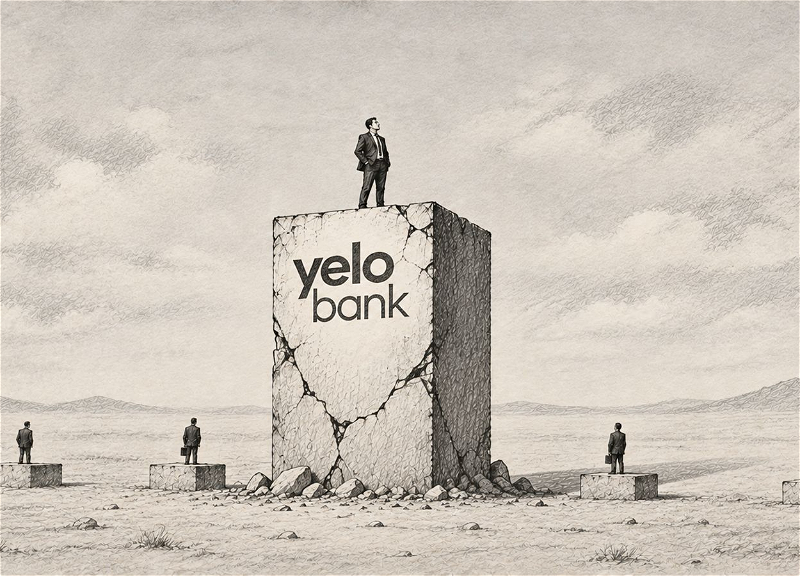
Yelo Bank has topped the Central Bank's table for the second month running, and this time by a wide margin.
Its index of 3.49 is three and a half times the neutral level and the bank's highest reading since June 2025. Its lead over second place exceeds a full point, the widest gap between the first two rows since January.
The market itself, meanwhile, kept cooling. Only seven of seventeen banks were above the neutral level in September, fewer than in any of the twenty-one months we have tracked. The median fell to 0.91, also a series low. Unibank returned to the top three and remains the only bank in the sector that has not once dropped below the neutral level in twenty-one months of observation. The biggest surprise of the month, however, came from the other end of the table: Yapı Kredi Bank Azərbaycan, which was in the top four as recently as August, posted 0.61, its best published result on record.
A calmer market, a hotter top
The column average rose from 1.08 to 1.20, which on paper looks like deterioration. Remove a single row, though, and the picture changes: without Yelo Bank, the average for the remaining sixteen banks is 1.06, almost exactly July's level, the lowest in the series. The entire increase in the average comes from the top of the table, not from the market.
This continues the trend we described in August as polarisation. A month ago eight banks were above 1.00; now there are seven. The spread between the first and last rows widened from 2.27 to 3.38 points. Most market participants generate fewer complaints than their size would suggest, while a small group at the top keeps drifting further away from the rest.
Yelo Bank: eight months above the norm
Yelo Bank's 2026 series reads: 0.93 in January, then 1.68, 1.80, 1.49, 1.96, 2.06, 1.77, 2.51 and 3.49 in September. January remains the only month of the year in which the bank was below 1.00. Since February it has stayed above the neutral level for eight consecutive months, has been in the top two for four months and has held first place for the second month in a row.
At 3.49, this is the bank's third-highest reading in twenty-one months, behind only 3.75 in June 2025 and 3.73 in February 2025. A year ago, in September 2025, Yelo Bank stood at a very similar 3.46, but the market average was then 1.66, so the bank exceeded it roughly twofold. Today it exceeds the average almost threefold. In other words, the market has cooled noticeably over the year, while Yelo Bank is back exactly where it was.
In August we wrote that the shape of Yelo Bank's curve fits the second scenario of our model better: a systemic problem that cannot be resolved at branch or call-centre level and produces not spikes but a slow climb. September tends to confirm that reading. The rise does not look like a one-off event; it extends a line that has been building since spring. What lies behind that line cannot be established from the regulator's data, since the Central Bank publishes the ratio but not the breakdown of complaints.
For scale, the opposite perspective is worth keeping in mind. The series' historical peaks remain far off: Bank BTB reached 7.65 in February 2025 and Bank Avrasiya 6.89 in January 2026. Still, Yelo Bank's September figure is the highest in the table since January 2026, when Bank Avrasiya and AFB Bank occupied the top rows.
Unibank and Bank of Baku: the market cooled, they did not
Unibank returned to third place with 2.20 after dipping to 1.64 in August. This is the bank's highest reading since February, but there is nothing surprising about it.
What is surprising is something else: over twenty-one months of our observations, Unibank is the only bank in the sector that has never fallen below the neutral level. Not once. Its lowest value over the whole period is 1.53, and it has been among the five worst rows of the table in seventeen months out of twenty-one.
The comparison with the market is even more telling. Unibank's average index is identical in 2025 and 2026, at 1.95. Over the same period the table average fell from 1.51 to 1.29. Put differently, the sector as a whole has made visible progress in dealing with customers, while Unibank has stayed put. In 2025 the bank exceeded the table average by roughly 1.3 times on average; in September 2026 it did so by 1.83 times. It has now been above the table average for seventeen consecutive months, since May 2025. The bank is not getting worse in absolute terms: it is falling behind by standing still while everyone else moves forward.
In terms of our two-scenario model, Unibank's series is a textbook case of the second scenario. These are not spikes that can be blamed on a failure in one department, but a plateau a year and a half long: month after month, this bank's customers take their issues to the regulator noticeably more often than the market's customers on average. We wrote about this in our May edition, when Unibank was "racing to become the leader of discontent", and in July, when it finally reached first place. A great deal has changed in the market since then, but not this row of the table.
Bank of Baku interrupted a two-month decline after its June peak of 1.92, posting 1.54 and staying in sixth place. Its story resembles Unibank's, only quieter.
In 2026 the bank has not once dropped below the neutral level, nine months out of nine, and together with Unibank these are the only two banks of which that can be said this year. Over the entire observation period Bank of Baku has fallen below 1.00 only once, in September 2025, and even then only to 0.97.
But what matters most in its series is not the numbers themselves but where they sit relative to the market. In 2025, with an average index of 1.43, Bank of Baku looked like a typical participant in a hot market: in eight months out of twelve its reading was below the table average.
In 2026 the bank's average is almost the same, 1.47, but the market has cooled, and Bank of Baku is now above the table average in seven months out of nine, including the last six in a row. The bank has not become worse at handling complaints. It simply has not become better when the market as a whole did, and in a cooling sector that was enough to move it from the middle of the table into its upper part. We pointed to this persistence in our spring editions, and six months later it has not gone anywhere.
The second tier
Expressbank took second place with 2.44. This is its second consecutive monthly rise after 0.71 in July, and in the regulator's report the bank is placed, together with Yelo Bank, in the high-index category. Expressbank belongs to the volatile group: in 2026 its reading has ranged from 0.71 to 3.01, and so far the bank has reversed its earlier rises. After 2.65 in May, for example, the index fell to 0.71 within two months. The current value remains below the year's February peak, and October's table will show whether the pattern repeats this time.
Azər-Türk Bank climbed from tenth to fourth place, from 0.84 to 1.81, its highest since March. Azər-Türk Bank is another member of the volatile group: its values over the observation period have ranged from 0.39 to 3.88, so a single move says little about direction.
Rabitabank: the August result did not hold
In our previous edition we singled out Rabitabank: in August the bank posted 0.75, its best result on record, and we cautioned that one month does not make a trend. September showed that the caution was warranted. The index returned to 1.77, almost an exact repeat of the bank's historical high of 1.78 in March 2025.
A jump of 1.02 points in a month is one of the sharpest in the September table. Seen over the long series, August looks like the exception and September like a return to normal: Rabitabank's average over twenty-one months is 1.34, and it has been above 1.00 in nineteen of them.
The old four break up
August's main story, the return to the top of the table of the same four banks that led it in January 2025, lasted one month. Yelo Bank and Unibank stayed in the top three, but the other two members of August's top four left it by a clear margin.
Yapı Kredi Bank Azərbaycan showed the strongest improvement of the month: from 1.71 to 0.61, from third place to fourteenth. This is the bank's best published result in twenty-one months; its previous low was 0.72 in July 2025. In 2026 its index had so far stayed within a corridor of 1.33 to 2.05, and in 2025 its average was 2.69, one of the highest in the series. Against that background the September figure is not merely an improvement but a break from the bank's entire previous trajectory. Given that Yapı Kredi has more than once featured in our headlines as one of the anti-ranking leaders, this result deserves to be recorded just as clearly.
Turanbank answered the question we left open in August. Back then the bank had climbed from fifteenth to second place in two months, and we described that reversal as requiring further observation. In September its index fell from 1.93 to 1.02, practically to the neutral level, and the bank moved down to seventh place. Turanbank's average for 2026 is 1.07, and the September figure almost exactly matches it: the August rise looks like an episode rather than a change of trajectory.
Below the neutral level
Bank VTB Azərbaycan closes the table with 0.11, the bank's best result over the entire observation period; its previous low was 0.20 in May 2026. Next to it, as usual, is PAŞA Bank at 0.16, the second-cleanest result of the month, against a twenty-one-month average of around 0.35. Xalq Bank fell to 0.31.
ABB, at 0.90, remains one of the most stable participants in the series: its average over the whole period is 0.86, and the September figure again sits in a narrow corridor around it. Kapital Bank returned to its usual 0.79 after 1.02 in August, a normal level for the country's largest retail customer base. Also below 1.00 are Accessbank (0.78), Bank Respublika (0.92) and AFB Bank (0.91), although the latter nearly doubled its reading after two months at 0.47. Premium Bank returned to the table at 0.70; according to the regulator's note, no complaints were received about it in August.
A brief note on the regulator's scale
We explained in detail why we stopped relying on the Central Bank's colour groups in our August edition. The September table adds two refinements. First, a value of 2.44 is coloured red, whereas 2.34 remained yellow in earlier tables, so the red-zone threshold now narrows to the interval between 2.34 and 2.44; it is still fixed and does not move with the market. Second, in fairness: this month the number of non-green rows, six, matches the number of banks above the column average (1.20). This is a coincidence rather than a change of approach: with the same colour set, the August average was 1.08 and there were four non-green rows.
On our scale there is one discrepancy with the regulator's in September: Turanbank, at 1.02, is formally above the neutral level but coloured green. The excess here is two per cent and, as with Kapital Bank in August, calls for comment rather than ranking.
What comes next
October's table will show several things: whether Yelo Bank continues the climb it has been on since spring, whether Yapı Kredi Bank Azərbaycan holds its record result, whether Expressbank's September rise proves to be another episode in a volatile series, and whether Unibank and Bank of Baku remain the only banks that have not once dropped below 1.00 this year. We will keep measuring against the 1.00 mark, regardless of how the table is coloured.
Central Bank complaint index, September 2026
|
# |
Bank |
September |
August |
Change |
|
Above the neutral level of 1.00 |
||||
|
1 |
Yelo Bank |
3.49 |
2.51 |
+0.98 |
|
2 |
Expressbank |
2.44 |
1.18 |
+1.26 |
|
3 |
Unibank |
2.20 |
1.64 |
+0.56 |
|
4 |
Azər-Türk Bank |
1.81 |
0.84 |
+0.97 |
|
5 |
Rabitabank |
1.77 |
0.75 |
+1.02 |
|
6 |
Bank of Baku |
1.54 |
1.16 |
+0.38 |
|
7 |
Turanbank |
1.02 |
1.93 |
-0.91 |
|
Below the neutral level of 1.00 |
||||
|
8 |
Bank Respublika |
0.92 |
1.07 |
-0.15 |
|
9 |
AFB Bank |
0.91 |
0.47 |
+0.44 |
|
10 |
ABB |
0.90 |
0.83 |
+0.07 |
|
11 |
Kapital Bank |
0.79 |
1.02 |
-0.23 |
|
12 |
Accessbank |
0.78 |
0.86 |
-0.08 |
|
13 |
Premium Bank |
0.70 |
- |
- |
|
14 |
Yapı Kredi Bank Azərbaycan |
0.61 |
1.71 |
-1.10 |
|
15 |
Xalq Bank |
0.31 |
0.59 |
-0.28 |
|
16 |
PAŞA Bank |
0.16 |
0.47 |
-0.31 |
|
17 |
Bank VTB Azərbaycan |
0.11 |
0.24 |
-0.13 |
Source: Central Bank of the Republic of Azerbaijan, "Bank müştərilərinin bank xidmətlərindən istifadəsi üzrə şikayət indeksi" reports, January 2025 to September 2026. Calculations of averages, medians, time series and colour-zone thresholds by First News Intelligence Unit. Premium Bank was not included in the August table: according to the regulator's note, no complaints were received during the month about banks absent from the table.
About the author:
First News Intelligence Unit (FNIU) is the analytical division of the 1news.az newsroom, specialising in research on Azerbaijan's financial sector and economy.
Read in other languages:
Антирейтинг Центробанка АР за сентябрь: Yelo Bank уходит в отрыв, Unibank снова в числе антилидеров