The Nurmagomedov-Dvalishvili brawl at an Abu Dhabi hotel: what are UFC and its rivals really selling? - VIDEO

On Wednesday, Nov. 11, Merab Dvalishvili was recording a video message in the lobby of the Yas Hilton hotel in Abu Dhabi.
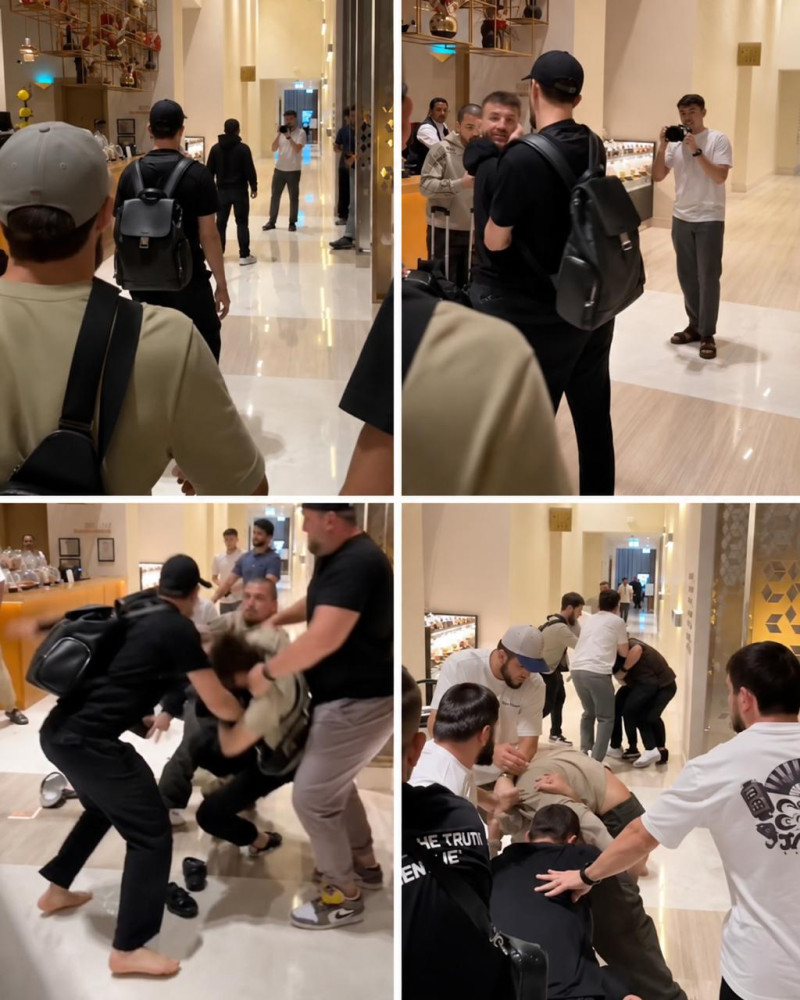
The former UFC bantamweight champion stood facing the camera with his back to the room, so he did not see a group of men come up behind him. Judging by the video that spread across the internet, the first of them was Usman Nurmagomedov, the undefeated champion of the PFL league.
On the footage, that spread on social media, he said something and hit Dvalishvili in the face. Within seconds the lobby of the five-star hotel turned into what tournament posters usually promise for money: punches, a crush, security pulling people apart. Dvalishvili recorded his message to the fans with a cut on his face while medics examined him. According to The National and the journalist Ariel Helwani, those involved in the fight were taken to the police for questioning. Nobody sold tickets to this fight. Everyone, most likely, will make money on it.
The backstory fits into one line of statistics and several years of mutual insults. In January 2025, Dvalishvili defended the belt against Umar Nurmagomedov, Usman's brother and Khabib's cousin, and handed him the first defeat of his career. The feud outlived both the bout itself and Merab's loss of the title. In July, at the RAF wrestling league tournament in Tbilisi, Dvalishvili spoke crudely about Umar and then struck the Dagestani wrestler Akhmed Gadzhimagomedov, who had come up to him with questions (Merab himself claims he was the one grabbed by the neck first). Islam Makhachev now openly calls the fight in Abu Dhabi an answer to Tbilisi. Ilia Topuria calls the attackers cowards. Each side thinks its own man is right. Nobody, it seems, thinks the thing itself is wrong.
A hotel lobby is not an octagon. In the cage there is a referee, a doctor at the fence, weight classes and a ban on strikes to the back of the head. In the lobby there are guests, reception staff and passers-by who signed no contracts and agreed to no risk. Anyone who settles a dispute not in the cage, where rules exist for that, but in the back of a man standing at a camera, admits that for him the rules are packaging, not content.
The easiest thing would be to write it all off to temperament, or to the Caucasian notions of honor that both sides invoke.
But this feud has its accounting. UFC 229, back in 2018, drew an estimated 2.4 million pay-per-view buys, a record for MMA, and a record for Nevada of $17.2 million in ticket sales. People bought it mainly for the hatred. Conor McGregor spent months insulting Khabib Nurmagomedov, his family, his country and his religion, and that spring he threw a dolly through the window of a bus carrying fighters. The fight ended with Khabib jumping over the fence at his opponent's cornermen, while men from his team stormed into the cage and beat McGregor. The Nevada Athletic Commission fined Nurmagomedov $500,000 against a $2 million purse, and McGregor $50,000. In an economy like that, a fine is not a punishment but an overhead cost.
Trash talk long ago stopped being a side effect of cage fighting and became a genre of its own.
Press conferences and weigh-ins are staged as shows where an insult is valued above an argument and a shove above a handshake. The fighters' animosity passes to their fans, and from there into social media and into national grievances. The tone is set from the top. In early 2023, Dana White was filmed in a nightclub in Mexico: he answered his wife's slap with slaps of his own. White said there was no excuse for it, and he stayed at the head of the company, and after the merger of the UFC with WWE he became the UFC's chief executive. At the same time he was launching Power Slap, a league in which opponents take turns hitting each other in the face with an open hand. In that system of coordinates, the slap that started the fight in Abu Dhabi looks not like a breach of the genre but like its continuation.
The money behind this is very big. In 2025, Paramount agreed to pay $7.7 billion for seven-year rights to broadcast the UFC in the United States, an average of $1.1 billion a year, roughly twice what ESPN was paying. Cities compete for the right to host tournaments. The Department of Culture and Tourism of Abu Dhabi extended its partnership with the UFC through 2028 and speaks of turning the emirate into the world capital of combat sports. The logic is clear: a broadcast to hundreds of millions of households, full hotels, the city's name in the credits. Less clear is why a city building itself a reputation with a Louvre on Saadiyat Island would tie its name to a spectacle whose main advertising material is someone else's blood. This week that material was filmed not in an arena but in a hotel lobby.
No less clear is whom this spectacle is bringing up.
Its audience is not connoisseurs of ground-fighting technique but men who want to look like the ones they see in the cage: with cut brows, cauliflower ears and the habit of settling matters with their fists.
Baku is living through this wave too (though the trend seems to have eased off somewhat). A few years ago, gyms for "cage fighting" opened in the city one after another, carrying UFC insignia few people checked the rights to, and the shelves of sports shops filled with T-shirts, gloves and shorts bearing the same logo. Teenagers were buying not a sport but an image, and the image is simple: respect is won through fear, and an argument is won by whoever strikes first.
The comparison with Olympic combat sports suggests itself, and not in the cage's favor. Judo begins and ends with a bow, and its founder, Jigoro Kano, built it on two principles: maximum efficiency and mutual welfare and benefit.
Olympic wrestlers, judoka and amateur boxers get injured too, but they are not sold through hatred of one another, and after the final they shake hands rather than promise their opponent a reckoning. The difference is not in the toughness but in the product.
Sport sells victory by the rules. The cage fighting industry sells conflict and leaves the rules to the insurance companies.
Defenders of MMA will object, and not without grounds. It is one of the most regulated combat sports: athletic commissions, medical clearances, doping control. Fighters train no less than Olympians. The promoters themselves punish fights outside the cage: after the brawl at UFC 322 in New York in November 2025, White banned Dillon Danis from UFC events for life. But the one punished was an outsider. The men from Makhachev's team who took part in the same brawl were simply escorted out of the arena, and it was the mayor of New York who promised to deal with them, handing the case to the police. The system readily punishes those it does not need and is lenient with those it makes money from.
Now the UFC has to decide whether to sign Usman Nurmagomedov. He has been a free agent since the end of October, and in October White said the UFC was "interested" in him. Helwani has already framed the main question: will the UFC sign a fighter after an incident like this.
Oleg Taktarov, the first Russian UFC champion, suggested the fight was staged. There is no way to check that, and that is perhaps the main result of the week: the industry has sold the feud as a show for so long that the viewer no longer tells one from the other. On Saturday at Etihad Arena, Dvalishvili will face Marlon Moraes, and Umar Nurmagomedov will face Urijah Faber.
After Wednesday, one must assume, there will be fewer empty seats.