Conferences instead of truth: how Yerevan is hiding 204 burial sites of Azerbaijanis

Yerevan has decided to seize the humanitarian agenda by holding an international conference titled "The Fate of Missing Persons: Humanitarian Dialogue and Cooperation," which, according to the program, concludes its work today.
The calculation is clear — to show foreign guests and international structures a readiness for dialogue, shifting attention away from its own unfulfilled obligations toward general appeals for trust. But this maneuver works only up to the moment when the statements of Armenian politicians are compared with the facts on the ground.
And those facts are that for almost three decades Armenia has still not clarified the fate of more than four thousand missing Azerbaijanis. Moreover, even the specific agreements on searching for remains and exchanging information that were reached in 2025 are today effectively frozen through the fault of the Armenian side.
Verbal promises and a freeze after the change of leadership
Meanwhile, the instruments for real work have long existed, and their effectiveness depends solely on Yerevan's political will. Since February 2025, direct contacts without intermediaries have been in place between Azerbaijan's State Commission on Prisoners of War, Hostages and Missing Citizens and Armenia's Interagency Commission on Prisoners, Hostages and Missing Persons. In the course of meetings and telephone talks, the sides reached specific verbal agreements. Moreover, on June 4, 2025, Armen Abazyan, then serving as director of Armenia's National Security Service, publicly confirmed the existence of preliminary consent to conduct joint search operations.
Baku has traveled its part of the path consistently and substantively. On the basis of archival documents and eyewitness testimony, Azerbaijan handed over to Yerevan a list of 834 of its citizens taken prisoner or hostage during the First Karabakh War and concealed from international organizations, including detailed dossiers on 104 people. In May and the first half of June 2025, lists of living witnesses and persons possessing information about the circumstances of captivity and burial sites were also handed over to the Armenian side. Their questioning by Armenia's relevant agencies could have given the investigation decisive leads, yet Yerevan has still not said a word about the results of checking these materials.
The culmination of Armenian sabotage was the story of the 204 burial sites. The Armenian side itself admitted that it possesses the coordinates of 204 mass and individual graves of missing Azerbaijanis, specifying that these are predominantly mass graves. Despite assurances of readiness to hand over these coordinates, as of today Baku has received no information whatsoever. Also telling is the particular episode involving the search for Azerbaijan's first military pilot, Vagif Gurbanov, who went missing on June 13, 1992, in the direction of the village of Nakhchyvanly in the Khojaly district.

The reference points handed over by Yerevan before June 2025 were not confirmed when checked on the ground, and the promise to bring to the site a witness capable of precisely indicating the grave remained an empty sound.
It is characteristic that all the key agreements were reached before the dismissal of Armen Abazyan on June 18, 2025, and the appointment 10 days later of Andranik Simonyan as head of the NSS. After the personnel reshuffle, practical cooperation effectively came to a standstill. The last substantive telephone conversation between representatives of the commissions took place on March 24, 2026. To direct questions about the reasons for the breakdown of the agreements, Armenian representatives referred to the absence of instructions from above and stated that the very fact of having direct contact should already be considered a great achievement. After that, substantive dialogue finally petered out.
The Washington treaty and the discrepancy between words and deeds
Such tactics directly contradict not only humanitarian norms but also Armenia's written obligations. On August 8, 2025, in Washington, with the participation of the President of the United States, a Joint Declaration was signed and a peace treaty between Azerbaijan and Armenia was initialed. Article 9 of the draft agreement enshrines the obligation of the parties to cooperate on cases of missing persons and instances of enforced disappearance, to exchange information, to search for and return remains, and also to carry out investigative actions. By signing this document, Yerevan deprived itself of the right to treat the subject of the missing as a matter of goodwill.
Against this backdrop, the speeches of Armenian leaders on November 19 from the rostrum of the humanitarian conference look like an attempt to substitute talk of new formats for the implementation of old agreements.
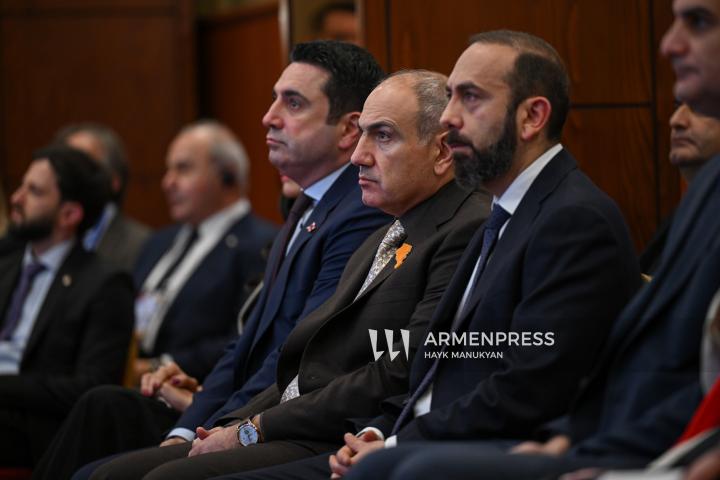
Prime Minister Nikol Pashinyan spoke about the state's responsibility to families, mutual mistrust, the need to seek answers including on the territory of Armenia itself, and mentioned the Dublin discussions on expanding institutional cooperation. Foreign Minister Ararat Mirzoyan, in turn, recalled the law on missing persons that entered into force in May 2026 and declared a constant readiness for joint search and identification. However, for this, neither new laws nor Dublin platforms are needed — it is enough to carry out Yerevan's own initiatives on handing over the coordinates of the 204 burial sites, sending specialists for joint exhumation, and receiving the remains.
Fear of evidence and the failure of the old mechanisms
The reasons why Yerevan is stalling on already agreed steps are obvious. Revealing the burial sites will inevitably expose the scale of war crimes against Azerbaijani prisoners and civilians. In the liberated territories, 32 mass graves have already been discovered to date, and forensic examinations record traces of torture, binding, and extrajudicial executions. Handing over the coordinates of new graves means, for Armenia, voluntarily surrendering evidence of its own guilt.
At the same time, Yerevan can no longer deny that it has the information. Former high-ranking Armenian military figures, including former Deputy Defense Minister Gagik Melkonyan and former commander of the occupying forces Samvel Babayan, have repeatedly publicly admitted that they know about the burial sites of killed Azerbaijanis. In addition, Yerevan bears the direct obligation to clarify the fate of 54 Azerbaijani prisoners officially registered by the International Committee of the Red Cross (ICRC) and visited by its staff at places of detention in Armenia and Karabakh. Of these, the remains of only 17 people have been handed over to Azerbaijan, while the bodies of another 33 prisoners, whose deaths in detention were reported by the Armenian side itself, have still not been returned, and the fate of four remains unknown.
Years of inaction on this issue have also demonstrated the complete failure of the former international mediators. On October 7 of this year, in an address to participants of the IV international conference in the Baku Dialogue format, Azerbaijani President Ilham Aliyev stated that the ICRC's many years of activity in resolving the problem of missing persons had brought no results.

Calling on Armenia to open its archives and hand over information about the burial sites, the head of state proposed creating a special mechanism on the problem of missing persons within the framework of the UN. If the former humanitarian institutions have been unable over decades to achieve a result, then an international mechanism of a higher political and legal level is required.
The mine barrier and the demand of families in Europe
A separate obstacle to the search for remains remains the mine threat. In Karabakh and East Zangezur, the approaches to many presumed burial sites are densely mined. The minefield forms handed over by Armenia under external pressure have extremely low accuracy, and for a number of critical areas no maps have been provided at all. Moreover, Yerevan is completely concealing the maps of the "new line of contact" equipped after 2020, that is, after the end of the Second Karabakh War. The scale of this mining became obvious after the anti-terrorist operation in September 2023, when more than 500,000 mines were neutralized in the liberated territories — in the three years after the 44-day war, the Armenian side laid more explosive devices than during the entire period after the First Karabakh War. Sappers are still finding mines and improvised traps near residential neighborhoods, along roads, in forests, on riverbanks, in farmlands, and in village cemeteries, which proves the Armenian calculation of obstructing the return of the civilian population to their lands.
While official Yerevan imitates humanitarian dialogue, the families of the missing are themselves bringing this problem to European squares. The public association "Families of the Missing of Karabakh," after a rally at the "Broken Chair" monument in front of the European headquarters of the UN in Geneva in 2025, held a series of pickets in Brussels in October 2026 in front of the European Parliament and EU institutions.
In the same month, the Azerbaijani "Gilavar Photo Club" organized documentary photo exhibitions in eight European cities — Geneva, Brno, Ljubljana, Sarajevo, Zagreb, Salzburg, Rome, and Milan — demanding from Armenia accurate mine maps and the truth about the missing.
Azerbaijan has repeatedly confirmed its readiness for substantive work in order to put an end to this long-standing tragedy for thousands of families. But trust is not born out of conferences and other idle talk. Until Yerevan puts on the table the promised coordinates of the 204 burial sites, the results of checking the lists of witnesses, and accurate maps of the minefields, any words by Armenian politicians about humanism will be perceived exclusively as an attempt to buy time and evade responsibility.