Yerevan's humanitarian spectacle against the backdrop of the unresolved tragedy of thousands of Azerbaijanis

There is a particular form of political cynicism — holding a humanitarian forum while sitting on archives that could close a decades-long tragedy for thousands of families.
Today, a two-day international conference titled "The Fate of Missing Persons: Humanitarian Dialogue and Cooperation" opened in Yerevan. From the podium come words familiar to Armenian diplomacy about the pain of loss, the need for dialogue, and commitment to international norms. But behind this compassionate performance hides the glaring fact that for more than thirty years the Armenian side has been concealing information about the fate of 4,010 Azerbaijanis.
Armenia's attempt to present itself as a country sincerely concerned about the problem of missing persons looks like an outright hoax. It is impossible to seriously discuss humanitarian cooperation while stubbornly keeping silent about where thousands of Azerbaijanis who vanished in the crucible of the First Karabakh War are buried. If the Yerevan forum provides no answer to this question, it can be considered yet another attempt to mislead the international community, substituting real obligations with fine rhetoric for foreign guests.
Paper obligations and sabotage
In the Azerbaijani-Armenian peace agenda, determining the fate of missing persons occupies a special place. A durable, genuine peace between Azerbaijan and Armenia is impossible on the basis of interstate protocols and the unblocking of communications alone — it also requires eliminating the grave humanitarian consequences of the war. And full responsibility for dragging out this process lies solely with Armenia, as the aggressor state that occupied a significant part of Azerbaijani territories for 30 years.
The argument that the searches require time and goodwill no longer works. On August 8, 2025, in Washington, with the participation of the U.S. president, a Joint Declaration was signed and the text of a peace treaty between Azerbaijan and Armenia was initialed. Article 9 of this document obliges the parties to cooperate on issues of missing persons and cases of enforced disappearance. This concerns the exchange of information, establishing the fate of the missing, the search for and return of remains, as well as the conduct of investigative measures. By signing on to this clause in the presence of the American leader, Yerevan assumed a concrete obligation that cannot be brushed aside with perfunctory phrases.
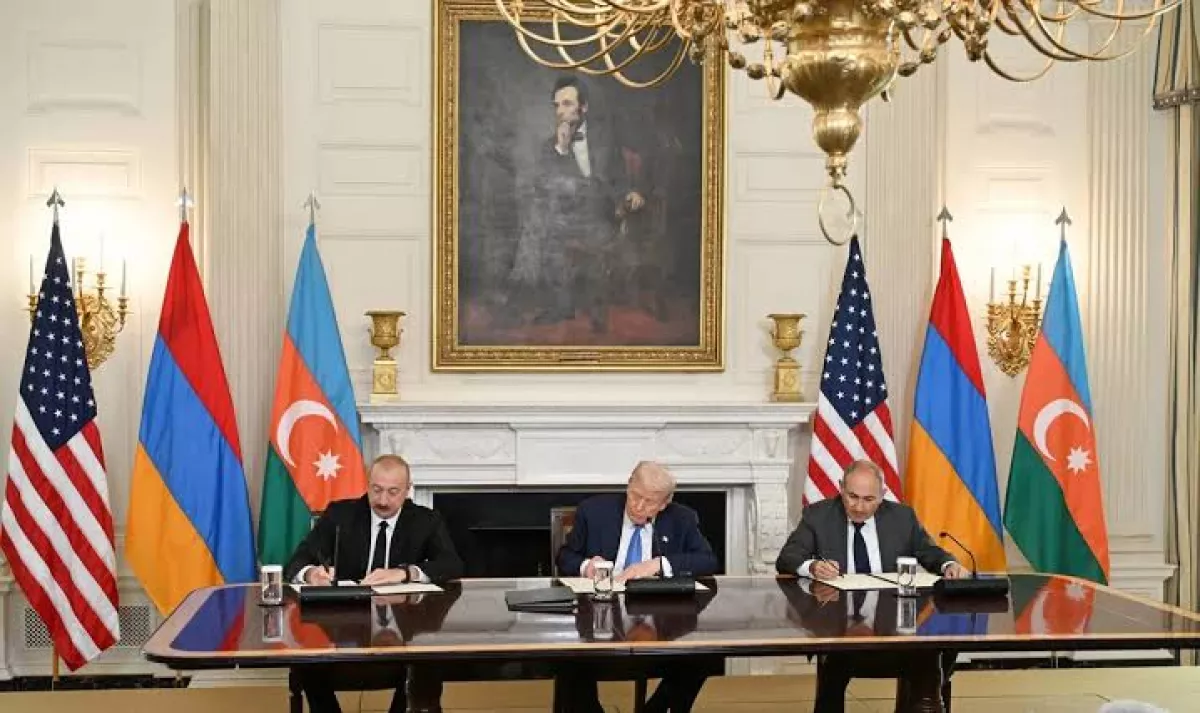
All the more so since, as of February 2025, direct contacts have been established between the state commissions of Azerbaijan and Armenia on missing persons, meetings are being held, and data is being exchanged. Baku is consistently fulfilling its part of the work. Azerbaijan handed Armenia lists of citizens taken prisoner and hostage during the First Karabakh War and concealed from international organizations. The lists were compiled on the basis of archival materials, various data, and witness testimony.
In the course of these contacts, the Armenian side promised to provide information on the locations and exact coordinates of more than 200 burial sites, including mass graves. However, the promise remained on paper. The very fact that Yerevan agreed to hand over these coordinates completely exposes the long-standing lie of the Armenian authorities, who had assured the world that they had no data whatsoever. Yerevan does have the maps and coordinates. Concealing them today is not a technical hitch but a deliberate political choice that calls into question the sincerity of the Armenian leadership in the peace process.
Fear of exhumation
So why does Yerevan cling so stubbornly to the secret of these two hundred burial sites? The answer lies on the surface — opening these graves will inevitably lead to the exposure of large-scale war crimes committed against Azerbaijani servicemen and civilians.
In the liberated territories of Azerbaijan, 32 mass graves have already been discovered. The forensic medical and criminalistic examinations conducted paint a terrifying picture. These are the remains of people with their hands and feet bound, with traces of brutal torture, with bullet holes in their skulls — all of this is irrefutable evidence of deliberate killings. For Armenia, handing over information about new burial sites means not simply a humanitarian gesture but providing the investigation with new evidence of direct legal significance. As can be seen, it is precisely the fear of international responsibility for crimes against humanity that compels the Armenian side to block access to information.
At the same time, in Armenia itself the existence of this data is not such a big secret. Former high-ranking Armenian military officers have repeatedly admitted publicly that they know perfectly well where the bodies of murdered Azerbaijanis are buried. Former Armenian Deputy Defense Minister Gagik Melkonyan, former commander of the occupying forces Samvel Babayan, and others have spoken about this openly in interviews and public appearances.

The result is an absurd situation — former field commanders and generals know the coordinates of the graves, but official Yerevan continues to pretend that it possesses only fragmentary information or no information at all.
A glaring example of such sabotage remains the story of the 54 Azerbaijani prisoners who were at one time officially registered by the International Committee of the Red Cross (ICRC). These people were under international observation; representatives of the humanitarian mission saw them alive. Nevertheless, out of 54 people, the remains of only 17 were returned to Azerbaijan. The remains of another 33 citizens, whose deaths in places of detention the Armenian side itself reported, have still not been handed over to their families. The fate of the rest remains shrouded in darkness. If a person died in captivity, the prison administration is required to have records of the date of death and the place of burial. But even in these indisputable cases, Yerevan evades giving an answer.
The failure of international mediators
Decades of waiting have undermined not only Armenia's reputation but also the authority of international humanitarian structures. The many years of activity by the International Committee of the Red Cross on this track have caused natural disappointment and sharp criticism in Azerbaijan. Possessing a mandate, access to both sides, and lists of registered prisoners, the organization has still failed (or did not want?) to get Yerevan to comply with the elementary norms of the Geneva Conventions.
This harsh assessment was voiced at the highest level by Azerbaijani President Ilham Aliyev. On October 7, 2026, in an address to the participants of the IV international conference in the Baku Dialogue format on the topic "Building Confidence and Developing Effective Mechanisms in Addressing the Problem of Missing Persons," the head of state stated that the ICRC's activity in this area has not brought any results. When thousands of families have been unable to receive an answer about the fate of their relatives for more than thirty years, the existing international mechanisms admit their own helplessness.

That is precisely why, in the same address on October 7, President Ilham Aliyev put forward a fundamentally new initiative. Calling on Armenia to immediately provide all data on missing persons, open its military archives, and hand over information on burial sites, the head of state proposed creating a special mechanism on the problem of missing persons within the framework of the UN. If the previous humanitarian institutions have proven incapable of overcoming Armenian sabotage, an instrument of a higher political and legal level is needed, one capable of compelling the guilty party to disclose information.
Mine terror as a way to cover up traces
The problem of searching for missing persons in Karabakh and East Zangezur is inseparably linked to another extremely grave problem — the mine threat. These two directions are links in one chain. The Armenian occupying forces deliberately mined the approaches to presumed mass burial sites, turning every search expedition into a deadly dangerous operation for sappers and forensic experts.
Under pressure from the international community, Armenia at various times handed Azerbaijan individual maps of minefields, but their practical value proved insignificant. The accuracy of these forms does not exceed 25 percent, and for the most critical and formerly densely populated districts, mining schemes were not provided at all.
Moreover, Yerevan still refuses to hand over maps of the minefields along the line of contact, which Armenian formations laid out after their defeat in 2020. The true scale of this crime was revealed after the anti-terrorist operation in September 2023, when more than 500,000 mines were discovered in the liberated lands. In fact, in the three years after the end of the 44-day war, more explosive devices were laid on Azerbaijani soil than during the entire nearly thirty-year period following the First Karabakh War.

Today, sappers in Karabakh and East Zangezur daily extract from the ground not only standard anti-personnel and anti-tank mines but also insidious improvised explosive booby traps. The geography of this mining proves that it had nothing to do with military necessity. Explosives were laid near destroyed residential quarters, along civilian roads, in forested areas, on riverbanks, on arable land, and even in village cemeteries. This was a deliberate scorched-earth tactic, designed to slow down the return of the Azerbaijani population as much as possible and to prevent the examination of territory that holds the traces of the crimes committed.
The voice of families against diplomatic deafness
While Yerevan organizes yet another conference to simulate humanitarian activity, the people directly affected by this tragedy are forced to knock on the doors of European institutions themselves. The war is over, but for 4,010 Azerbaijani families it continues every day in a state of agonizing uncertainty. This is not abstract historical statistics but a living wound of the present day.
Having despaired of waiting for a reaction from international mediators, the relatives of the missing have moved to active steps on European platforms. The public association "Families of the Missing of Karabakh" back in 2025 held a high-profile action in Geneva at the "Broken Chair" monument in front of the European headquarters of the UN. In October 2026, a series of protest actions took place in Brussels — in front of the buildings of the European Parliament and key EU institutions. The participants of these pickets came out with one simple and lawful demand — to force Armenia to reveal the truth about the fate of their loved ones and to hand over the coordinates of the burial sites.
In parallel with this, in October 2026 the Azerbaijani public association "Gilavar Photo Club" held a series of documentary photo exhibitions in eight European cities at once — Geneva, Brno, Ljubljana, Sarajevo, Zagreb, Salzburg, Rome, and Milan. Images of destroyed cities, minefields, and portraits of people who have waited decades for news of their relatives became a vivid reminder to the European public of the real price of the Armenian occupation and the ongoing information sabotage.
Holding a conference in Yerevan against the backdrop of this stubborn silence looks like an attempt to turn reality on its head. It is impossible to build regional trust and speak of humanitarian dialogue while holding the memory of thousands of families hostage. If Armenia truly wants to prove its commitment to the peace enshrined in the Washington agreements, it does not need international forums. It needs to take just two concrete steps — put accurate minefield maps on the table and hand over the coordinates of the 200 burial sites. Until then, any speeches about humanism coming from Yerevan will remain nothing but empty words.