From Ho Chi Minh to Ilham Aliyev: the story of a friendship that opens new horizons

When Vietnamese leader Ho Chi Minh came to Baku in 1959, he was interested in the oil fields of the Caspian and in the experience of Azerbaijani specialists.
At that time, cooperation between the two countries was largely determined by the needs of Vietnam's developing oil industry. Almost seven decades later, the range of common interests has expanded considerably and now covers areas from energy and investment to trade, transportation routes, and access to new markets.
The official visit of Azerbaijani President Ilham Aliyev to Vietnam is taking place at an important stage in bilateral relations. This is the second official trip by the head of the Azerbaijani state to this country since the 2014 visit. In May 2025, following the state visit of General Secretary of the Central Committee of the Communist Party of Vietnam To Lam to Baku, the parties adopted a Joint Statement on the establishment of a strategic partnership. The current talks are intended to give this status concrete economic and political substance.
A friendship tested by time
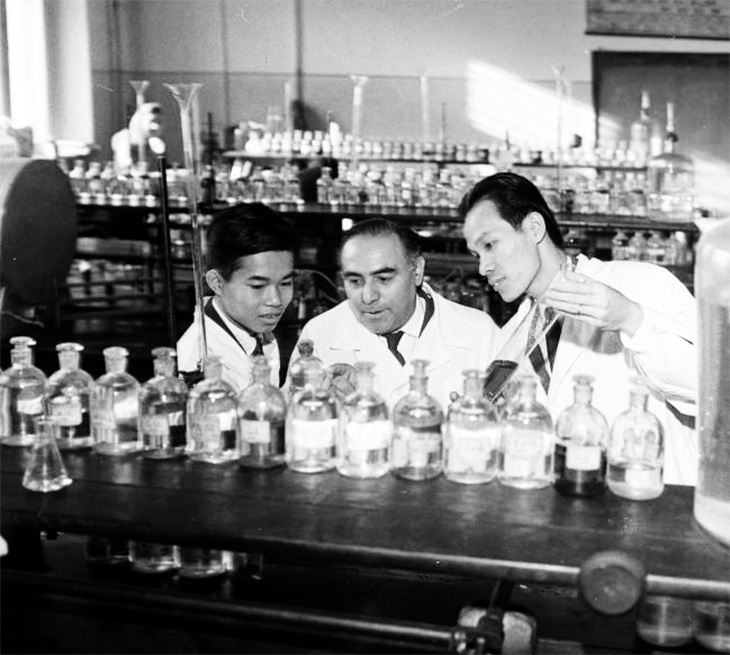
An important milestone in the history of bilateral ties was the 1983 trip to Vietnam by a Soviet delegation headed by Heydar Aliyev, who at the time held the post of First Deputy Chairman of the Council of Ministers of the USSR. On the initiative of the National Leader, the visit lasted eight days and covered key regions of the country. The agreements reached then gave a powerful impetus to the development of the Vietnamese economy. Specialists from this Southeast Asian country gained the opportunity to learn from the professional experience of Azerbaijani oil workers, while natives of our country took part in the establishment of Vietnam's oil and gas industry.
During the Soviet period, about five thousand citizens of Vietnam received their education in Azerbaijan. Many of them later applied the knowledge they had acquired in their homeland.
Contacts in culture also developed. Azerbaijani director Ajdar Ibragimov, who worked in Vietnam from 1959 to 1962, took part in the establishment of the national film school, helped train local directors and actors, and later devoted several books to this country.
Today, the political dialogue between Baku and Hanoi rests on accumulated experience and mutual support in the international arena. The countries cooperate within the framework of the UN, the Non-Aligned Movement, and the Conference on Interaction and Confidence Building Measures in Asia. For Azerbaijan, Vietnam's position on the issues of our country's sovereignty and territorial integrity is of particular importance. Ilham Aliyev separately expressed gratitude to Hanoi for its support of Azerbaijan's internationally recognized borders and for the firm position taken by Vietnam as a non-permanent member of the UN Security Council during the 44-day Patriotic War.
The new stage of relations implies expanding cooperation far beyond the traditional energy sector. The strategic partnership provides for the development of ties in investment, defense, cybersecurity, and other areas. Now the most important task is to turn political trust and mutual interest into joint projects and sustainable economic ties.
From oil cooperation to new projects
Trade turnover between the two countries exceeded 150 million dollars by the end of 2025. For states with such potential, this figure, of course, does not yet reflect all the possibilities. And the president of Azerbaijan notes the need for a significant increase in mutual trade.
The oil industry remains one of the key areas. In 2025, SOCAR and Vietnam's national oil and gas company PetroVietnam signed a memorandum of understanding providing for cooperation in the exploration and development of oil and gas fields, the provision of technical services, and the training of specialists.

Thus, the historical connection that emerged back in the days of the Soviet Union is acquiring new substance, now at the level of the national companies of two independent states.
However, the energy agenda is gradually becoming broader. Vietnamese business is showing interest in projects in Azerbaijan, including in construction, infrastructure development, and renewable energy. One example is ROX Group, with which the relevant documents were signed in September 2026 as part of the Second Azerbaijan International Investment Forum. For Baku, attracting such partners means additional opportunities to diversify the economy and expand the non-oil sector. For Vietnamese companies, it means access to new destinations and markets.
The potential for cooperation is not limited to this. Agriculture, industry, transportation, logistics, the service sector — in each of these areas, points of convergence can be sought. The most important task is for the interest shown at the political level to grow into sustainable business contacts, joint ventures, and long-term investments.
Geography as an economic advantage
Transportation occupies a special place on the current agenda. Here the capabilities of the two countries truly complement each other. Vietnam has developed port infrastructure and holds an important place in the trade and production chains of Southeast Asia. Azerbaijan, located at the intersection of the East-West and North-South transportation routes, is developing infrastructure that makes it possible to connect the markets of Asia and Europe.
That is precisely why the Middle Corridor could become one of the practical instruments for expanding Azerbaijani-Vietnamese trade. For Vietnamese producers and exporters, it opens up additional opportunities for delivering goods to European markets, and for Azerbaijan, the prospect of increasing transit shipments and strengthening its role in international logistics chains. At the same time, the North-South transportation corridor is also at issue, which expands the geography of possible cooperation.
There is already an indicator showing that this direction is gradually taking on a practical character. In January-September 2026, the volume of transit shipments increased almost sixfold compared to the same period last year and exceeded 8,000 tons. For now, this is a relatively small freight flow, but its dynamics show that transportation cooperation between the two countries is ceasing to be merely a promising idea.
Turning this momentum into a sustainable trade route will require coordinated work by transportation operators, relevant agencies, and business. Competitive tariffs, predictable delivery times, and regular shipments will be important. But the very possibility of connecting Vietnam's production and port capacities with Azerbaijan's logistics infrastructure already creates a foundation for new economic ties.
A partnership with a human dimension
Relations between Baku and Hanoi have another component that cannot be measured by trade turnover. For decades, humanitarian, educational, and cultural contacts have shaped mutual respect between the two peoples. Today this work is being continued, in particular, by the Heydar Aliyev Foundation. Among its projects in Vietnam are the construction of a primary school in Ha Giang province and support for educational programs. In 2025, the Foundation's Vice President Leyla Aliyeva visited Vietnam, where she held meetings with representatives of the country's leadership, the creative intelligentsia, and graduates of Azerbaijani universities. Financial assistance was also provided to the Hanoi College of Commerce and Tourism.
In 2025, a Ho Chi Minh Memorial Room was opened at the Azerbaijan State Oil and Industry University. This event was another reminder of how the friendship between the two countries began. In 2026, the fourth "Days of Vietnam" covered two cities at once for the first time — Baku and Gabala. The main cultural program took place in the capital, while in Gabala Vietnamese performers appeared as part of the International Music Festival. In turn, Vietnamese readers were presented with a translation of Ajdar Ibragimov's book "What I Saw in Vietnam."
An important manifestation of mutual support was Azerbaijan's assistance to Vietnam after the devastating Typhoon Yagi in 2024 and the large-scale floods in 2025. Such steps strengthen relations on a purely human, emotional level that goes beyond officialdom.
It is especially noteworthy that interest in rapprochement is also being shown by Vietnamese media, which are closely following the Azerbaijani leader's visit. Publications devoted to this visit discuss the prospects of simplifying travel for citizens of the two countries, introducing a visa-free regime for holders of ordinary passports, and developing direct air service. Such initiatives could give relations an additional dimension — making Vietnam closer for Azerbaijanis and Azerbaijan more accessible for Vietnamese entrepreneurs, tourists, and students. After all, the true strength of interstate ties is determined, among other things, by how actively ordinary people make use of them.

In an interview with VNA, Ilham Aliyev emphasized the complementarity of the two states' capabilities: "Today Vietnam is a dynamically developing state of Southeast Asia, and Azerbaijan is a key logistics and energy hub of the South Caucasus. By joining efforts, we will be able to enter new markets, implement joint projects, and create additional opportunities for business and investment."
This is precisely what distinguishes the current stage of relations. Once people came to Baku for the experience of oil workers; today the interests of the two countries intersect in a far broader field — from energy projects to international logistics and business contacts. Baku and Hanoi have every reason to turn their historical friendship into a partnership that will bring tangible benefits to both sides. And the current visit is intended to bring exactly such a result closer.