The new Nakhchivan as the President sees it
Nakhchivan is entering a stage in which its geographical isolation is increasingly less decisive for its future development.
President of Azerbaijan Ilham Aliyev is presenting a new model for the development of the Autonomous Republic — a territory that for many years had to be defended and supplied with everything necessary must now become a space of production, energy, trade, and transit.
In this picture, Nakhchivan is no longer a periphery but one of the future hubs of regional connections — from the Zangezur corridor to European markets. Now a far more ambitious task is being set before the region: Nakhchivan must not only be reliably supplied with energy, transport, and modern infrastructure, but must itself become a source of economic activity, a center of production, and an important link in Eurasian communications. It was precisely such a perspective that President Ilham Aliyev outlined in an interview with Azerbaijani Television during his trip to Nakhchivan. The president's words reveal a broader design — to transform the autonomy's strategic position from a factor requiring the state's constant attention into one of its main economic advantages.
The president notes that this is already his 17th trip to Nakhchivan, and each of them "is of great importance and has excellent results." Over these years, many important projects have been implemented, the overall development of Nakhchivan has been ensured, "and, of course, in the future the necessary decisions will also be made and the rapid socioeconomic development of Nakhchivan will be ensured."
In recent years, a foundation has been formed in Nakhchivan without which further transformation would not have been possible. The specific nature of the exclave required a special approach, particularly in matters of security, above all military security. The president is convinced that this task remains one of the main priorities.
"Of course, in these years, among the priority issues, first of all, was the strengthening of Nakhchivan's defense potential. Great work has been done in this direction, and today, at the flag-presentation ceremony, the military might of Nakhchivan was once again demonstrated — both its equipment with hardware, and the most modern at that, and the creation of new commando forces. And this is a picture that we have been observing lately in the Armed Forces of Azerbaijan. As you know, by my order, a Separate Army was created in Nakhchivan. This army is, of course, an integral part of the Armed Forces of Azerbaijan. However, the specific nature and geography of Nakhchivan and the absence of a geographical connection with the main part of Azerbaijan have, of course, made it necessary to pay closer attention to the security of this land — the Nakhchivan Autonomous Republic, and this remains unchanged. Therefore, this is the first condition. As I noted today, the Armed Forces of Azerbaijan carry weight in the region. Including that Nakhchivan's military potential is growing stronger every day and will continue to grow stronger."

The security of Nakhchivan has always been an important part of the state agenda. Its geographical separation from the main territory of Azerbaijan objectively required special attention both to the region's defense capabilities and to its energy supply and the resilience of vital communications. However, security issues include not only the military component. No less important a place in this system is occupied by energy security — the region's ability to guarantee its own energy supply and maintain resilience.
In this connection, the president notes the expansion of space for economic and infrastructure projects. Such a transition is especially noticeable in industry. The industrial park laid down in Nakhchivan should become not just another infrastructure facility, but a platform for creating new production facilities and jobs. In terms of area, among Azerbaijan's industrial parks it is second only to the one in Sumgayit.
"At the same time, as a component part of this park, a thermal power plant with a capacity of 300 megawatts will be built," the president stated. "I must note that today Nakhchivan's generating capacity is about 200 megawatts. This one plant alone will lead to a 1.5-fold increase. Naturally, this plant has two goals: the first is providing the Nakhchivan Autonomous Republic with constant energy, the second is export issues."
At the same time, as the head of state notes, the said 200 megawatts of generating capacity exceed Nakhchivan's current needs, and taking this into account, "the export of large volumes of electricity from Nakhchivan will also be envisaged."
A separate place in the concept of Nakhchivan's energy security is occupied by the green agenda. "Many hydro and solar power plants and a modular-type power plant have been built here. Energy security is the second most important factor after physical security. Today, as I have already said, the foundation was laid for a thermal power plant with a capacity of 300 megawatts, and I familiarized myself with the construction of two solar power plants with a capacity of 50 megawatts.
Nakhchivan's solar energy potential is enormous. According to the monitoring conducted and precise analysis, the most favorable place for solar electricity production on the territory of Azerbaijan is Nakhchivan. Therefore, a territory of more than 600 hectares has already been allocated, and solar power plants with a capacity of hundreds of megawatts will be built there.
It is gratifying that the creation of renewable energy sources in our country is, as a rule, handled by the private sector. The information provided to me today shows that from an economic point of view, that is, from the point of view of profitability, these projects are attractive to investors.
Here an important role is played both by the positive investment climate in Azerbaijan and by state support for the development of renewable energy sources and, in general, by our growing potential, including export opportunities. Because, as I have already noted, today Nakhchivan is fully insured in terms of electricity supply," the president said.

Nakhchivan's energy security in this logic goes far beyond the region's internal needs. Against the backdrop of wars, the instability of transport routes, and growing risks for energy chains, the ability to guarantee uninterrupted supply becomes an independent factor of strategic resilience. That is precisely why Baku seeks not merely to provide Nakhchivan with the necessary resources, but to create a system maximally protected from external shocks. "If today there are rare countries in our region that have no problems with electricity, then Azerbaijan ranks first among them. Because for one reason or another, our region is experiencing an energy crisis that may deepen. These are the wars going on in our region, and growing risks, and the rupture of transport chains connected with the transportation of energy resources, and other factors. It is not ruled out that new unpleasant events may occur in the future. Therefore, Azerbaijan's special role here is indisputable. We must ensure that the continuous and stable energy supply of Nakhchivan is never disrupted," is how President Ilham Aliyev speaks about this.
Another step aimed at ensuring Nakhchivan's energy security is gasification. And while, as the head of state notes, the overall level of gasification in Azerbaijan is 96 percent, which is also a very high figure, in Nakhchivan this indicator has already reached 100 percent: "For these purposes, at one time, again on my initiative, we signed an agreement on gas exchange with the Islamic Republic of Iran. On the basis of this agreement, a gas pipeline was laid from Iran to Azerbaijan, and at the same time the transportation of gas from Azerbaijan's Astara district to the territory of Iran was ensured. That is, through exchange we provided Nakhchivan with gas 100 percent. In parallel with this, we carried out gasification. For so many years now — I can say almost 15 years, and maybe more — gasification in Nakhchivan has been 100 percent."
No less important an element of Nakhchivan's resilience is reliable transport communications. The restoration of a direct link with the main part of Azerbaijan is capable of fundamentally changing the autonomy's position, reducing dependence on external routes and, moreover, at the same time turning its geographical location into a strategic advantage. This is no longer simply about restoring transport links, but about forming a new system of connectivity capable of changing the configuration of regional routes.
"The creation of the Zangezur corridor, as you know, was our initiative. Connecting the main part of Azerbaijan with its integral part — Nakhchivan — was our long-standing dream. We moved confidently and very skillfully, we approached this goal and have already come close to it," the president stated.
Work on this direction received new impetus after the Washington summit of August 8, 2025. But something else is fundamentally important — Baku did not wait for the completion of all external sections of infrastructure to begin its own work: "As soon as the Second Karabakh War ended, we immediately began restoring both railways and highways, including the construction of roads leading to Nakhchivan. Today the Horadiz-Aghband highway is practically ready. A number of minor issues remain. The construction of the railway is also proceeding at a rapid pace. We can accelerate this project at any moment. We simply see no need for this because of the unreadiness of the Armenian section. In order to direct investments and capital investments toward resolving more important and urgent issues.
But in any case, next year the railway will also reach the Armenian border. As for the construction of the Nakhchivan railway, work is currently under way. On my instruction, the Ministry of Transport is handling this work. Azerbaijan Railways CJSC has begun construction work in the direction of Ordubad, and the missing sections will be built anew. Two sections did not exist, both are near the Armenian border — one in the territory of the Ordubad district, the second in the Sadarak district. The length of both sections is not very great, approximately 3-5-7 kilometers. The remaining section of the railway is in principle in working condition, it is used even today and can be used. It is just that the throughput capacity of the railway existing today is 1.5 million tons. At the initial stage, it is enough for this road, which is a branch of the Zangezur corridor and of the East-West corridor in general, to begin functioning. But we want no less than 15 million tons of cargo to pass through this transport corridor. For this, it is necessary to restore and rehabilitate the railway existing today. The information and presentation provided to me today were very important. And my instruction was that there is no need to lose time. Azerbaijan, with its own funds, can and must bring this railway fully into working condition and ensure that its throughput capacity is brought up to 15 million tons."
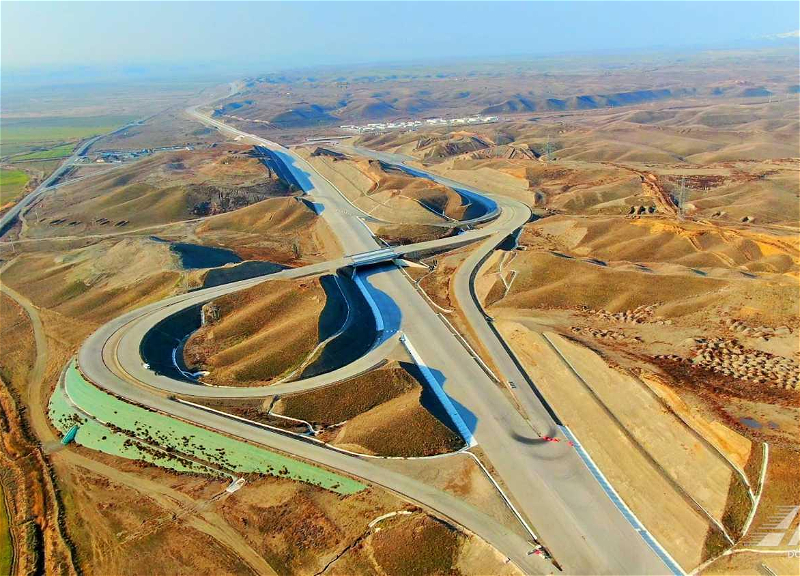
As can be seen, today this is no longer simply about restoring the historical connection as such, but about creating a modern trunk line capable of operating as part of international transport networks.
At the same time, Baku is also open to international participation: "Many international structures and some countries are interested in this road, especially in the Nakhchivan segment of Azerbaijan Railways. One of them is the European Union. Representatives of the European Union were sent to Nakhchivan. Here, on the ground, they familiarized themselves with the situation and also want to become participants in this corridor."
"In principle, we do not object. Our position is that Azerbaijan Railways is already completing all work in the territories located in the main part of Azerbaijan, and there is no need here for any foreign participation. As for the rehabilitation of the Nakhchivan railway, in principle an international consortium could be created here. Of course, on the condition that the controlling stake belongs to the Azerbaijani state, the international consortium may consist of investors, and we are open to this. Even without their participation, we ourselves will lay this road. Right now we have no financial problems whatsoever. Even if we did, we would always find the funds for this important project. But we believe that in order to make this road more attractive to international actors and potential cargo shippers, the Nakhchivan railway project, exactly as I said, may be implemented by a consortium consisting of several companies.
In connection with this issue, we have received several messages from various countries. I do not want to speak about this yet. From a conceptual point of view, this is possible. However, today I also told the minister of transport and the head of the Railway Administration that we are, of course, open to this, but we do not want to lose time. Because during the last conversation with Mr. President Trump it became clear that the construction of the railway on the territory of Armenia must begin this year; there are only 42 kilometers of road there.
And on the territory of Nakhchivan, according to the new feasibility study — because a completely new feasibility study has been developed — the length of the road will be 194 kilometers. Previously it was shorter. Why is it now longer? Because previously the turns were tighter, and if we take that line as a basis and restore it in its former form, it will not be able to handle 15 million tons of cargo. Therefore, the road will be longer — 194 kilometers. We cannot lose time. We have the funds both this year and next year. Therefore, my words will probably reach various addressees. If someone wants to participate in this project, let them not waste time and come to an agreement with us as soon as possible. Because certain bureaucratic obstacles, the dragging out of issues — this is not our, not the Azerbaijani, method of management. We identify problems, make decisions, and immediately proceed to implementation," the head of state stated.
And here another important feature of the state's new transport policy manifests itself — Nakhchivan is regarded as one of the most active centers of the strategic route. That is, the significance of the new communications goes far beyond restoring links between Nakhchivan and the main part of Azerbaijan. Their strategic potential is determined by the possibility of integrating the autonomy into several international transport routes at once. Here is what the president says about this: "This road, as I have already said, will be important not only for Azerbaijan, but for a broader geography. Because, as I have already noted, it will become one of the branches of the East-West transport corridor. At the same time, it will become a branch of the North-South transport corridor. Because today, when the North-South transport corridor is spoken of, what is usually meant is the Russia-Azerbaijan-Iran route, that is, the crossing to Astara and the Astara-Rasht project on the territory of Iran. As far as I know, the implementation of the project has either already begun or will begin. In any case, on the territory of Azerbaijan this project is ready. But after the opening of the Zangezur corridor, a second railway line from Azerbaijan to Iran will be opened. There is a railway from the Zangezur corridor with entry into Nakhchivan, and from the Julfa railway station to Iran. That is, this project can be implemented faster. The North-South transport corridor is directed toward the Persian Gulf. From there it can extend, for example, to Pakistan, which is close to this region. That is, this will be a very important transport project, at the center of which is Nakhchivan."
The economic effect of such a position is obvious — a large cargo flow means demand for logistics, warehouses, servicing, production, and new services. Therefore, transport infrastructure in this case becomes not an end in itself, but a mechanism for the structural restructuring of the autonomy's economy: "Therefore, today, from a strategic point of view, in addition to the factors I have already spoken about, this factor also plays a very important role. Of course, the passage from here of, say, 15 million tons of cargo, and perhaps an even more significant volume, will lead to a great revival. More jobs will be created, economic activity will increase, and Nakhchivan, I can say, will become one of the indispensable transport hubs. This is quite possible. We all know well, we have spoken about it many times, that our country has no access to the open seas, to the oceans. But today, when the implementation of Eurasian transport corridors is being discussed, it is impossible to bypass us. And the same future awaits Nakhchivan, which, of course, will bring us both economic and other dividends."

However, the Zangezur corridor is already not only a transport project; the Azerbaijani leader views it more broadly: "For example, we have a ready project for laying power transmission lines from the main part of Azerbaijan to Nakhchivan through the territory of Armenia. A very large substation has been built in the Jabrayil district, liberated from occupation. Its main function is the transmission of electricity. Such substations are called converter substations. It was built not for internal energy supply, but for the transmission of large volumes of energy. It is ready. It was built specifically for the Zangezur electric power corridor."
"As a result of the analysis carried out by our specialists on the territory of Armenia, even the places where exactly the electricity poles should be installed have been determined. I hope that the Armenian side will also not drag out this issue. Since first and foremost they themselves may need it, because their main source of energy today is the nuclear power plant, the management of which, moreover, is not in their hands. That is first. Second, this plant is outdated and represents a source of danger for the entire region. Azerbaijan and Turkey have repeatedly expressed their concern on this issue on various international platforms. Extending the service life of this plant cannot be an endless process; sooner or later it must be closed. Naturally, if it closes, Armenia will be completely plunged into an energy crisis. Therefore, as they say, having an additional source can only be beneficial.
For example, today our energy lines are connected with Russia, Iran, and Georgia, and through Georgia — with Turkey. Therefore, the energy corridor that will extend from the territory of Armenia to Nakhchivan, then to Turkey and Europe, will also allow Armenia's energy system to withstand in the event of a crisis. Therefore, the sooner we implement this, the better. Of course, you know well that over the past five years we have installed poles in the snow in the mountains of Kalbajar at an altitude of 3,500 meters. That is, if we are to implement this project, it will take a maximum of six months.
But Armenia, of course, must do this itself. Therefore, I believe it is necessary to bring clarity to this issue as soon as possible. This will be an integral part of the Zangezur corridor, TRIPP. Because this project is not only a railway, a highway. Even a fiber-optic cable, power transmission lines, and in the future, if necessary, oil and gas pipelines could pass here.
Because the more alternatives there are, the better for everyone. Therefore, answering the question about Nakhchivan's energy security, I would like to return to what I said earlier: an absolutely stable and insured energy system is being created and has in fact been created here, but we continue to improve it. Of course, we need to expand export opportunities, including from the territory of Nakhchivan," the president stated.
"I say once again, in our region, apart from us, there is no other country that is provided with such a volume of energy resources, be it oil and gas or electricity. By expanding our export opportunities to neighboring countries, we will also reach the European market. Because we have now entered the European market with our oil and gas. But we want to enter it with electricity as well.
Today the only route is Georgia, Turkey, and then Europe. We must expand it. In addition, the feasibility study of the Black Sea energy cable project is ready. But if there is a second line, this will only increase our strength. You probably also remember that back in November 2024, during COP29, we agreed with the presidents of Kazakhstan and Uzbekistan and signed an agreement on laying an electric cable along the bottom of the Caspian Sea. That is, we must be prepared for this too.
Azerbaijan will prove itself as a country that produces, receives, transmits, and exports electricity. That is, such are our strategic views and plans. I repeat, these plans meet the interests of the countries located around us. It is just that coordination work here must be conducted correctly, at the necessary level, and negotiations must be accelerated. I can say that today negotiations on this are under way with both Turkey and Iran. It is too early to say anything yet. And as for Armenia, I want to say once again: the sooner an energy corridor is created on its territory, the better it will be for TRIPP and for the entire region," the head of state emphasized.

Also important is how the president links Nakhchivan with the liberated lands — Karabakh and East Zangezur — through a single logic of the development of territories, each of which has its own specific character but is at the same time included in a common economic and infrastructure system. "Considering that Karabakh and East Zangezur are being built practically from scratch, the distance between the Zangilan and Ordubad districts is only 42 kilometers. This is in fact a single space, and it was so historically as well. Zangezur, Nakhchivan, and Karabakh were a single space, and the migration of people took place over the centuries. Therefore, in this vast geographical territory many people have relatives, and we regard this as a single, exemplary land of development," the head of state said.
He recalled that Karabakh and East Zangezur have been declared a green energy zone, and Nakhchivan is also a green energy zone: "As of today, the greater part of the energy produced here comes from renewable sources. We have already created two energy storage systems based on storage batteries with a capacity of 250 megawatts. I have given an instruction that in Nakhchivan, at the first stage, an energy storage system based on storage batteries with a capacity of no less than 100 megawatts also be installed. Because power plants using renewable energy sources — solar and hydroelectric power plants — also operate here. Therefore, in order to accumulate this energy, we need to use these modern technologies."
All this work is already continuing systematically: "If we look at the geographical situation of our country, we will see that for each region there is a special development plan. Each of our economic districts is developing successfully, and this ensures the overall development of our country. Therefore, the plans are enormous, and I have no doubt whatsoever that they will be implemented. Because there is a strong will, there are also financial resources, and we do not depend on anyone. By creating in Nakhchivan a management system analogous to the one operating in Karabakh and East Zangezur, we are in fact uniting these three regions from an administrative point of view as well. Of course, on the condition of preserving the status of the Nakhchivan Autonomous Republic as an autonomous republic, however, the rules of management must be improved.
We have seen the advantages of the new management system in Karabakh and East Zangezur. I am confident that the more than 90,000 people living there also see this. The same management system — a special representation of the President — has also been applied in Nakhchivan. Thus, these structural reforms, carried out in parallel with personnel transformations, undoubtedly represent an approach aimed at achieving the main goal — that this region, this ancient land, develop constantly, that people live here in comfort, safety, and well-being," Ilham Aliyev stated.

In the head of state's strategic vision, a clear sequence can be discerned — security creates the basis of stability, energy ensures resilience, transport opens external markets, industry and investments generate jobs, and modern urban and social infrastructure makes economic growth tangible for the population. That is precisely why today's Nakhchivan in this concept can no longer be viewed exclusively through the prism of its geographical isolation.
Its position is gradually turning from a limitation into an advantage. At the intersection of the East–West and North–South routes, next to Turkey and Iran, in the future connected with the main part of Azerbaijan through the Zangezur corridor and simultaneously integrated into energy and digital communications, Nakhchivan gains the opportunity to go far beyond regional significance.
The president is in fact speaking of a transition from a model of supplying Nakhchivan with resources to a model of using its potential. And while the first stage was connected with making the region safe, resilient, and provided with everything necessary, the next is connected with making it producing, exporting, and connecting.
This is precisely the main meaning of the "new Nakhchivan" outlined by the president — it is not a periphery that needs to be linked with the outside world, but a territory that itself is becoming one of the important connecting links of an enormous geographical space.