The specter of revanchism at the podium of Armenia's parliament: the opposition refuses to let go of the "Karabakh" past
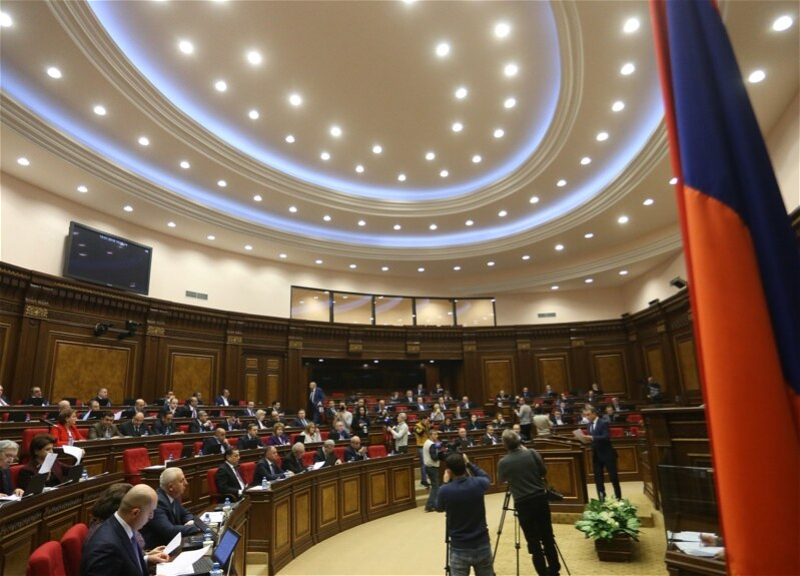
The podium of Armenia's National Assembly has once again been drenched in the poison of revanchism, laying bare the deep chasm between the country's past and its future.
The pretext for yet another round of tension was a provocative statement by Arega Hovsepyan, a deputy from the "Powerful Armenia" party, nominated by the opposition for the post of chair of the National Assembly's Standing Committee on European Integration. No constructive discussion or substantive dialogue on the relevant issues took place within the walls of parliament — all that was heard was yet another populist declaration from radical forces, an attempt to drag society into a new catastrophe.
Hovsepyan, who previously managed to work both in the structures of the former illegitimate administration of the separatist regime and in Armenia's Foreign Ministry, attempted to revive slogans that have discredited themselves. Declaring that "the Karabakh movement did not begin with the decision of one person and will not end with the decision of one person," Hovsepyan pompously added: "It was a movement of the entire Armenian people. No one has the right by their own decision to close a page that is written into the history of an entire people."

However, behind the beautiful rhetoric and the appeal to "historical memory" lies a dangerous, destructive tendency. Arega Hovsepyan's speech became yet another vivid illustration of the fact that today's Armenian opposition has absolutely no agenda other than provoking a new military conflict. Territorial claims against Azerbaijan are already being voiced openly from the parliamentary podium, and radical forces are in effect openly calling for war. The radical revanchism to which these circles continue to cling stubbornly ignores the region's new geopolitical realities and does direct harm to Armenian statehood itself.
The shadow of the past and ideological catharsis
Armenian society has today reached a threshold at which it must, as a whole, recognize the full destructiveness of the so-called "Karabakh movement" and go through an inevitable catharsis. The idea of "miatsum," mythologized for decades, and expansionist ambitions turned the country into a hostage of endless isolation, with an economy cut off from key regional projects.
Earlier, Armenian Prime Minister Nikol Pashinyan directly acknowledged this fact, describing the "Karabakh movement" as a fatal mistake. According to him, the ruling "Civil Contract" party found the strength within itself to radically reconsider its approach to this problem and to take a firm course toward a peace agenda. Pashinyan called the transition to a peace strategy a "new revolution" for his party after the events of 2018 and the early elections of 2021.
The prime minister openly stated that his party's 2021 election platform did not contain such radical rethinking and in many respects did not differ from the platforms of other political forces. He admitted that at the beginning of his political activity both he and his supporters were inspired by the "Karabakh movement." However, genuine national interests require the courage to look the truth in the eye. "Leadership implies the capacity for self-analysis and self-criticism. Understanding the situation, we had to lead the country out of geopolitical traps. Having gone through a difficult path, we took upon ourselves the boldness to declare that we will not continue the Karabakh movement," Pashinyan said.
Illusions of revenge against national statehood
The main problem of the Armenian opposition lies in its refusal to acknowledge elementary facts of international law. Speeches like Hovsepyan's are aimed not at defending the people's interests, but at destabilizing the domestic situation and indulging destructive forces.
Revanchist circles accuse the current authorities of losses, but these accusations are utterly groundless. Prime Minister Pashinyan clearly responded to such criticism: "Factors connected with the Karabakh movement were used to prevent the progress of our state. We are accused of losing territories. But I want to say clearly that we did not lose territories. In fact, those territories that we are accused of losing never belonged to us."
The Armenian leadership has at last formulated a fundamental change of paradigm: the main task of the authorities is to provide the citizens of Armenia with a normal, safe and prosperous life, not to condemn them to "martyrdom" for the sake of other people's territories and alien geopolitical games. And it is time for society to realize that the real Armenia is its sovereign territory, recognized by the international community, and not revanchist phantoms.
Peace as a strategy and a geopolitical inevitability
However, Armenia's peace agenda, aimed at the delimitation of borders, the establishment of good-neighborly relations with Azerbaijan and the unblocking of transport communications, is meeting fierce resistance from the opposition bloc. Pashinyan justly characterized this alliance of radicals as a "three-headed war party," referring to the oligarchic and ultranationalist figures Samvel Karapetyan, Robert Kocharyan and Gagik Tsarukyan.
It is precisely these actors and the political and economic groups connected with them that for many years shaped and exploited the Karabakh agenda as an instrument for holding on to power, preserving influence and controlling resources. Today, when reality has changed, they are interested in revising it — not out of considerations of national strategy, but for the sake of revenge. Their rhetoric is built on attempts to revive already closed topics, on appeals to society's emotions and fears, and on imposing illusions.
No less important is the fact that this revanchist line is being fueled from outside — by certain foreign circles for whom maintaining tension in the South Caucasus remains a convenient instrument of influence. In such a context, domestic radicals become conduits of someone else's agenda, deliberately or circumstantially playing into the hands of those who are not interested in lasting peace in the region.
Yet attempts to block the peace process and return the country to a state of endless confrontation are doomed to fail. The opposition's revanchism is a road into the abyss, leading to the final loss of sovereignty. To build a sustainable future and achieve real integration into the international community, Armenia must finally rid itself of this toxic legacy. Society must make a choice in favor of pragmatism, peace and the development of its own country, leaving verbose speeches about "unburnable pages of history" where they belong — in the archives of the past.