
The Baku-Tashkent axis: how political trust turns into geoeconomic power
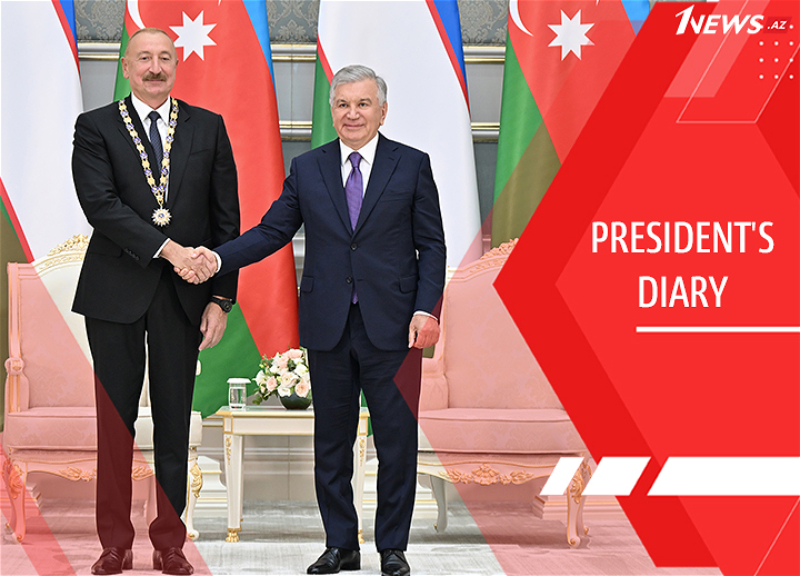
A treaty of eternal friendship, a trade turnover target of $1 billion, large-scale investment projects and geoeconomic initiatives — the state visit of Azerbaijani President Ilham Aliyev to Uzbekistan and his talks with President Shavkat Mirziyoyev open a new page in the history of bilateral relations.
The current visit, which the Uzbek leader described as historic, becomes yet another qualitatively important stage in the progressive development of bilateral relations, complementing the already established foundation of partnership with a new level of economic and investment interconnectedness.
Against this backdrop, Azerbaijan and Uzbekistan are increasingly acting as a connecting link between Central Asia, the Caspian region and the South Caucasus.
A long-term model
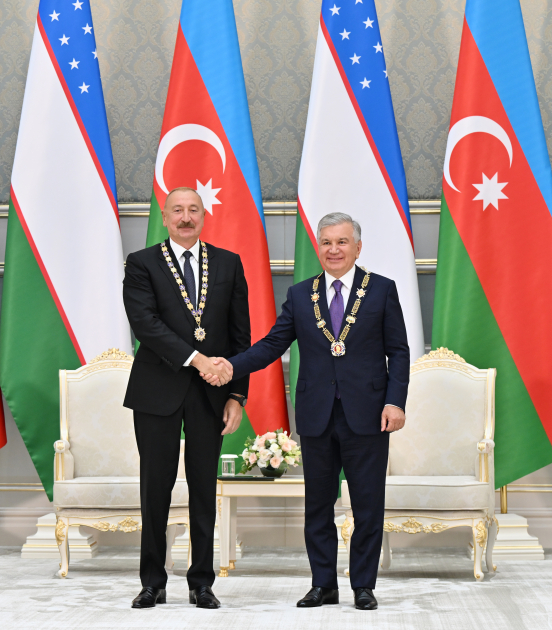
The treaty of eternal friendship signed by the heads of state was not a starting point; rather, it is the political formalization of an already established model of relations.
In recent years, Baku and Tashkent have consistently translated historical closeness and mutual sympathy into concrete mechanisms of interaction — from interstate dialogue and joint regional projects to investment cooperation and industrial collaboration.
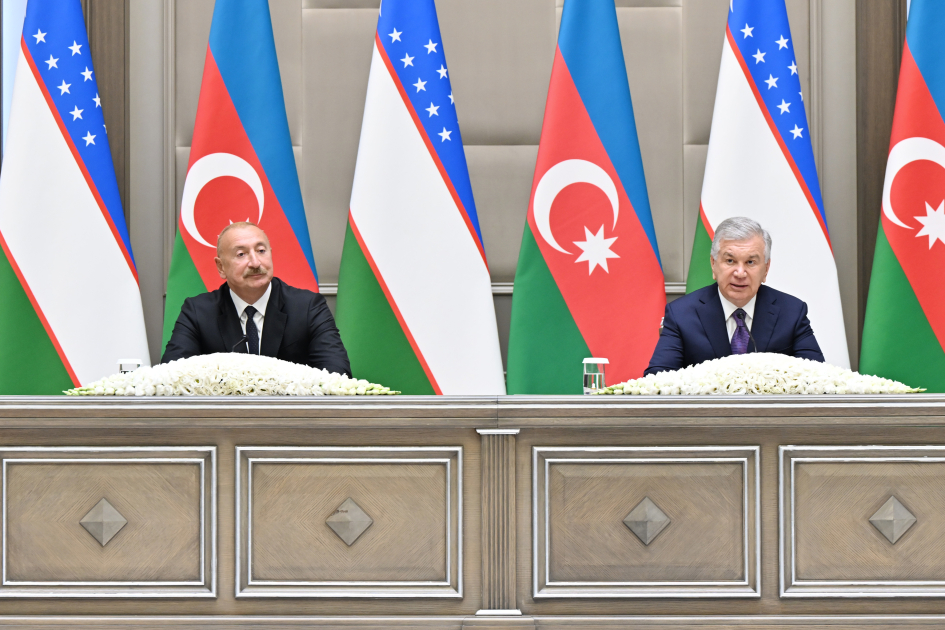
Uzbek President Shavkat Mirziyoyev directly linked the new level of relations with the signing of the treaty of eternal friendship: "This is not just a document, it is a reflection of our joint aspiration to deepen interaction, expand opportunities for cooperation and build a common future."
The Uzbek leader emphasized that the relations have already acquired the character of a strategic partnership based not only on political interests: "Azerbaijan is our reliable ally, strategic partner and brotherly state. Our relations are based on a common civilizational code, shared historical roots, centuries-old friendship, unbreakable spiritual values, similar culture and traditions. It is precisely this deep connection that makes our relations monolithic and invulnerable to external circumstances."
For his part, President Ilham Aliyev emphasized that the brotherly feelings between Azerbaijan and Uzbekistan are mutual. At the same time, the head of state focused on the practical side of the rapprochement, particularly noting the role of President Shavkat Mirziyoyev in expanding the bilateral partnership. He stressed that until recently there were practically no joint projects between the two countries, whereas today the parties are discussing investments in a whole range of sectors and are setting the task of bringing trade turnover to $1 billion: "Today we speak of the goal of one billion in trade turnover not as some distant dream, but as something we will probably reach in a couple of years."
Thus, the political formula of "eternal friendship" acquires quite tangible content. Behind it stand investments, enterprises, transport routes, energy projects and the growing presence of the two countries' companies in each other's markets.
A billion-dollar portfolio
It is telling that the presidents view the growth of trade turnover not as a declaration — a separate program with concrete measures has already been approved to achieve the goal, and the existing portfolio of projects allows us to speak of much higher potential. Moreover, the $1 billion bar is by no means "the limit," and in the future the volume of trade may be increased several times over. "But we agreed that this is not the limit, it can be increased several times over. We will do this. Our teams have all the calculations, resources and powers," President Shavkat Mirziyoyev emphasized.
In other words, Baku and Tashkent are seeking to move toward systemic economic integration, in which the expansion of trade turnover will be ensured not only by the export of individual categories of products, but also by the creation of new production chains.
It is here that industrial cooperation takes on special significance. The Azerbaijani and Uzbek economies have complementary capabilities, which means that the expansion of interaction can take place in several directions at once — from energy and the chemical industry to agriculture, construction, finance and geology.
The president of Uzbekistan reported on a portfolio of cooperation projects formed for the visit in the spheres of energy, geology, chemistry, construction, finance, agriculture and other sectors. "An important role in advancing these projects is played by the investment fund created several years ago, which in a short time has become an effective mechanism for supporting joint business initiatives," the Uzbek leader said.
The president of Azerbaijan, in turn, noted that cooperation covers practically all key areas, "starting from energy, transport, investment projects, tourism, cooperation in the mining sphere, the automotive industry, agriculture, processing."
This fundamentally changes the very logic of bilateral economic relations. If trade shows the volume of existing ties, then investments determine their durability. An enterprise, a joint project or an investment fund creates an interest that persists for years and binds economic systems far more firmly than one-off trade operations.
In this context, the previously created Investment Fund is becoming one of the key instruments of the new stage of cooperation. As Ilham Aliyev noted, the fund is already one-third covered by projects, "if we add investment projects in tourism infrastructure and in Azerbaijan's automotive industry, then this is already billions in investments." Moreover, "the volume of investments that we envisage and that has already been contracted through projects far exceeds the volume of the fund," and "if we look at the investment portfolio as a whole, we will see that it is much larger than the 500 million we have determined."
The head of Uzbekistan, for his part, noted that an agreement had been reached to accelerate the disbursement of the allocated funds: "and then we will increase this fund, because we have gained good joint experience in using the resources of this fund."
All this means that the financial infrastructure for further expansion of the partnership already exists; now the task is to fill it with new initiatives.
Investments as an indicator of trust
A particularly important signal was that mutual investments are gradually going beyond the capitals. Regional cooperation is becoming an independent direction of the economic policy of the two states.
Shavkat Mirziyoyev separately noted the intensification of contacts between regions: "It is they that are the drivers of the expansion of trade and economic partnership. Noting that to this end this month Azerbaijan was visited by the hakims of the city of Tashkent, the Bukhara and Namangan regions, the Uzbek leader emphasized that regional authorities are already demonstrating concrete results of interaction.
Ilham Aliyev also emphasized the scale of the regional component, pointing out that further plans for interaction cover many regions of Azerbaijan.
The interregional cooperation forum held the day before thus receives a practical continuation in the form of concrete investment initiatives.
For Baku and Tashkent this is especially important. Economic diplomacy ceases to be a task only for central governments and begins to rely on a broader network of business contacts. The more regions and companies are involved in cooperation, the more stable the entire structure of bilateral relations becomes.
A special place in this process is occupied by Uzbekistan's participation in the restoration of Azerbaijan's liberated territories. Tashkent was one of the first to support this process not only politically, but also invested directly in the restoration of Karabakh. The Mirza Ulugbek school built in Fuzuli and investments in garment production in Khankendi have become concrete symbols of Uzbek participation in the revival of Azerbaijan's liberated lands.
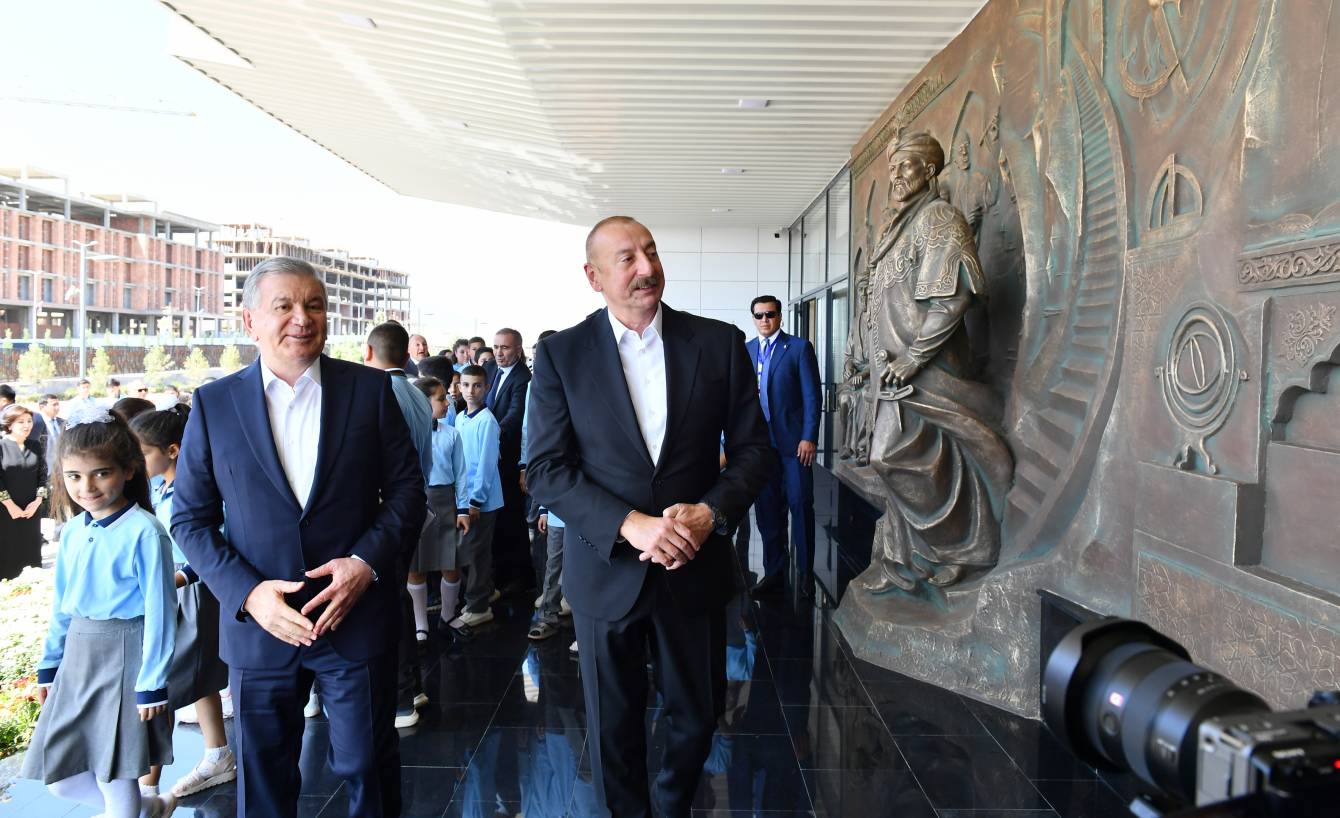
Ilham Aliyev called Shavkat Mirziyoyev's contribution to attracting investments to Karabakh special. These projects show that Uzbekistan acts not merely as an important economic partner of Azerbaijan, but as one of the participants in the large-scale transformation of a strategic region.
From the Caspian to Central Asia
Even more serious prospects are opened up by the transport direction. For Uzbekistan, which has no access to the world ocean, reliable alternative routes to the west are of strategic importance. For Azerbaijan, the development of such routes strengthens the country's role as a transport hub between Central Asia and European markets.
Therefore, the interest of the two states in the Trans-Caspian corridor has an obvious geoeconomic basis.
Shavkat Mirziyoyev announced the intention to jointly develop the potential of the Trans-Caspian route, increase the efficiency of logistics infrastructure and increase transportation volumes. One of the practical steps should be the creation of a joint fleet in the Caspian Sea. "We will jointly develop the potential of the Trans-Caspian corridor, increase the efficiency of logistics infrastructure, and stimulate transportation. To this end, we will step up work on creating a joint fleet in the Caspian Sea," Shavkat Mirziyoyev noted.
In this case, transport cooperation ceases to be a separate sector of the bilateral agenda. It becomes a connecting element of the entire economic model. The more effectively the Central Asia–Caspian–South Caucasus link works, the more opportunities Uzbek producers will get to enter new markets, and Azerbaijan — to further strengthen its role as a transit center. At the same time, this is not only about transporting finished products. The development of transport infrastructure creates conditions for the formation of new production and logistics chains. Investments begin to follow transport routes, and industrial cooperation follows investments.
That is precisely why the transport agenda of Baku and Tashkent has significance that far exceeds the volume of bilateral trade. It fits into a broader process of forming new economic ties across a vast geographical space.
A new geography
The large-scale political and economic conclusion from the current visit is connected precisely with the changing geography of interaction. After Azerbaijan joined the cooperation format of the Central Asian countries, the former border between the two regional spaces became significantly less noticeable. Baku and Tashkent now interact not only as two states, but as participants in a larger regional architecture.
Ilham Aliyev directly calls Central Asia and Azerbaijan a single geopolitical, geoeconomic region, emphasizing the enormous potential of its further development: "Central Asia and Azerbaijan are one geopolitical, geoeconomic region, which has enormous potential today, but even greater potential for growth. And the overall positive dynamics of the development of this large, I would even say, newly created and already sufficiently integrated region largely depends on close interaction between our countries, Uzbekistan and Azerbaijan."
This assessment is important above all because behind it lies no longer an abstract idea of regional closeness, but a set of concrete processes. Transport corridors are developing, mutual trade is growing, investments are expanding, joint industrial projects are emerging. At the same time, political coordination on international platforms is being strengthened.
In this sense, Azerbaijan and Uzbekistan are becoming among the key engines of the rapprochement of two strategic regions. Their interaction creates horizontal ties that gradually form a common space of economic interests.
This is especially noticeable against the backdrop of the growing importance of the Middle Corridor. For the countries of Central Asia it creates an additional outlet to the South Caucasus and further to European markets. For Azerbaijan, it strengthens its importance as a connecting link between East and West.
As can be seen, the development of Uzbek-Azerbaijani relations simultaneously meets the national interests of both countries and forms a broader regional infrastructure of cooperation.
The economy as the foundation of political partnership
Another feature of the current stage is the rapid expansion of the sectoral geography. Energy, oil and gas exploration, mining, the automotive industry, agriculture, processing, the banking sector, tourism — today there is practically no major segment of the economy in which Baku and Tashkent do not see opportunities for joint work.
The emergence of Azerbaijani business directly in the Uzbek market is also telling. The entry of a leading Azerbaijani bank and the expansion of SOCAR's activities testify to a transition from intergovernmental agreements to a deeper presence of companies. In particular, SOCAR is entering Uzbekistan's retail market with projects related to the exploration of oil and gas resources. "In principle, we are already at the final stage and very much hope to begin drilling production wells next year, after, I hope, exploratory drilling and exploration work yield good results," is how President Ilham Aliyev speaks about it.
At the same time, Uzbek investments in Azerbaijan are gaining increasingly noticeable significance. Automotive production and tourism infrastructure look especially promising, where the parties see an opportunity to use the advantages of the two markets and create products with higher added value.
Ilham Aliyev emphasized that the total volume of future investments may already be measured in billions of dollars. But more important than the figure itself is where these funds are directed: into sectors capable of creating new production capacities and providing a long-term economic effect.
At the same time, the Azerbaijani leader particularly noted Uzbekistan's investment climate, linking it with the reforms carried out by Shavkat Mirziyoyev: "And investments are made, as a rule, in friendly countries, in our case brotherly countries, and, as a rule, where there is a good investment climate. And again I return to what I began with. It is the great merit of Shavkat Miromonovich that it is he who, through his reforms, his persistence and wisdom, created such an investment climate that now both international financial institutions and global international actors view Uzbekistan as a state at a successful stage of its development."
In fact, investments are becoming one of the indicators of political trust — the willingness to invest one's own capital in a partner's economy testifies to a much higher degree of confidence in the sustainability of relations.
A partnership that goes beyond bilateral relations
The results of just the first day of the visit show: Baku and Tashkent no longer view their relations exclusively through the prism of bilateral trade or individual investment projects.
Behind the economic agenda, a larger strategic construction is taking shape. Its elements are obvious: the Caspian and the Trans-Caspian corridor, Central Asia and the South Caucasus, investments and industrial cooperation, energy and transport, regional ties and political coordination.
The strengthening of ties between Azerbaijan and Uzbekistan is also significant for neighboring states, creating additional opportunities for other participants in transport and production chains, expanding the space of economic interaction and increasing the interconnectedness of the two regions.
The current visit of the head of the Azerbaijani state to brotherly Uzbekistan demonstrates a qualitative transformation of bilateral relations. If the previous model was built primarily on historical, cultural and political closeness, now a dense network of material interests is being added to it.
A new stage: when geography becomes strategy
Therefore, the main outcome of the Tashkent talks lies not only in the signed documents, figures or the list of investment projects. The key significance of the visit lies in the formation of an integral and long-term logic for the development of relations.
Baku and Tashkent are creating a partnership in which political trust is transformed into investments, investments into production, production into trade, trade into transport flows, and transport interconnectedness into broader regional integration.
It is precisely this sequence that makes the current stage fundamentally different from the previous one. The goal of $1 billion in trade turnover becomes in this system merely the nearest benchmark. Much more important is that the two countries are simultaneously increasing their investment presence, forming joint production chains, developing the Trans-Caspian route and reaching a new level of interaction in Central Asia.
Azerbaijan and Uzbekistan are in fact forming their own model of regional interaction — with an understanding that in the modern geoeconomy the sustainability of a state increasingly depends on the quantity and quality of the ties it creates around itself. And today Baku and Tashkent are linked by more than just common history and cultural closeness. They are increasingly closely linked by a common economic future. With the implementation of the current agreements on the declared scale, the next result of this rapprochement will be not merely growth in bilateral trade, but the formation of one of the most stable economic bridges across a vast geography.
This is precisely the strategic significance of the current visit — Azerbaijan and Uzbekistan are moving from relations based on closeness to a partnership capable of independently shaping a new geoeconomic reality of the region.