Cinema in the service of revanchism: who in Armenia is trying to "revive" a terrorist and war criminal, and why?
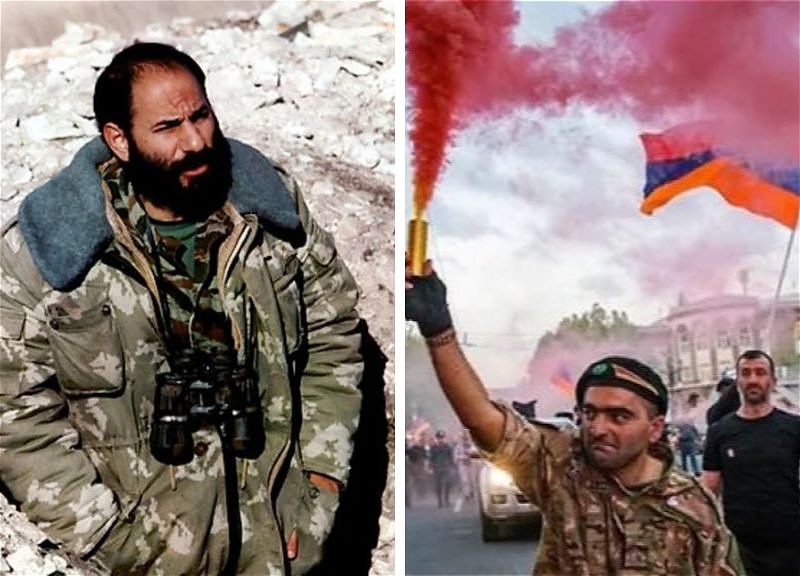
In the history and folklore of every people there are heroes — mythical or real, cloaked in glory — whom the older generation holds up as an example to the younger one, passing on along with their names certain ideas about honor, courage, duty, and love for the homeland.
In all times, the young generation needs ideals whose heroism it will identify with its own deeds. A Frenchman proudly tells his children about Joan of Arc and the heroes of the Resistance, an Englishman about the knights of the Round Table and the Duke of Wellington, a Turk about Sultan Mehmet the Conqueror and Atatürk. An Azerbaijani passes down from generation to generation the epics of the legendary Koroghlu, Babek, Javad Khan, and the story of the glorious heroes of modern times — Mehdi Huseynzade, Mubariz Ibrahimov, Natig Gasimov. Songs are composed about them, books are written, films are made.
But whom are young people in modern Armenia urged to emulate?
For ages frightening children with tales of the "terrible Turks," hammering into children's minds an unaccountable fear and hatred toward an entire ethnic group, this country at the same time all but canonizes real war criminals, presenting their deeds as a "feat" and an example to follow.
And this heroization does not remain merely on the pages of textbooks or in political rhetoric. It takes on new forms, becomes entrenched in the public consciousness and, most tellingly, is transferred to the screen. The question of whom a country turns into a hero on screen is far from always a matter of art. Especially when it concerns a man whose name is linked to terrorist activity and the deaths of civilians.
These days Armenia is preparing to shoot the film "Monte." It is about Monte Melkonian, whose biography is connected with terrorist activity and war crimes. As the newspaper "Hraparak" reports, the project has received financial support from Armenia's Ministry of Education, Science, Culture and Sport and from the Yerevan City Hall.
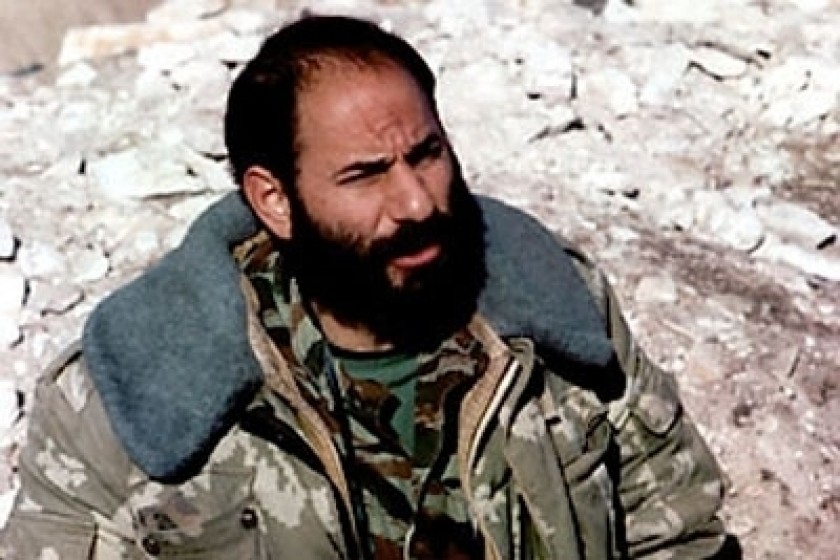
Well, Melkonian's biography is fairly well known.
The facts: Monte Melkonian, nicknamed "Avo," was an international terrorist and saboteur, a specialist in explosives and hostage-taking. He took part in wars in the Middle East. He is responsible for the lives of more than a thousand civilians around the world.
Having joined the Armenian terrorist organization ASALA in the spring of 1980, Melkonian led the organization's unit in Western Europe, organized and took part in terrorist attacks in Rome and Athens, and helped train militants for the terrorist operation to seize the Turkish consulate in Paris in September 1981. Later he formed a new faction, the "ASALA Revolutionary Movement."
In November 1985, Melkonian was arrested in Paris and sentenced to 6 years in prison "for illegal possession of weapons and forgery of documents."
After being released from the French prison, Melkonian continued his terrorist activity — now in Karabakh. During the First Karabakh War, at the time of the occupation of Azerbaijan's Khojavend district, Melkonian was the commander of a detachment of Armenian militants.
He was eliminated in Karabakh in 1993.
Officials attended his funeral in Yerevan, including the then-president of Armenia.
That is the official chronicle. And here is an excerpt from the book by Markar Melkonian, Monte's brother. The book is called "My Brother's Road," and a significant part of it consists of the recollections and thoughts of Monte Melkonian himself, recorded by his wife:
"It seemed that the battle for Garadaghly, the first battle Monte commanded in an official capacity, had gone successfully. But soon everything changed. Militants of Arabo and Aramo pushed 38 prisoners into a ditch on the outskirts of the village, among them civilians, including women... The soldiers of Aramo and Arabo, eager to avenge the death of their comrade who had been killed only the day before, began shooting the prisoners and finishing them off with knives, all without exception. 'Scar' Edo, one of the five lads of the Patriotic detachment from Ashtarak, doused several wounded soldiers with gasoline and threw a lit match. By the time Monte approached the ditch, there was only a heap of remains there."
And this is how the book describes the Khojaly genocide, in which Monte Melkonian's detachment took part:
"At about 11 o'clock at night, approximately 2,000 Armenian fighters crept through the thick last-year's grass right up to Khojaly from three sides and began driving the residents in the direction left open, to the east. By the morning of February 26, the refugees had reached the eastern peak and began descending the slope in search of salvation in Azerbaijani Aghdam, six miles away. There, among the hillocks and already within sight of safety, the soldiers of Nagorno-Karabakh overtook them. 'They just shot and shot and shot,' said refugee Raisha Aslanova, testifying to representatives of Human Rights Watch conducting an investigation. The Arabo fighters then drew their knives from their sheaths and began to strike with them.
Now only the wind whistled in the dry grass, a wind that had picked up recently and had not yet had time to carry away the smell of corpses. Monte had arrived in Martuni only 22 days earlier, but he had already walked across two fields of death, watered with the blood of prisoners and unarmed civilian peasants... Monte walked, crunching over the deadwood on which women and girls were scattered like dolls.
Khojaly was a strategic target, but it was also an act of retribution."
Monte Melkonian — a terrorist and war criminal guilty of the agonizing deaths of defenseless Azerbaijani women, children, and elderly people — was awarded the title of national hero in Armenia.
Today it is no longer only a matter of the past. Something else is far more important: why is it that today, when Azerbaijan, whose people suffered from aggression and war, is ready to turn the page on enmity, Armenia is once again trying to bring such figures back into the public space — and with the support of state structures at that?
Do they not consider in Yerevan that such heroization does not exist in a political vacuum? That it is inevitably perceived as a continuation of the same chauvinistic and revanchist logic that once led to tragedy?
It is telling that the danger of such an approach is recognized even by representatives of the Armenian nationalist camp. That same Markar Melkonian, six months after Armenia's crushing defeat in the Second Karabakh War, published an article warning ultranationalists who were calling for revenge and a new war with Azerbaijan. After the war, the "literary work" of the brother of the terrorist "Avo" took on a new tone, not as bombastic as before. In his article "Ultranationalist Foolishness: How Much More Can Armenia Take?" he spoke of a serious underestimation of Azerbaijan's military power and combat readiness, while at the same time pointing to an overestimation of Armenia's capabilities and illusions about the West's readiness to intervene and take its side. Summing up his conclusions, Melkonian also wrote about those who once again want to challenge the international community and "eagerly await the next war."

A paradoxical situation emerges: even among radicals there are warnings about the unacceptability of a new confrontation, while individual state structures support a project dedicated to a man whose name is linked to numerous war crimes.
If the lessons of the past have truly been learned in Armenia, then a completely natural question arises: why turn its participants into screen heroes again today?
All the more so since today there is a chance to finally turn this page of history.
The peace process requires not only political agreements, but also a gradual change in the very way societies perceive each other. Do they not consider in Yerevan how much such projects contradict the peace process between Azerbaijan and Armenia and the spirit of the Washington agreements?
Cinema really is a powerful weapon of mass influence. And when Armenia supports the on-screen resurrection of a terrorist, the answer to the question of "who and why" becomes obvious. Behind it lies a dangerous attempt by revanchist circles to "revive" the image of a war criminal and once again implant an ideology of hatred in the minds of the rising generation.
Would it not be more logical to create cinema that prepares society for lasting peace, rather than putting filmmaking at the service of revanchism?
As long as Yerevan funds such films, the question of Armenia's real readiness for peace and good-neighborly relations remains, alas, rhetorical.