Phantom pains of the Fifth Republic: while barricades blaze near the Élysée Palace, Paris manufactures grievances against Baku

For several months now, France has been shaken by large-scale protests, the ratings of Emmanuel Macron and his cabinet have been methodically setting new historic lows, and the parliamentary opposition is fiercely demanding the government's resignation, early elections, and even the president's impeachment.
One would think that in a situation where the Fifth Republic is bursting at the seams under the weight of a socioeconomic crisis, official Paris should have neither the time nor the resources for foreign policy adventures. But reality says otherwise: the inhabitants of the French corridors of power are still troubled by Azerbaijan.
A persistent impression is forming that criticism of Baku has turned into a universal lightning rod for the French establishment. As soon as the level of street discontent within France itself spikes to a critical point, Paris immediately takes the old, worn-out record about "human rights in the South Caucasus" off the shelf.
The other day, the Ministry for Europe and Foreign Affairs of France and the Minister Delegate for Foreign Trade and Economic Attractiveness Nicolas Forissier made yet another round of unfounded claims. Official Baku responded firmly and exhaustively, calling the insinuations voiced absolutely unacceptable.
"The selective approach demonstrated by France, unilateral assessments, and continued reliance on politically motivated narratives do not serve to advance the peace agenda in the region," emphasized the spokesperson of the Ministry of Foreign Affairs of the Republic of Azerbaijan Aykhan Hajizada, calling on the French government to abandon its biased approach and refrain from interfering in Azerbaijan's internal affairs.
In his speech in the French Senate on the process of normalizing relations between Baku and Yerevan, Forissier, adopting the mentorial posture customary for French diplomacy, stated that Paris is following "with close attention and deep concern" the situation with "Armenian prisoners in Azerbaijan, as well as the fate of the displaced population of Nagorno-Karabakh."
This short phrase could not more vividly reveal the political duplicity and legal nihilism of official Paris. There, it seems, they still refuse to grasp a simple truth: the people whom French officials persistently call "Armenian prisoners" are the former ringleaders of the separatist junta, who face specific, documented charges of war crimes, crimes against humanity, terrorism, and the financing of separatism. Their cases were examined in strict accordance with Azerbaijani legislation and international law.

Baku rightly pointed out the inadmissibility of shielding war criminals. "Azerbaijan rejects attempts to portray persons who have been subject to judicial proceedings in the country or who have been convicted as 'arbitrarily detained.' Among those held accountable are individuals accused and convicted of committing grave crimes, including war crimes, crimes against humanity, and terrorism. Their cases were examined within the framework of Azerbaijan's national legislation and relevant international obligations. External attempts to demand the release of persons convicted of grave war crimes are incompatible with the principle of the rule of law."
No fewer questions are raised by Forissier's passage about the "displaced Armenian population of Nagorno-Karabakh." First, for the information of the French side, the toponym that Paris clings to so stubbornly has long since become a thing of the past — on the map there exists the Karabakh economic region of Azerbaijan. Second, the Armenian residents left this region entirely voluntarily, without any coercion from Baku, which has repeatedly been recorded even by international missions, including representatives of the UN.
But the main point lies in the phenomenal selectivity of French memory. For nearly thirty years, while the Armenian occupation lasted, Paris — moreover in the status of a co-chair of the OSCE Minsk Group, obliged to maintain neutrality — persistently turned a blind eye to the tragedy of one million Azerbaijani refugees and internally displaced persons. People who were not merely "displaced," but driven from their native homes in Armenia and in the occupied Azerbaijani lands with particular cruelty, at gunpoint. In all these decades, not a single word has been uttered from the rostrum of the French Senate about the inadmissibility of ethnic cleansing and about the right of Azerbaijanis to a "safe and dignified return."
"A selective approach to humanitarian issues undermines the credibility of appeals concerning international law and human rights," the Azerbaijani foreign ministry emphasized.
Further in his speech, Nicolas Forissier recalled that France "quite clearly condemned" the military operation conducted by Azerbaijan in September 2023. Such rhetoric is a direct challenge to the very essence of international law. The anti-terror operation that Baku carried out in less than 24 hours in September 2023 was an absolutely legitimate and legally impeccable measure. It pursued a legitimate goal: to put an end to the unlawful presence of Armenia's armed forces and the armed gangs of the separatist regime on the sovereign territory of Azerbaijan, to restore constitutional order, and to ensure the security of its own citizens. Not a single country in the world, including France itself, would tolerate on its territory an illegal army stuffed with heavy weaponry.
Azerbaijan's Foreign Ministry particularly emphasized the cynicism of attempts to present an anti-terror operation on its own sovereign territory as a violation of international norms, while at the same time preferring not to notice the thirty-year occupation, bloody ethnic cleansing, and the systematic trampling of the basic rights of hundreds of thousands of Azerbaijanis. "The anti-terror measures carried out by Azerbaijan in September 2023 were aimed at putting an end to the illegal military presence and activities of Armenian armed forces and related structures on the sovereign territories of the Republic of Azerbaijan, at restoring the country's constitutional order, ensuring its sovereignty and territorial integrity, and were conducted in accordance with international law, including the relevant provisions of the UN Charter. Attempts to present these measures as a violation of international law, while ignoring the decades-long occupation, ethnic cleansing, and systematic violations of the rights of hundreds of thousands of Azerbaijanis, are unacceptable," Aykhan Hajizada stated.
Attempts to rewrite the history of the recent conflict and to shift responsibility from the aggressor to the victim of aggression are being extended by Paris into the humanitarian and cultural sphere as well.

Lacking weighty arguments in the political and legal field, the French side regularly circulates insinuations about an allegedly existing threat to the cultural heritage in Karabakh. However, the reality on the ground completely refutes these conjectures, as official Baku pointed out, categorically rejecting accusations of the destruction or deliberate alteration of cultural and religious heritage sites: "The preservation and restoration of cultural heritage monuments in the territories liberated from occupation remains one of our country's unchanging priorities. At the same time, it is important not to leave unnoticed the large-scale destruction and cases of appropriation of cultural and religious heritage sites of the Azerbaijani people committed during the period of many years of occupation by Armenia, including mosques, cemeteries, and other historical monuments."
While Paris invents nonexistent violations, in France itself the situation with the basic rights and freedoms of its own citizens is rapidly deteriorating. Before taking on the role of supreme arbiter and lecturing a state that acts strictly within the letter of the law, the French leadership would do well to look at the chronicle of events on the streets of its own cities.
The autumn wave of protests in France once again exposed the systemic crisis of state governance and the unprecedented brutality of the security forces. Demonstrations by students, schoolchildren, and trade unions against the authorities' failed social policy, the decline in living standards, and the collapse of the education system are being suppressed by methods far removed from European standards of democracy. Tear gas, stun grenades, water cannons, and rubber bullets have become Paris's main argument in its dialogue with its own youth. Hundreds detained, dozens injured, severe injuries sustained by participants in student actions — such is the real price of French "freedom of assembly."
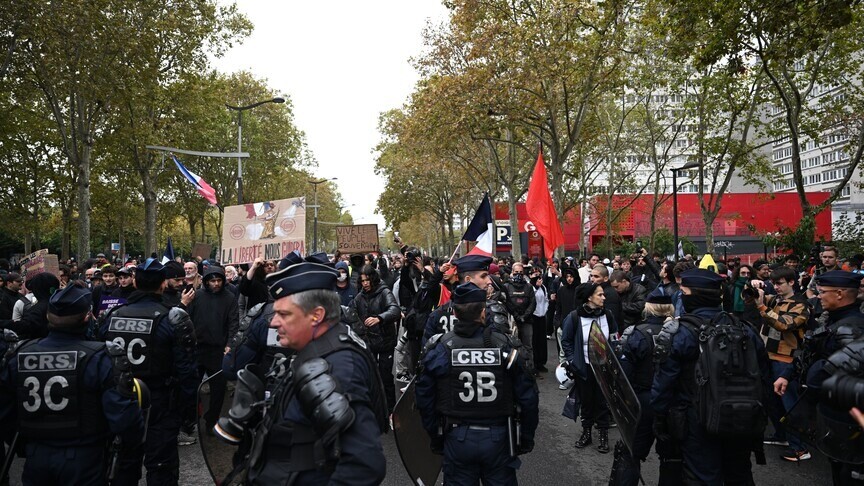
Against this backdrop, the moralizing of French ministers directed at Baku sounds like outright farce, as Aykhan Hajizada pointed out, calling on Paris to put its own house in order: "Instead of addressing the serious concerns related to the situation in France itself in the sphere of human rights and state governance, the French government prefers to pass judgment on the internal affairs of other states. The excessive use of force by French law enforcement agencies against demonstrators, including minors, has repeatedly caused serious concern. The existence of persons who sustained severe injuries during student protests in France, as well as the initiation of numerous investigations in connection with unlawful actions by police officers, further heighten this concern. In addition, the ongoing court proceedings and corruption investigations involving French political figures, including members of parliament, raise legitimate questions regarding the transparency, public accountability, and integrity of state institutions. Instead of selective criticism of other countries and politically motivated assessments, France should first and foremost focus on resolving the aforementioned problems within its own country."
Unfortunately, Nicolas Forissier's speech in the Senate is not an unfortunate slip by an individual official, but a link in a long chain of deliberate anti-Azerbaijani attacks. With an incomprehensible persistence bordering on obsession, Paris continues to churn out statements and communiqués whose sole aim is to torpedo the peace process between Azerbaijan and Armenia, to drive a wedge into regional stability, and to preserve at least the illusion of its influence in the South Caucasus.
But this strategy is doomed to failure. The authority of the current French government within its own country has sunk below the baseboard — its own citizens are denying it their trust, taking to the streets with demands for change. In such a situation, attempts to act as a foreign policy moralizer, inventing grievances where the law and international law are entirely on Baku's side, look not merely unconvincing, but frankly pathetic.
Recalling Ivan Krylov's immortal fable, French politicians, before lecturing others and making up tall tales about others' actions, would do well to ask themselves a simple question: "…wouldn't it be better, my dear, to turn and look at yourself?" Until Paris learns to hear its own people and to observe elementary norms of law at home, any of their groundless lectures will remain nothing but empty hot air.