Budget 2027: economic transformation, export ambitions and investment priorities

Azerbaijan is approaching the next stage of economic transformation with a markedly changed structure of its economy and sources of revenue.
The oil and gas sector is gradually ceasing to be the sole pillar of growth, the non-oil economy is expanding the tax base, domestic companies are entering foreign markets, and the state is preparing to hand over an increasingly large role in the investment process to private capital.
However, diversification is not only about increasing the share of the non-oil sector in GDP; it is a transition to a model in which the economy's resilience is determined by the ability to create new sources of revenue, attract long-term investment and compete in foreign markets.
It is precisely in this context that one should view the main parameters of the state budget for 2027 and the priorities for further development outlined by Minister of Economy Mikayil Jabbarov.
Speaking at a plenary session of the Milli Majlis during the discussion of the budget package, the minister presented not only an assessment of the results achieved, but also a list of tasks on whose resolution the economic dynamics of the coming years will depend.
The parameters of the draft reflect an important feature of the current stage: budget policy must simultaneously ensure the fulfillment of state obligations and preserve room for further economic transformation. Moreover, this concerns not only control over expenditures, but also the quality of their use, the ability of state institutions to ensure a return on every manat invested.
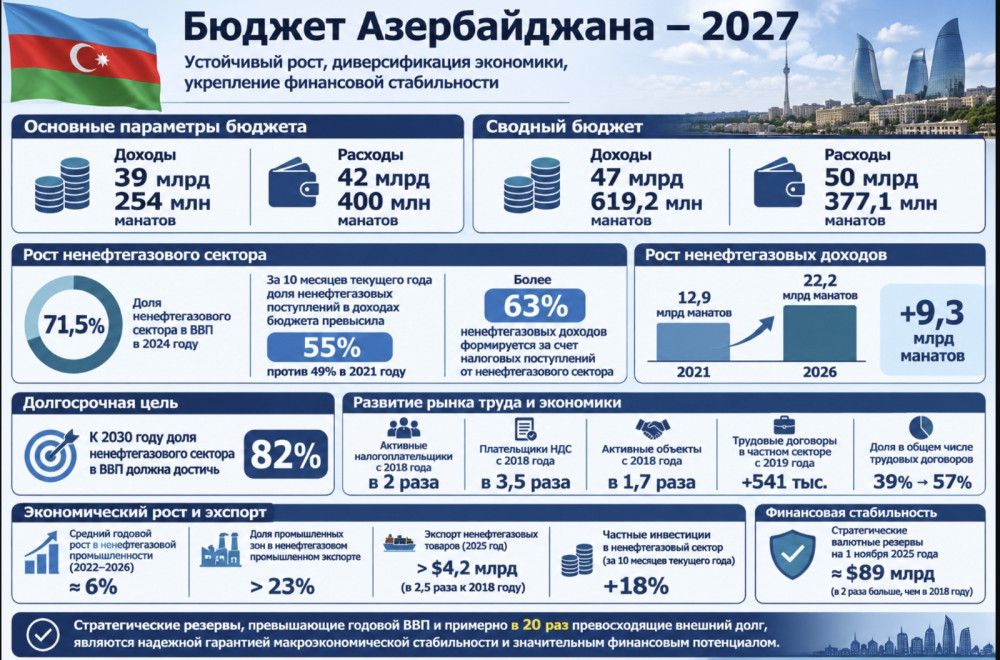
According to the document, state budget revenues for 2027 are projected at 39 billion 254 million manats, and expenditures at 42 billion 400 million manats. The deficit will amount to 3 billion 146 million manats, which exceeds the previous year's figure by 1.7%.
Consolidated budget revenues are projected at 47 billion 619.2 million manats, and expenditures at 50 billion 377.1 million manats. Its deficit will amount to 2 billion 757.9 million manats, which is 28.7% less year on year.
The non-oil economy strengthens its position
One of the most telling results of economic policy in recent years has been the change in the structure of GDP and budget revenues. Whereas previously the oil and gas sector determined the main dynamics of the economy, today non-oil production plays an increasingly important role in shaping economic growth.
As Mikayil Jabbarov noted, over the 10 months of this year GDP growth was ensured overall by the non-oil and gas sector. Last year its share in the nominal value of GDP reached 71.5%. "As a result of the president's political will and the development course he has defined, the economy's dependence on the oil and gas sector is consistently declining. As in recent years, over the 10 months of this year GDP growth was ensured overall by the non-oil and gas sector. Last year the sector's share in the nominal value of GDP reached 71.5%," the minister said.
No less important changes are taking place in the structure of state revenues. Over 10 months, the share of non-oil and gas revenues in budget income exceeded 55%, compared with 49% in 2021. More than 63% of the budget's non-oil and gas revenues are generated by tax receipts from the non-oil and gas sector.
Over the past five years, the budget's non-oil and gas revenues have grown by 9.3 billion manats — from 12.9 billion manats in 2021 to 22.2 billion manats in 2026.
Diversification acquires real economic content when the development of the non-oil sector is reflected not only in production indicators, but also in the ability of business to generate tax revenues, create jobs and provide alternative sources of economic growth. This is precisely what makes it possible to gradually reduce the economy's dependence on the conditions of energy markets.
Notably, a long-term goal has already been set: according to forecasts, by 2030 the share of the non-oil and gas sector in the country's GDP should rise to 82%. Achieving this indicator will require further expansion of the production base, increased competitiveness of domestic enterprises and entry into new markets.
Reforms that changed the economic structure
Behind the current results lies consistent work to change business conditions, expand formal employment and create incentives for the development of non-oil entrepreneurship. It is telling that a number of current economic indicators in fact correspond to the results that were forecast when the package of tax reforms was presented eight years ago.
Thus, since 2018 the number of active taxpayers has doubled, the number of VAT payers has increased 3.5-fold, and the number of active facilities 1.7-fold. The number of employment contracts in the private non-oil and gas sector has more than doubled since the beginning of 2019 — by 541,000 — while its share in the total number of employment contracts has risen from 39% to 57%. In the 10 months of this year alone, the number of employment contracts in this sector increased by 49,000. Tax revenues from the non-oil and gas sector grew by more than 13%. In 2022–2026, average annual growth in non-oil and gas industry will amount to about 6%.
These indicators characterize changes in several areas at once: the transparency of the economy is increasing, the tax base is expanding, official employment is growing, and the production component of the non-oil and gas economy is strengthening. The growth in the number of VAT payers testifies to an expansion of the tax base, while the increase in the number of employment contracts points to growth in official employment in the private sector.
At the same time, production infrastructure is expanding. The share of industrial zones in non-oil and gas industrial exports already exceeds 23%. The development of such sites makes it possible to concentrate production, infrastructure and investment, creating conditions for the formation of new industrial clusters.
By the end of this year, exports of non-oil and gas goods will exceed $4.2 billion. Compared with 2018, they will have increased 2.5-fold.
As can be seen, economic policy is gradually moving from stimulating domestic production to the next stage — increasing its export orientation. And here what matters is not only the volume of products manufactured, but also the ability of Azerbaijani companies to establish themselves in foreign markets.
New sources of revenue: state companies and foreign markets
Another area of transformation is the changing role of state companies in the economy. Whereas previously the effectiveness of their activities was assessed primarily in terms of fulfilling production and infrastructure tasks, now the ability to operate on commercial principles and deliver financial returns is becoming increasingly important.
Since 2020, Azerbaijan has been pursuing a policy of rehabilitating state companies. The transition to a holding management model, the introduction of corporate governance standards and other institutional measures are aimed at increasing their efficiency.
According to Mikayil Jabbarov, the result of these changes has been the ability of a number of state companies not only to operate more efficiently, but also to transfer dividends to the state budget.
This is an important shift in the approach to managing state assets. State ownership in itself should not mean a constant need for budget support. On the contrary, with competent management such assets are able to become an independent source of revenue, reducing the burden on public finances.
In parallel, the international presence of Azerbaijani business is expanding. The entry of domestic companies into foreign markets and the acquisition of foreign assets create additional opportunities for diversifying revenues. This is no longer only about exporting goods and services from Azerbaijan, but also about forming economic interests beyond the national market. In this way, Azerbaijani business is gradually expanding the geography of its activities, and the country's economy is gaining additional channels of integration into international markets.
Betting on private investment
However, further diversification of the economy is impossible solely at the expense of state resources. As the non-oil and gas sector expands and budget expenditures are optimized, the question of attracting private capital becomes increasingly relevant.
It is here that one of the most significant turns in economic policy is taking shape: the state is gradually moving away from a model in which it acts as the main investor, and is shifting to the role of a partner that creates conditions for implementing private projects and shares investment risks.
"In Azerbaijan, economic growth in the coming period will be ensured by private investment," the minister of economy stated. According to him, the first results of this transition are already noticeable: over the 10 months of this year, private investment in the non-oil and gas sector grew by approximately 18%.
Under conditions of fiscal optimization, state investments must become more selective, and their role must be supplemented by the investment activity of business. This requires not only tax incentives, but also a predictable regulatory environment, accessible financial resources and mechanisms for implementing long-term projects
In particular, the recently approved package of tax incentives for a period of up to 20 years for innovation, startups and technology parks is intended to stimulate investment in areas capable of becoming new drivers of economic growth.
Other instruments to support entrepreneurship are also expanding. Of great importance is the structural transformation of domestic demand and the increase in the share of local production in public procurement. This will make it possible to create new opportunities for domestic producers, generate additional demand for their products and gradually strengthen the position of local business.
But to implement such a model, one more problem needs to be solved — ensuring the availability of long-term financing.
Long-term financing: conditions for new growth
One of the challenges to which Mikayil Jabbarov drew particular attention is related to the limited availability of financial instruments for capital-intensive projects.
Industrial enterprises, infrastructure facilities and technological production require significant investment, and their payback period often exceeds the capabilities of traditional short-term lending. For this reason, the formation of long-term financing mechanisms is becoming one of the conditions for further industrial development. Work in this direction is already underway. This year, a legislative framework for venture and crowdfunding financing was created. At the same time, steps are being taken to prepare a new regulatory framework for capital markets and crypto assets.
It is also planned to stimulate long-term savings in the national currency and expand the sphere of cashless payments. All these measures are aimed at developing the domestic financial market and expanding the sources of capital available to entrepreneurs.
But Azerbaijan's financial capabilities are not limited to the domestic market. "Our strategic currency reserves exceed the external state debt, and this is a significant advantage for the country. Increasing the return on reserves and effectively directing a certain part of them toward long-term financing of the country's economy are also among the important tasks," the minister noted.
Thus, strategic reserves, which exceed annual GDP and are approximately 20 times greater than the external state debt, represent not only a guarantee of macroeconomic stability, but also significant financial potential.
At the same time, this is not about simply increasing state expenditures. The fundamental task is to increase the return on sovereign resources and determine effective mechanisms for their participation in the long-term financing of the economy, while maintaining the country's financial stability. Another aspect is also important: the presence of significant reserves does not eliminate the need to increase the efficiency of budget expenditures. On the contrary, the larger the scale of the projects being implemented, the higher the requirements for the quality of their planning and execution.
"Under conditions of fiscal optimization, the timely and maximally efficient spending of every manat allocated from the budget is of particular importance. Strict observance of project implementation deadlines and strengthening executive discipline are among the main tasks facing us," Mikayil Jabbarov said.
This is especially relevant given that Azerbaijan continues to finance large-scale restoration and construction projects in the liberated territories, while simultaneously fulfilling social and infrastructure obligations.
A new engine of growth
An additional strategic direction is the expansion of Azerbaijan's presence in international markets. At the same time, export policy is gradually moving beyond traditional commodity supplies: the export of services is becoming increasingly important. Transport and logistics, financial services, tourism, information technology and data centers — these are precisely the areas with the potential to generate new export revenues.
This approach makes it possible to use the country's geographical location, transport infrastructure and expanding international ties not only for the transit of goods, but also for providing services with high added value.
Accelerating export-oriented development also implies more systematic work with foreign markets. Many priority export areas are already covered by three state programs adopted in 2026. The next step is to identify the countries that will become priority markets for Azerbaijani business, and to establish free or preferential trade regimes with them.
Here, foreign economic diplomacy acquires particular importance. As a result of an active foreign economic policy, Azerbaijan has established strategic partnership relations with numerous countries. This forms a political and diplomatic basis for expanding trade and economic cooperation. However, to turn external ties into sustainable economic results, further work is needed to open markets, eliminate trade barriers and ensure favorable conditions for domestic producers.
A telling decision in this direction is the expansion of the opportunities of the Alat Free Economic Zone: its products will be supplied to the domestic market without the application of customs duties. This is an additional instrument for integrating the zone's production capacities into the country's domestic economy.
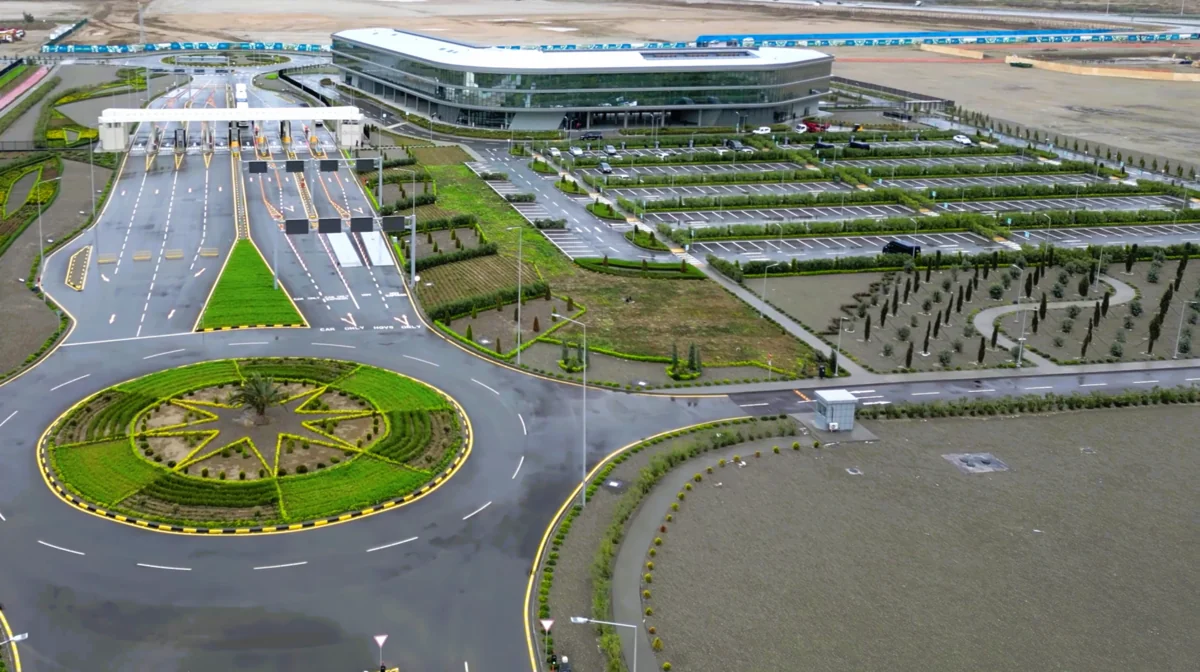
Ultimately, the important task is for Azerbaijani enterprises not to limit themselves to domestic demand, but to become full-fledged participants in international production and trade chains.
Against the backdrop of a changing world
All the priorities outlined acquire additional significance amid changes in the global economy. The restructuring of supply chains, the fragmentation of international trade and the changing configuration of energy and transport corridors create both new risks and opportunities for states capable of adapting to changing conditions.
In this context, Mikayil Jabbarov drew attention to the forecasts of the International Monetary Fund: "According to the October estimates of the International Monetary Fund, global economic growth in the medium term will remain at 3.2%, while a return to the pre-pandemic figures of 3.7% is not forecast."
Under such conditions, the resilience of the national economy is determined not only by the volume of accumulated resources, but also by the ability to manage them effectively, to respond in a timely manner to external changes and to create new competitive advantages.
Azerbaijan has already demonstrated that it is capable of solving large-scale state tasks relying on its own financial capabilities: "The country's defense capability has been strengthened, large-scale restoration and construction work has been carried out in the de-occupied territories, major social packages have been implemented, and the level of citizens' well-being has been raised. The key point is that all these tasks are being carried out exclusively at the expense of the state's own resources, without attracting borrowed funds. This year, along with fulfilling substantial expenditure obligations, as of November 1, 2026, the country's strategic currency reserves have doubled compared with the end of 2018 and amounted to around $89 billion."
This experience is of fundamental importance for understanding the next stage of economic development. If previously the key task was to create a financial and institutional foundation for fulfilling the state's historic obligations, now the formation of a self-sufficient, diversified and competitive economy comes to the fore.
This is precisely the main meaning of the current transformation — Azerbaijan seeks to move from a model in which the state's financial capabilities determined the main scale of economic development to a model in which new sources of growth are formed by business itself, by private investment, exports and production with high added value. The accumulated resources, the reforms carried out and the expanded international ties create the necessary prerequisites for this. The next test of economic policy is the ability to turn these advantages into sustainable growth.
Thus, the 2027 budget reflects not so much the completion of economic transformation as the transition to its next stage. The financial safety margin accumulated over previous years and the results of reforms have created conditions for a gradual change in the role of the state in the economy. Now the key indicator of success will be the ability of the private sector to independently provide new sources of growth, attract investment, expand production and compete in international markets. It is by these results that the effectiveness of the chosen economic model will be assessed in the coming years
Reports from the Report news agency were used in preparing this material