A year after Washington: The new reality of the South Caucasus and building peace
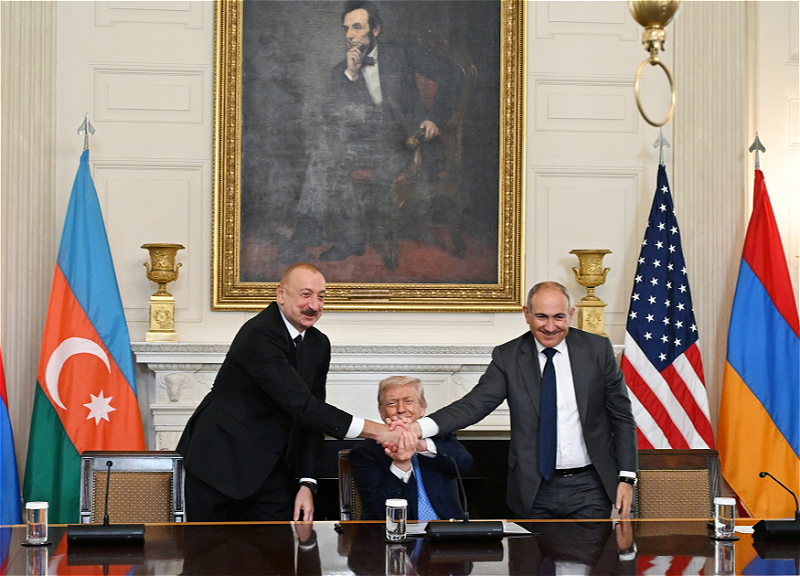
A year has passed since August 8, when the Washington summit entered the modern history of the South Caucasus as one of the central diplomatic events.
The Joint Declaration signed at the White House by the leaders of Azerbaijan and Armenia with the participation of the U.S. president and the initialed text of the peace agreement opened a fundamentally new stage in the life of the region. This step marked an epochal shift: the long period of hostility gave way to the practical construction of a new regional architecture of security and partnership.
Over the past twelve months, this new system has been filled with real practical content: the lifting of transit restrictions, the activation of transport and logistics projects, and the final dismantling of outdated external mediation institutions are creating a model of independent and sustainable regional development. The transition to direct bilateral dialogue has proven its effectiveness, turning the peace process from declarative to institutional.
Political analyst Elmira Talibzade, specially for 1news.az, sums up the past year, assesses the dynamics of the normalization of relations, and examines in detail what constitutes the new geopolitical reality of the South Caucasus today:
“If we assess the past year since the Washington meeting, it becomes clear how far the peace process has advanced. The new geopolitical reality has acquired a stable character not only on the bilateral track but also across the South Caucasus as a whole.
However, it is important to understand that this new reality did not originate in Washington. Its foundation was laid after Azerbaijan restored its territorial integrity in 2023, after which the negotiation process moved into a bilateral diplomatic format in Abu Dhabi thanks to the political will of the leadership of both sides. It was then that the negotiation matrix itself changed. The five principles proposed by Azerbaijan back in 2022 — mutual recognition of sovereignty and territorial integrity, renunciation of territorial claims, non-use of force, delimitation of borders, and establishment of diplomatic relations — became the substantive basis of the peace process.
Over the past year, this diplomatic work has received quite concrete continuation. Four meetings of expert groups were held, translating political agreements into practical terms. This is fundamentally important, as it indicates that ‘the mechanism continues to work’ and the normalization process has acquired its own institutional momentum.
At the same time, Azerbaijani diplomacy has indeed achieved a great deal during this period. Baku has managed to consistently remove the previous model of conflict from the international agenda and consolidate a new one, namely: sovereignty, territorial integrity, the opening of communications, and economic cooperation. What just a few years ago seemed like fantasy and was perceived exclusively as one side’s position has today become the basis of an internationally supported process.
The Washington meeting on August 8 with the participation of President Trump thus became not the beginning of the process but its most important diplomatic formalization. It is fundamentally important that Washington provided the political platform; however, responsibility for the substance of peace remained with the parties themselves. This is a far more sustainable model than previous formats, when the fate of the region depended to a significant extent on external mediators — and this experience, as we recall, was, to put it mildly, unsuccessful.
Over the past year, the practical substance of relations has also changed. This was perhaps most vividly demonstrated by events surrounding disruptions in shipping through the Strait of Hormuz, when Azerbaijan supplied Armenia with fuel and ensured the transit of goods from Russia and Kazakhstan through its territory. Even Prime Minister Pashinyan acknowledged that, under the prevailing conditions, ensuring alternative fuel supplies without Azerbaijan’s participation would have been significantly more difficult.
The next level is TRIPP, one of the most promising projects in recent years, and one that works in both directions. It involves connecting the main territory of Azerbaijan with Nakhchivan through Armenia’s territory and integrating this route into a broader East-West connectivity system. Once this project is implemented, the economic value of peace for all states in the region will increase substantially, and consequently, so will the cost of any potential conflict.
That is why I believe that today it is more accurate to speak not simply of a peace treaty but of the formation of a new regional architecture, which is composed of a number of decisive elements.
We should not forget the EU’s attention to the region, as clearly evidenced by the visits to Azerbaijan by Ursula von der Leyen, António Costa, and Kaja Kallas. Peace between Azerbaijan and Armenia is gradually ceasing to be solely a regional issue — it is becoming part of a broader European strategic agenda, as Brussels views our region through the prism of its interests in energy security.
Yet for all that, it would be wrong to say that the peace process is already complete or close to completion. The main outstanding issue remains the unresolved legal aspect. For Azerbaijan, it is fundamentally important that territorial claims be excluded not only from political rhetoric but also from Armenia’s constitutional and legal system. As we know, this concerns primarily the provisions of Armenia’s current Constitution, which, through reference to the Declaration of Independence, contain the idea of ‘reunification’ of Armenia and Karabakh.
Therefore, Baku rightly insists on amending the Constitution before the final signing of the peace agreement. In my view, this is an absolutely logical position: if states truly recognize each other’s territorial integrity, this principle must be enshrined not only at the diplomatic level but also in domestic legislation.
How close is Yerevan to this? There has been some progress in the political discussion, but practical steps in this direction are still insufficient to speak of readiness in the actual plane. Therefore, the constitutional issue remains the last major legal barrier before the final formalization of peace.
Nevertheless, practically everything else has changed: the territorial reality, the balance of power, the negotiation model, the transport geography, and the economic logic of the entire region.
Therefore, the question today is no longer whether it is possible to return the South Caucasus to the previous system. Over the past year since the Washington summit, Azerbaijan’s diplomacy has managed to consolidate the new reality, translate a significant part of the issues into the practical plane, and create conditions in which the next stage depends not so much on international mediation as on the sustainability of the political will of both sides and Armenia’s readiness to adopt the necessary internal legal decisions.”