From Moscow to Brussels — or to its own region: which path is Armenia choosing?
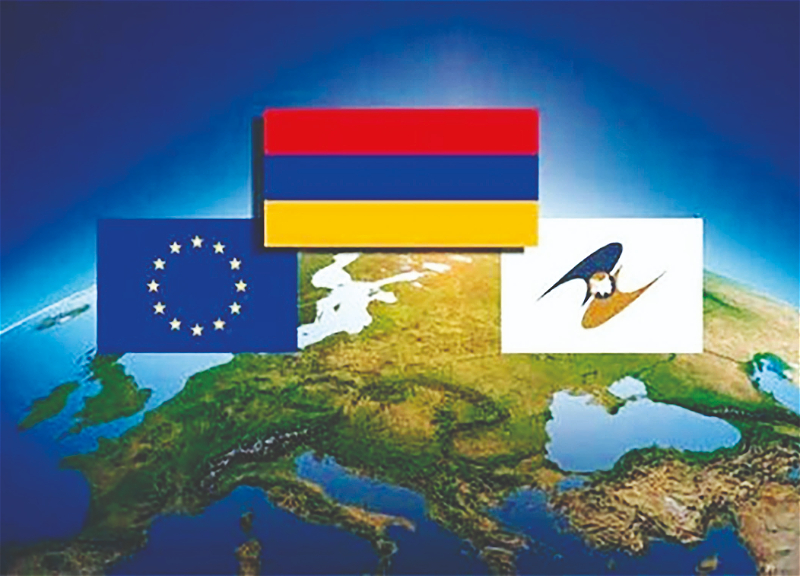
Armenia finds itself in a situation where Yerevan's economic and political choice is increasingly becoming the focus of attention of two centers of power at once — Russia and the European Union (EU).
At the same time, the Armenian authorities themselves are so far trying to maintain relations with Moscow while simultaneously expanding cooperation with Brussels. However, recent events show that the space for such balancing is gradually narrowing.
Another signal came on September 1 on the sidelines of the Shanghai Cooperation Organization (SCO) summit in Bishkek, where Armenian Prime Minister Nikol Pashinyan met with Russian President Vladimir Putin. While not long ago Yerevan was talking about a possible referendum on the issue of European integration, Pashinyan has now effectively abandoned this idea.
According to the Armenian prime minister, the adoption of a law on beginning the process of joining the EU does not in itself mean the need to immediately hold a referendum. In his words, the issue has not yet matured enough to be put to a vote of the citizens.
Putin did not agree with such an interpretation. The Russian president stated directly that Moscow needs to understand Yerevan's further foreign economic course, since the rules of the Eurasian Economic Union (EAEU) and the EU differ fundamentally in many areas.
At the same time, the Russian leader emphasized that Moscow respects the right of the Armenian people to independently determine the country's future.
"Whatever Armenia decides, so it will be. But we must adjust our trade and economic policy in connection with these possible decisions," Putin said.
It is precisely here that the main question arises: how long will Armenia be able to simultaneously maintain its former relations with Moscow and deepen integration with Brussels?
Armenian and Russian political experts shared their points of view with 1news.az.
Two unions — one economy
Armenian blogger and public figure Ishkhan Verdyan believes that the problem lies primarily not in politics, but in economics.

In his opinion, full membership in both the EU and the EAEU at the same time is impossible, since these are two different customs associations with their own rules.
"The incompatibility of Armenia being simultaneously in the EAEU and in the EU is obvious, because the matter here is not even about some political points, but precisely about economics. <…>
If Armenia becomes a member of the European Union, open trade relations will apply between it and other EU countries.
At the same time, Armenia is already a participant in the Eurasian Economic Union, within which an open market also operates. In that case, an economic contradiction arises: European goods will be able to enter Armenia duty-free as an EU member state, and then from Armenia just as duty-free reach Russia and other EAEU countries. From the point of view of economic logic, simultaneous participation in two associations with such free trade conditions is impossible," the expert noted.
At the same time, he considers Yerevan's current position vulnerable: if the Armenian side reserves the right to independently determine when the appropriate moment for a referendum comes, then Moscow effectively receives a similar right — to adjust its own economic policy depending on Yerevan's actions.
Russian historian, political scientist and expert on the post-Soviet space Aslan Rubayev, in turn, proposes separating political rhetoric from economic reality.
According to him, Moscow indeed proceeds from the incompatibility of Armenia's full membership in the EU and the preservation of membership in the EAEU. However, this does not mean that Russia is striving for an abrupt break with Yerevan.
"I would not say that Russia is interested in some abrupt break with Yerevan. On the contrary, the Russian position, in my view, is that as long as Armenia maintains the current format of relations with the EAEU, Moscow will be interested in preserving economic ties to the maximum," Rubayev believes.
That is, as long as it is a matter of declarations, Moscow is ready to maintain the previous model. But if Yerevan's European course moves from political statements to full-fledged accession to the EU, economic relations will inevitably have to be restructured.
"Russia will proceed not from political statements, but from new legal and economic realities.
Therefore, I would speak not about Moscow 'punishing' Armenia for its European choice, but about Russia preparing for the possibility that the previous model of relations may cease to exist," Rubayev noted.
The Russian market is closing — the European one is opening
Against this backdrop, trade policy takes on particular significance.
Since the end of May, Russia has been introducing restrictions on the import of certain categories of Armenian agricultural products. The Russian side explains this by identified sanitary, veterinary and phytosanitary violations. In Yerevan, however, such measures are often perceived as an instrument of political pressure.
Ishkhan Verdyan believes that the consequences of the Russian restrictions have turned out to be ambiguous.
According to him, the reduction of access to the Russian market has forced Armenian producers to look more actively for buyers in other countries. At the same time, the expert draws attention to the fact that the overall volume of Armenian exports, despite the change of destinations, has not changed significantly.
"Armenia is to a significant extent oriented toward trade and economic relations with Russia. Its economy is closely tied to the Russian market, and Armenia derives certain economic advantages from this cooperation. Therefore, from this point of view, Yerevan has no obvious reasons to give up existing benefits, just as Moscow has no interest in destroying the established economic ties with Armenia. <…>
But I think Armenia can in fact export everything that is made in Armenia. And it will find, I think, its buyers on the market," he said.
However, another problem arises here: finding a market for exports and replacing Russia as a source of imports are far from the same thing.
It is precisely this that the Russian expert emphasizes.
Rubayev notes that Russia and Armenia are connected not only by politics. There is trade, energy, transport, investment, labor migration and human ties formed over decades.
Therefore, in his opinion, any restrictions automatically acquire political significance, even if they are initially explained exclusively by economic or sanitary reasons.
"If a significant part of Armenian exports is traditionally oriented toward the Russian market, then a change in the conditions of access to this market is very painful for Armenian producers.
And here an interesting situation arises. If Moscow really is reducing opportunities for Armenian business in the Russian direction, then this simultaneously pushes Yerevan to look for alternative markets — primarily the European one. <…>
Economics becomes part of geopolitics. And this concerns not only Russia. Russia uses the economic instruments it has, and the EU in response offers Armenia its own economic incentives," the political scientist says.
Brussels offers an alternative
While Moscow speaks of the need to determine Yerevan's future within the framework of the EAEU, Brussels is offering Armenia new opportunities.
On September 2, the EU Council approved a temporary liberalization of trade with Armenia. The proposed measures are to abolish import duties for two years on a broad list of Armenian products and cover about 80% of Armenian exports to the European Union. The final decision must still go through the necessary procedures.
Back in June, the European Union announced the allocation of 34 million euros to Armenia to mitigate the consequences of the Russian trade restrictions.
The result is a kind of economic duel: Moscow is reducing opportunities for part of Armenian exports on its market, while Brussels is simultaneously offering Yerevan an expansion of its presence in the European direction. At the same time, European support for Armenia is hardly limited exclusively to economic interests. As cooperation deepens, Brussels may put forward more serious political demands before Yerevan as well, including further alignment of European rules and standards with Armenian legislation and foreign policy.
But to what extent is the European market capable of replacing the Russian one?
And here the experts' positions diverge.
Ishkhan Verdyan believes that Armenia needs to diversify not only its exports, but the very system of its foreign economic ties. However, in his opinion, the key to this is located not only in Brussels.
According to the Armenian expert, in the event of a serious deterioration of relations with Russia, Armenia will first of all have to pay attention to its own region.
"I think that as soon as significant trade relations are established between Armenia and Azerbaijan, and consequently Turkey, this will inevitably change the existing system of economic ties in the region. As a result, the map of political influence may also change substantially.
Russia, which today effectively possesses significant levers of influence in Armenia, may gradually lose part of its strategic positions. It is precisely such a prospect that the region faces today. <...>
Azerbaijan is fundamentally necessary for Armenia," Verdyan said.
He believes that it is precisely the opening of communications with Azerbaijan and Turkey that is capable of creating new opportunities for Armenia — from supplies of energy resources and food to access to the markets of Central Asia and Europe.
In this logic, European integration ceases to be the only direction. A much more complex configuration opens up before Yerevan: Russia — as a traditional economic partner, the EU — as a source of investment and technology, and Azerbaijan and Turkey — as immediate neighbors and potential transport and trade partners.
Aslan Rubayev generally agrees with this assessment, although he proposes looking at it somewhat differently.
"We are seeing not simply an 'Armenian turn to the West.' We are seeing an attempt by Yerevan to rebuild the very regional model of its security and economy," the political scientist notes.
In his opinion, the normalization of relations with Azerbaijan and Turkey may turn out to be an even more fundamental process for Pashinyan than European integration itself.
The reason is simple — geography cannot be changed.
"Armenia is located between Turkey, Azerbaijan, Georgia and Iran. If Yerevan manages to normalize relations with Baku and Ankara, open transport communications and reduce the level of regional confrontation, it will have a completely new economic configuration.
And then the EU becomes for Armenia not necessarily the final destination, but one of the external centers of power with which relations can be balanced. <…>
I would not say that Armenia is 'choosing Turkey and Azerbaijan instead of the EU.' Rather, Yerevan is trying to build a system in which Turkey and Azerbaijan become part of a new regional architecture, the EU — a source of investment, technology and political support, and Russia — at least in the economic dimension — retains the role of a most important partner.
And this, in my view, is far more interesting than the simple opposition of 'Russia versus Europe,'" Rubayev believes.
The main choice is still ahead
Thus, what is happening is difficult to reduce to the simple question "Moscow or Brussels?"
For Yerevan, the problem is considerably deeper. Armenia is trying simultaneously to preserve existing economic ties with Russia, expand relations with the EU and open new opportunities within the South Caucasus.
But such a strategy has a limit.
As long as Armenia remains a member of the EAEU and does not take a practical step toward full membership in the EU, room for maneuver remains. However, if European integration moves into the stage of real accession to European structures, Yerevan will inevitably face the question of the compatibility of the two integration models.
At the same time, Russia will also be forced to choose its own strategy.
Moscow may try to hold Armenia through political pressure and economic restrictions. But, as Rubayev warns, such tactics are capable of producing the opposite effect.
"Russia should not try to hold Armenia exclusively through political pressure. This would rather contribute to Yerevan's final departure from the Russian orbit," he believes.
It is far more rational, in his opinion, to maintain the attractiveness of the Russian direction and to show Armenian society the advantages of economic cooperation.
In the end, the current situation can indeed be compared to a kind of "triangle of interests." Moscow demands clarity and reminds of the EAEU rules. Brussels offers Yerevan new economic opportunities. And Armenia is so far trying to prove that it is still too early to make a final choice.
But the question already lies not only in whether it is Moscow or Brussels.
Perhaps Armenia's main choice today is between the former model of dependence on one center and a new regional system in which the key role will be played not only by Russia and the EU, but also by its closest neighbors — Azerbaijan and Turkey.
And the faster this system changes, the less opportunity Yerevan has to truly "sit on two chairs."
Lyaman Hasanova