'Free Palestine' and accusations of antisemitism: why Macklemore was removed from Ed Sheeran's tour
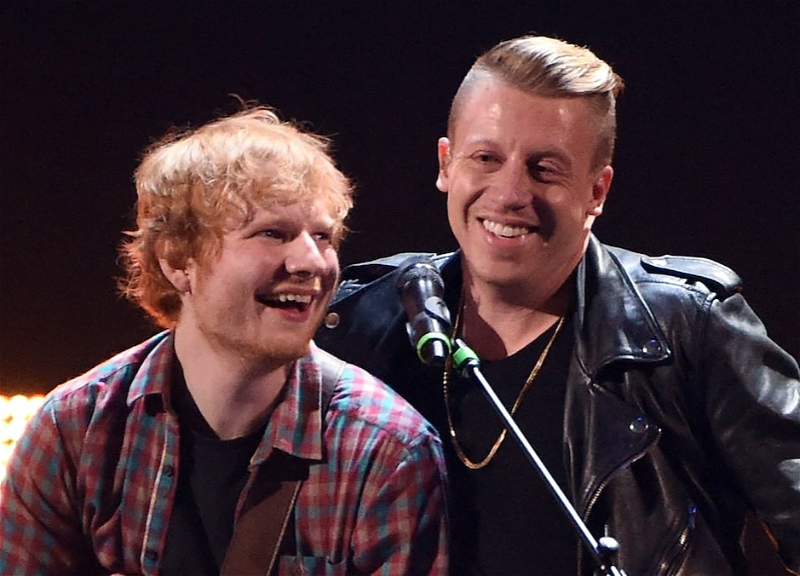
American rapper Macklemore will no longer perform as an opening act on Ed Sheeran's American tour after calling from the stage to "free Palestine."
Gillette Stadium owner Robert Kraft explained the ban on his performance in part by citing "the rapper's antisemitic rhetoric," Macklemore himself believes he is being silenced for his position on Gaza, and Sheeran maintains that the decision was made not by him but by the promoter and the venues.
The public on social media, meanwhile, responded overwhelmingly to the rapper's statement.
How it all began
Macklemore, whose real name is Benjamin Haggerty, opened for Sheeran at MetLife Stadium in New Jersey on September 4 and 5. According to Variety, the rapper told the audience that this was largely why he agreed to the tour in the first place: to step out onto a stadium stage and say "Free Palestine," and so that people in Gaza and the West Bank would know they had not been forgotten. He then performed the song Hind's Hall, while footage of the destruction in Gaza was shown on the stadium screens. He was wearing a keffiyeh.
The performance prompted a petition from the Israeli-American Council demanding that the rapper be removed from the remaining tour dates. The authors of the petition stated that the issue was not Macklemore's right to hold political views, but where the line lies when an opening artist uses a concert venue to promote a one-sided political agenda.
The position of singer Pink
A new wave of publications arose after singer Pink (Alecia Moore) reposted someone else's post criticizing Macklemore's performance. A wave of comments followed, and on September 11 the singer published a detailed statement.
Pink writes that she reposted a text that contained wording not all of which she herself would have chosen, and that she responded to the criticism that followed with sarcastic memes, which she acknowledges as her mistake. Explaining what exactly upset her, the singer recalls two episodes. In 2014, according to her, she applauded Macklemore at the Grammys, when 33 couples were married to his song Same Love, and four months later the rapper appeared on stage in a costume with a fake hooked nose and a black beard, calling it a "random costume." Pink writes that every Jewish person she knows understood what that was, but after the rapper's apology she let the matter go. In 2014, Macklemore apologized for that look, stating that he had not intended to mock Jews, and the Anti-Defamation League accepted his apology at the time. At Sheeran's concert, according to Pink, Macklemore, in front of a stadium full of families, with footage of the war on the screens, dedicated a song to a movement of his choosing, and then told the Jews present in the stadium that it wasn't about them. He has no right, the singer writes, to decide that for them.
Pink emphasizes that the reason for the repost was not the words "Free Palestine" and not anyone's right to say them: she has never demanded that another artist be silenced, is not seeking anyone's dismissal, and is not asking for ticket refunds. What she needs, she writes, is to be able to say, as a Jewish mother, that this frightened her and people close to her, and not to hear in response that their fear is propaganda and that she herself supposedly approves of genocide. The singer recalls that she has defended unpopular positions before: she performed the song Dear Mr. President criticizing the American authorities during wartime, supported LGBT teenagers, and handed out banned books. Now, she writes, she is standing up for her own people, and that has turned out to be an even lonelier undertaking than she expected. According to her, the comments under her posts include the slogan "From the river to the sea" and the word "Zionist" used as an insult.
Addressing those who are angry with her, Pink writes that it is not necessary to agree with her, and that in order not to wish fear and persecution upon a Jewish family sitting two rows below at a concert, one does not need to support the actions of the Israeli government. She separately addresses those who are frightened these days, listing Jews, Muslims, Palestinians, and Israelis.
The promoter's decision
On September 14, the promoter of the American leg of the tour, Messina Touring Group, announced that the venues of the upcoming concerts had notified it of their refusal to host shows with Macklemore in the lineup, which would have led to the cancellation of the tour and affected hundreds of thousands of spectators. After discussions with interested parties, the rapper will not perform on the remaining dates. The promoter did not name which venues specifically had imposed this condition.
Macklemore's position
That same day, Macklemore published a detailed twelve-slide statement on Instagram. He writes that the decision to remove him from the tour was made by Ed Sheeran and his team. According to him, at the height of the media noise surrounding Pink and his performance at MetLife, Sheeran told him about a call from Robert Kraft, the owner of Gillette Stadium, where concerts had been scheduled: Kraft allegedly stated that Macklemore would not perform at his stadium. In addition, as the rapper claims based on Sheeran's account, Kraft brought in the owners of other stadiums, and together they gave the singer an ultimatum: either Macklemore leaves the tour, or there will be no concerts at their venues.
Macklemore calls Sheeran a friend whom he has known for 13 years, and emphasizes that he is not writing out of a desire to hurt him. He describes the singer's position as extremely difficult: his customary apolitical stance has come under such pressure for the first time. According to the rapper, Sheeran told him that the words "Free Palestine" and the depiction of the Palestinian flag wound many of the people he had spoken with. Macklemore replied that if those words are more offensive to someone than the deaths of tens of thousands of Palestinian children, then there is a fundamental divergence between them; however, according to him, Sheeran never stepped back from his public position of "I don't take anyone's side."
The rapper notes that he has been saying the same words at concerts around the world for almost three years, and they became a problem only now, at the largest stadiums in the U.S. alongside one of the most popular artists in the world. He devotes a significant part of the statement to his position on the conflict: he insists that the victims in this story are not artists but Palestinians, cites a figure of more than 20,000 children killed in Gaza, argues that there is no neutrality between the oppressor and the oppressed, and that accusations of antisemitism are used to shield Israel from criticism. He concludes by saying that he hopes to preserve his friendship with Sheeran, and that if the words "Free Palestine" cost him the stage but brought attention back to Palestine, then it is the most successful tour of his life.
Robert Kraft's position
Kraft confirmed that same day that he made the decision regarding Gillette Stadium. His statement says that the stadium does not provide a platform for hate speech, and that given Macklemore's recent actions, the material shown from the stage in New Jersey, and what Kraft called a broader history of antisemitic rhetoric and imagery offensive to the Jewish community, the rapper's participation in the September 25 and 26 concerts would have crossed that line. Kraft also stated that his decision was not intended to diminish the suffering of Palestinian civilians or to deprive anyone of the right to speak out in their defense, and he offered to meet with Macklemore and discuss the facts. He left the rapper's claim that Kraft had persuaded the owners of other stadiums to make a similar decision unanswered.
Ed Sheeran's position
Sheeran responded on Instagram on September 15 with a six-slide statement captioned with a note that he considers it important to lay out the facts. He writes that he is horrified by the conflict between Israel and Palestine, and calls the suffering of both sides a human tragedy. According to him, Macklemore himself asked to join the tour, and Sheeran agreed out of respect for him as an artist; his opening acts choose for themselves what to play.
Sheeran confirms that after the concerts in New Jersey, the venues announced their intention to cancel the shows if Macklemore remained in the lineup. He was told that the reason was the way the rapper conveyed part of his message, not everything he said. All week, Sheeran writes, he held negotiations with the venues, including with Robert Kraft, as well as with promoters and activists from both sides, trying to find a solution, but the decision of the venues and the promoter turned out to be final.
The key point of his statement: it was the promoter, not he, who decided to remove Macklemore from the tour, and the rapper's contract was with the promoter. Sheeran said he could not cancel the concerts, since that would have hurt the audience, the touring crew, and other musicians for whom the tour is a job and a source of income.
Sheeran separately explains why he does not speak publicly about the conflict. He writes that he is not complicit, that he has personal views and supports certain initiatives in his own way, but that he does not use his professional platform for politics, since people of different backgrounds, including children, come to his concerts and do not expect a political forum. Sheeran notes that he respects Macklemore's resolve, but believes that different paths lead to peace, and that he himself prefers to preserve space for dialogue.
Reaction
The difference in the audience's response is clearly visible in the numbers. At the time this article was prepared, Macklemore's post had gathered about 6 million likes, 231,000 comments, and about 878,000 shares. That is roughly 17 times more likes than Sheeran's statement (about 356,000) and roughly 11 times more than Pink's post (about 542,000), under which commenting is restricted. Among the most popular comments under Macklemore's post, words of support predominate. Climate activist Greta Thunberg expressed full solidarity with the rapper and wrote that artists' silence in the face of injustice will not be forgotten; her comment collected about 293,000 likes.
Many musicians also came out in support of Macklemore. British singer Paloma Faith called him a rare and important voice. The pop group MUNA wrote that everyone involved in the attempt to silence free speech about genocide is pathetic, and expressed solidarity with the rapper. R&B singer Kehlani noted in a comment under Macklemore's post that many venues and their owners act this way in concert, and declared her support. The rock band Garbage called the decision insane and stated that there was neither violence nor hatred in the rapper's words, and that a call to end occupation and violence cannot be equated with antisemitism.
Sheeran also came in for criticism. Popular children's presenter Ms. Rachel wrote that the singer had an opportunity to show that supporting Palestine cannot be punished, but that he gave in to pressure, and that silence during a genocide is not a neutral position. Similar reproaches were voiced by ordinary social media users, who pointed out that by declaring neutrality, Sheeran had effectively taken a side.
Ed Sheeran's tour will continue on September 19 in Philadelphia, now without Macklemore.