Not just numbers: how Azerbaijan's new economic model is taking shape
A country's economy can be described in various ways — through growth rates, output volume, investment, exports, or social spending.
But sometimes a few indicators say far more about what is happening than lengthy economic reports. Especially when behind them lies not one-off statistics, but a consistent policy designed for years ahead.
These are figures behind which an entire economic concept can be discerned: $20 billion in investment, more than $30 trillion in assets under the management of the world's largest investment institutions, external debt at 5.6% of GDP, $90 billion in foreign currency reserves, 16 million tons of transit cargo and a stated target of 30 million tons — all of this is only part of today's key parameters of Azerbaijan's economic policy.
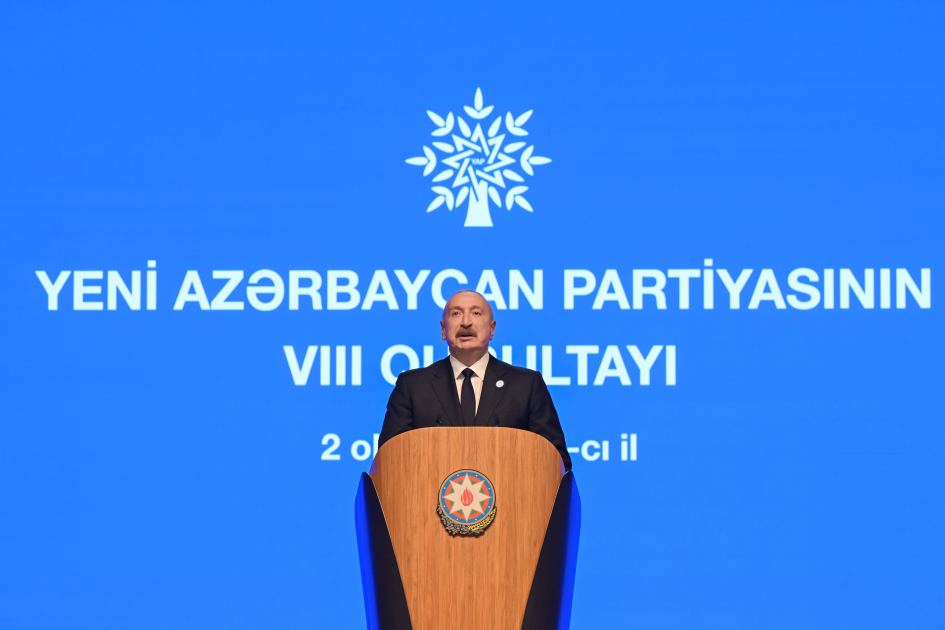
Behind each of these indicators lies a separate process. And if they are viewed not in isolation but as a single system, it becomes clearer why, in President Ilham Aliyev's programmatic address at the VIII Congress of the New Azerbaijan Party, economic, social, energy, and transport issues were presented as interconnected elements of a single strategy.
The social package
If state policy stands behind economic indicators, then its ultimate meaning is measured not only by volumes of investment, reserves, or transit. In the end, the economy must work to improve people's well-being. That is precisely why the social component occupies a special place in the president's address — economic sustainability here is directly linked to the growth of incomes, pensions, and social benefits. In his speech, the head of state announced a new stage of this policy: "Instructions have already been given — next year, the minimum wage, pensions, and social benefits will be raised. We regularly pursue this policy so that the well-being of the Azerbaijani people improves from year to year. But naturally, this requires economic development. True, the growth rates of gross domestic product are not measured in such large figures, but our overall economic potential is strong enough."
What matters in this statement is not only the announced measure itself, but also its economic logic. The increase in social payments is viewed not in isolation, but as a continuation of the course toward improving the well-being of the population, based on the capabilities of the economy. In essence, this is a new social package within the framework of the next stage of social reforms. The scale of this stage can also be assessed from budget parameters: according to the estimates presented, in 2027 more than 18.5 billion manats, or about 44% of total state budget expenditures, is planned to be allocated to the social sphere. The increase in all types of labor pensions is expected to affect around 1.1 million people.
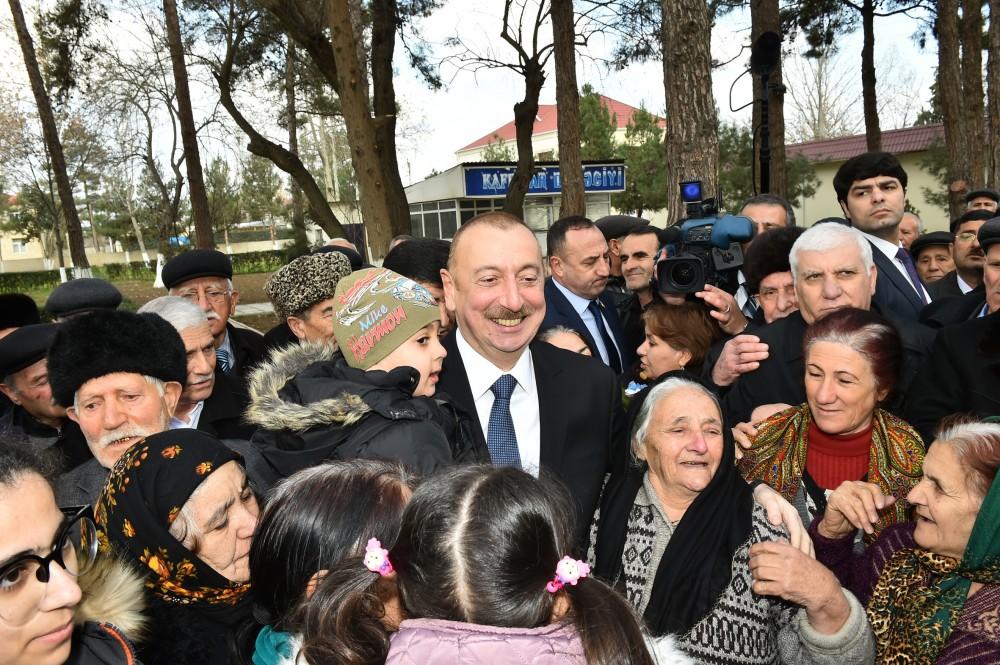
Thus, social policy in this case emerges as one of the key points where the country's economic potential is directly converted into an improvement in citizens' standard of living. At the same time, this concerns not only the size of specific payments, but also the state's ability to maintain a high level of social spending simultaneously with the implementation of other large-scale state priorities.
Investment as an indicator of confidence
The state's ability to consistently expand social obligations is directly linked to how sustainably the economy itself is developing. Under current conditions, sustainability is determined not only by government spending, but also by the inflow of private capital, the expansion of production, the development of new projects, and the attraction of investment from abroad.
That is precisely why investment becomes the next important indicator in this system. Moreover, this concerns not simply the funds attracted, but the willingness of international capital to enter the country's economy and participate in its long-term development.
Today there is fierce competition for investment in the global economy. States offer investors infrastructure, tax conditions, markets, human capital, political and financial stability. Therefore, the volume of investment contracts actually concluded becomes one of the indicators of how capable an economy is of attracting external capital.
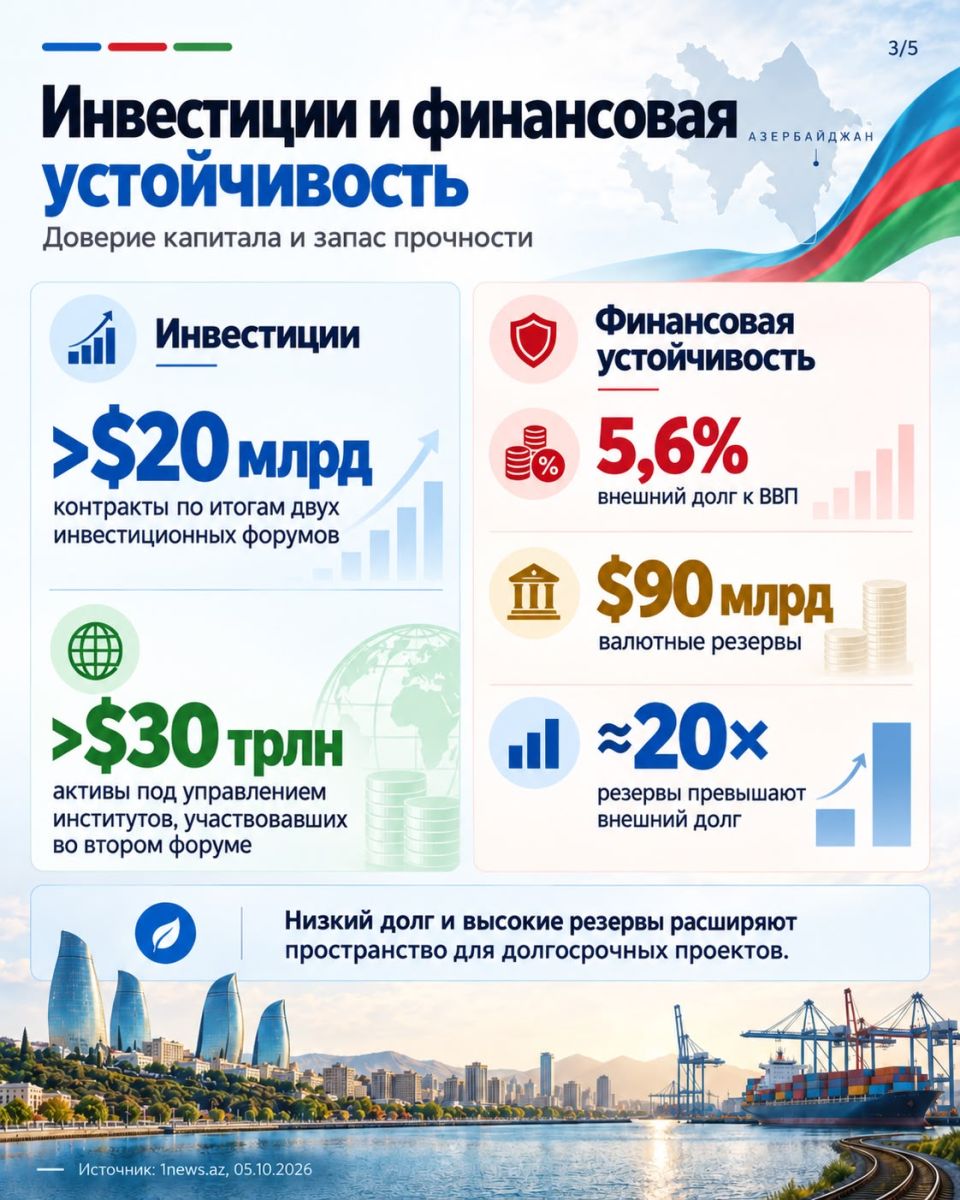
"In Azerbaijan, the International Investment Forum has been held only twice — in September of this year and last year. The total volume of investment contracts signed at both forums exceeds 20 billion dollars. That is, without investment no economy can develop. Government investment alone will not be enough here. We need investment from abroad — both in the oil and gas sector and in the non-oil and gas sector," Ilham Aliyev emphasized.
Here, the very combination of two directions — oil and gas and non-oil and gas — is fundamentally important. For an economy a significant part of whose export potential has historically been linked to hydrocarbons, attracting capital into non-resource sectors has particular significance.
The figures cited demonstrate the scale of the context. The head of state regards this as confidence in Azerbaijan's economy: "Look, the Second Investment Forum, held at the end of September, was attended by the world's leading investment institutions. The volume of funds under their management exceeds 30 trillion dollars. That is, it is not hard to imagine what level of people — and the heads of these companies and investment funds came here — cooperate with Azerbaijan and want to cooperate in the future."
As can be seen, Azerbaijan is already becoming part of the field of interest of global investment players, for whom decisions are measured in trillions of dollars. But investment appeal is not only the ability to attract capital; no less important is the question of the financial sustainability of the state itself.
Debt as an indicator of financial sustainability
Against the backdrop of the global economy, where a high level of government debt remains a serious challenge for many countries, another indicator looks especially notable — the level of Azerbaijan's external debt. "For many years we have followed the path of gradually reducing our external debt. At one time, I set the task of bringing it to 10 percent of gross domestic product. Today our external debt amounts to 5.6 percent of the country's gross domestic product. And this is one of the lowest figures on a global scale. I can say that in all developed countries it is either 100, or 110, or 120 percent. Speaking at the investment forum, I also said that, if we wished, we could reduce our debt to zero within 24 hours. What does this mean? It means that we will not leave a debt burden to future generations. In order for our economic development to advance at an even higher pace, we will implement investment projects more actively," the president says of this.
5.6 percent is an indicator that works especially well in comparison. It makes it possible to shift the conversation about government debt from an abstract plane into an understandable proportion: how large external debt is relative to the size of the economy. At the same time, the president linked the low level of debt not simply to current financial policy, but to the principle of intergenerational responsibility — this concerns the aspiration not to transfer the debt burden to future generations.
A margin of safety
Financial sustainability is especially telling when the state bears large expenditures simultaneously. In Azerbaijan, such areas are defense and security, strengthening the army, restoration of the liberated lands, and infrastructure projects. The president calls economic and financial stability "a very serious factor in our success." "Despite enormous expenditures — on military matters, army building, border protection, the restoration of Karabakh — we increase our foreign currency reserves from year to year, and they have already reached 90 billion dollars, which is approximately 20 times greater than our external debt. If anyone finds a second such country, let them tell me, so that I too may know," he emphasized.
The Azerbaijani leader does not simply name the figure of the reserves — in the structure of his address it is contrasted simultaneously with large expenditures and external debt. In other words, the logic looks like this: the state finances large-scale projects, continues spending on security, carries out the restoration of the liberated territories — and at the same time maintains a significant volume of foreign currency reserves. It is precisely the combination of these factors that constitutes the main content of this indicator.
Energy resources and geopolitics
Today energy has once again found itself at the center of world politics. Conflicts, the disruption of traditional supply routes, competition for markets, and states' striving to ensure energy security have made the reliability of suppliers a strategic issue. In this system, Azerbaijan occupies a special position thanks to a combination of oil, gas, electricity, and other capabilities.
The president formulated it as follows: "The new geopolitical and economic reality is that today many countries cannot obtain energy resources as they did before. And here Azerbaijan is once again one of the rare countries that produces, extracts, and exports all types of energy resources on a global scale — crude oil, petroleum products, natural gas, electricity, petrochemical products, and fertilizers. And the main source for their production is energy."
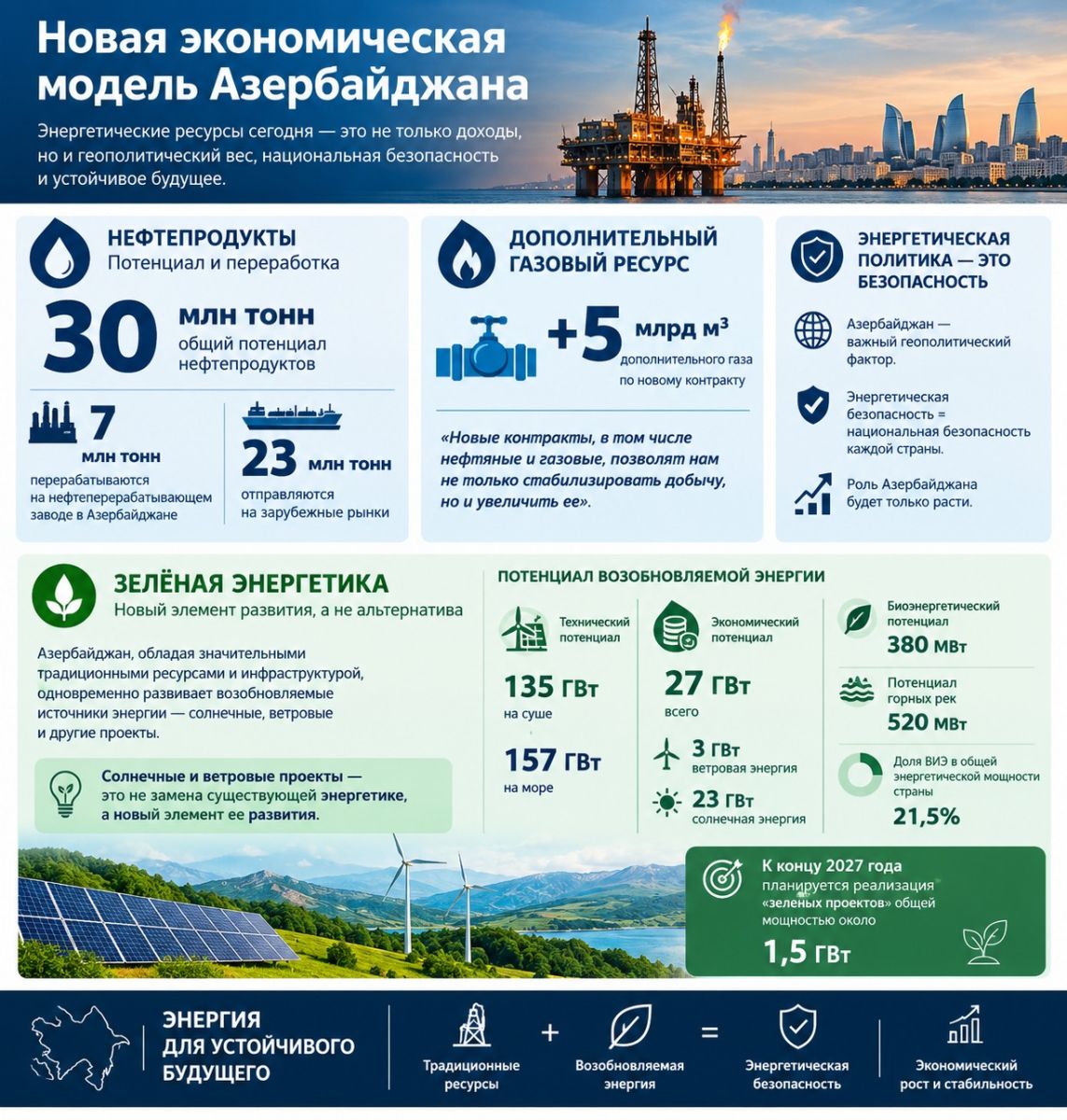
This is an important transition from the concept of an "oil and gas economy" to a broader understanding of energy potential. Azerbaijan possesses not only resources underground. Over the decades, infrastructure for extraction, processing, transportation, and export has been created. It is precisely infrastructure that turns a resource into an economic and, under certain conditions, a geopolitical factor. The president separately noted the potential of petroleum products — 30 million tons. Of these, 7 million tons are processed at the oil refinery in Azerbaijan, and 23 million tons abroad. "Today there are not many countries possessing 30 million tons of petroleum products — and moreover not in one place, but in three. Therefore, I repeat, if we take into account that, unfortunately, the wars around us do not cease — we would very much like them to cease, but they do not cease — demand for our products and our gas will increase even more," the Azerbaijani leader emphasized. "Therefore, Azerbaijan, rich in energy resources, is today turning into a very serious geopolitical factor and security factor. Since energy security means the national security of every country, our role will continue to grow."
It is noteworthy that some of the contracts signed within the framework of the investment forums will lead precisely to an increase in gas and oil production: "Our largest oil field — Azeri-Chirag-Gunashli — has been in operation for more than 30 years, and a natural process of declining production is under way there. Therefore, the newly signed contracts, including the oil fields we have acquired in foreign countries, will give us the opportunity not only to stabilize production, but to increase it. Including the gas contract signed last month — just one contract — will give us an additional 5 billion cubic meters of gas."
At the same time, energy policy is not limited to preserving traditional oil and gas potential. In parallel, the "green energy" direction is developing, including projects in the field of renewable energy sources. It is worth noting that the technical potential of green energy sources is estimated at 135 GW onshore and 157 GW offshore. The economic potential amounts to 27 GW, including 3 GW of wind energy and 23 GW of solar energy. Bioenergy potential is estimated at 380 MW, and the potential of mountain rivers at 520 MW. Today renewable energy sources account for approximately 21.5% of the country's total energy capacity. But even this figure is viewed as intermediate. By the end of 2027, the implementation of "green projects" with a total capacity of about 1.5 GW is envisaged. It is precisely here that the logic of the ongoing changes becomes especially noticeable. This is not about a simple choice between traditional and "green" energy. Azerbaijan, possessing significant traditional energy resources and infrastructure, is simultaneously creating additional generation based on renewable sources. In this system, solar and wind projects become not an alternative to the existing energy sector as such, but a new element of its development.
This is especially important at a time when energy security is increasingly regarded by states as part of national security.
Logistics: from dream to reality
If energy gives Azerbaijan a resource and export base, then the transport and logistics system creates another channel of economic influence — through the movement of goods. Geography in this case becomes an economic asset only when the appropriate infrastructure has been created for it.
In recent years, Azerbaijan has invested in the development of transport infrastructure, port capabilities, railways and highways, the customs and logistics system, as well as in the development of international transport corridors. The president emphasizes: "this is a long-term strategy."
"This year the expected volume of transit cargo passing through the territory of Azerbaijan will reach 16 million tons. That is, this is enormous growth. At one time we dreamed of 3–4 million tons. We created the infrastructure, established contacts, including taking the necessary administrative measures, and made these corridors — the Middle Corridor and the North-South Corridor — very attractive. However, we are halfway there. I have set the goal that transit cargo passing through the territory of Azerbaijan should reach 30 million tons in the medium term. Imagine how much additional funding will come to us, thousands of jobs will be created, and the importance of our country will grow even more," the head of state said.

Here the dynamics are especially clearly visible: this is a story of change in the scale of Azerbaijan's transport function. Once the stated goal is achieved, the economic effect will be expressed not only in transit payments — demand will grow for logistics, warehouses, service offerings, repairs, insurance, railway and port capacities. That is, transit is capable of creating around itself an entire chain of additional types of economic activity.
The liberated lands: the economy of restoration
All these processes are taking place in parallel with one of the largest state programs — the restoration of Karabakh and East Zangezur. This direction has an economic, social, and infrastructural dimension at the same time.
Today 96,000 people live, work, and study in Karabakh and East Zangezur. "To date we have allocated 28 billion manats to the development of these regions. The overwhelming majority of this was directed to infrastructure projects, and a significant part of them has been completed. At the same time, today former internally displaced persons have already settled in 48 population centers, and in subsequent years the Great Return will proceed at an even faster pace," the head of state emphasized.
This is another set of indicators that shows the scale of the changes taking place. It would be wrong in this case to reduce the restoration of the liberated territories only to the construction of new homes. This is about creating a full-fledged environment for people's lives: roads, energy, water, communications, social infrastructure, jobs, education, medical services. Therefore, the restoration of Karabakh and East Zangezur is gradually becoming part of the country's broader economic geography.
What unites all these figures
If only a few of the indicators listed are put on the screen, one can see a set of impressive figures.
$20 billion — the volume of investment contracts concluded as a result of two International Investment Forums.
$30 trillion — the volume of funds under the management of the world's leading investment institutions that participated in the Second Forum.
5.6% — the ratio of Azerbaijan's external debt to GDP.
$90 billion — the volume of foreign currency reserves.
16 million tons — the transit cargo flow expected this year.
30 million tons — the medium-term transit target.
Each of these figures relates to a separate sphere. But together they form a single economic picture: investment, financial sustainability, energy, and logistics must reinforce one another.
Investment makes it possible to create new capacities. Financial sustainability gives the state room for long-term projects. Energy infrastructure provides export opportunities. Transport corridors turn geographic location into a source of revenue and new connections. The restoration of the liberated territories forms a new economic territory within the country.
That is precisely why social policy was placed at the beginning of the economic section in the president's address. Increases in wages, pensions, and social benefits are the end point of a much longer chain that begins with economic activity, investment, production, exports, logistics, and financial sustainability. Ultimately, an economic strategy is tested by how these figures are transformed into new jobs, incomes, infrastructure, business opportunities, and quality of life.
That is precisely why the most important thing on the current economic agenda is the ability to connect the above-mentioned indicators into a working system. In that case, figures cease to be mere statistics.
They become a way to see the direction in which the economy is moving — from accumulated resources to new opportunities, and from individual projects to a larger-scale economic infrastructure for the country.