UN crisis: Baku has formulated a prescription for rehabilitating international law

The resolution has been adopted. The demand has been formulated. The international community has expressed its position.
But what happens if a state simply refuses to comply with a decision of the UN Security Council? It is precisely here that the weakness of the international system is revealed: it is capable of recording violations, but by no means always of ensuring that they are eliminated.
The United Nations — created in the middle of the last century as the chief guarantor of the maintenance of international peace and security — is today experiencing the deepest systemic crisis. An institution called upon to ensure compliance with international law is demonstrating impotence in the face of aggression, while the principles it has proclaimed are giving way to political expediency and double standards.
At a time when the world map is rapidly being covered with hot spots, local clashes are escalating into protracted wars, and global crises remain for years without any real solution, the UN's inability to offer effective response mechanisms is becoming ever more obvious. The organization, called upon to prevent catastrophes, often limits itself to stating what is happening, its decisions remain on paper, and the mechanisms of collective security turn out to be hostages of individual interests.
President of Azerbaijan Ilham Aliyev, in his speech at the opening ceremony of the 7th World Forum on Intercultural Dialogue, gave a clear and uncompromising assessment of the current reality: "Today, when we see how new wars break out almost every year, it becomes clear that it is very difficult to put an end to war. It is very easy to start wars, but it is very difficult to end them, and it is also very difficult to win."
The modern history of Azerbaijan has particular significance in this context. "The experience of Azerbaijan, when we won a war that was just, and when the losing side capitulated, and after that we did not go further, we stopped when the time came to stop, and we proposed peace, should be studied by those who are now at war and probably do not know how to stop it. Therefore, I believe that our experience will be very valuable in understanding which of the precedents we have created can be used to settle some conflicts. Yes, it is true that all conflicts differ from one another, but the basis of all conflicts is the same. It is ambitions, it is aggression, it is a sense of superiority. It is the feeling that you will not be punished for what you do to those whom you attack, and, unfortunately, sometimes this lasts forever. In our case it lasted 30 years, but we put an end to it. And, as I have already said, we acted in full compliance with international law," the head of state stated.
So why do resolutions adopted at the highest level remain nothing but paper for years? The answer is simple: the structure of the UN lacks a real, fast-acting mechanism, binding on all, for implementing the decisions adopted. A paradoxical situation has developed: an international institution issues a verdict, but has no instruments for its enforcement if this does not meet the interests of individual players.
Azerbaijan encountered this injustice directly. Four UN Security Council resolutions, adopted in 1993 and demanding the full, immediate and unconditional withdrawal of occupying forces from Azerbaijani territories, remained unfulfilled for nearly 30 years. The UN never did activate effective mechanisms of coercion that could have ensured the implementation of its own decisions.
The root of the problem lies in the selective application of international law and the absence of effective mechanisms that would ensure the implementation of adopted decisions regardless of political interests. President Ilham Aliyev points directly to this systemic flaw, drawing attention to the need to reform the mechanisms for implementing UN Security Council resolutions: "Another issue that should also be taken into account is the mechanism for implementing the decisions of international organizations. At present, many people are talking about reforms in the United Nations. I do not want to go into detail, but I believe that one of the important issues should be the mechanism for implementing UN Security Council resolutions. As I have already said, we were in this situation for thirty years. The UN Security Council adopted four resolutions that contained a demand to liberate the Azerbaijani territories. They were not implemented. There was no mechanism for their implementation. No sanctions were imposed on Armenia."
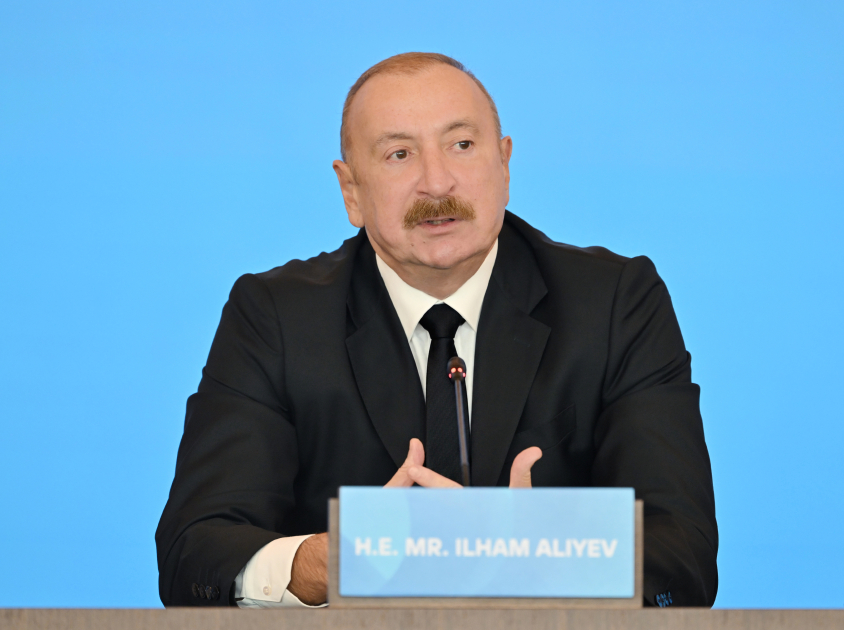
The selectivity of the international reaction is especially clearly manifested in the practice of sanctions policy. When restrictive measures become one of the main instruments of international pressure, the absence of any consequences for many years of occupation of territories, war crimes, mass violations of human rights, and the disregard of UN Security Council resolutions lays bare the obvious asymmetry in the approaches of the world community. The President of Azerbaijan calls precisely such inconsistency a manifestation of double standards, emphasizing that they undermine confidence in international law and must not remain the norm of world politics: "Now, wherever you look, there are sanctions everywhere. If you look from Azerbaijan to the North and to the South, you can see hundreds of sanctions. But Armenia was not subjected to sanctions, and this is a matter of double standards. This is nothing other than double standards, and we have always fought and will continue to fight against double standards in politics. This is one of the important elements of our foreign policy, because we suffered from it and still continue to suffer. Of course, the word 'suffering' as applied to today's situation may perhaps sound too harsh. In fact, it is not suffering, because we have already achieved what we wanted and live freely on our own land. But nevertheless, the policy of double standards must be completely eradicated from international politics."
Double standards are manifested not only in the absence of sanctions, but also in the very assessment of the consequences of conflicts, the scale of violations of international law, and responsibility for them. The Azerbaijani experience demonstrates how great the gap is between the gravity of the deeds committed and the international reaction to them. Focusing attention on the concrete consequences of the occupation of Azerbaijani territories and the absence of commensurate measures of international influence, the head of state emphasized that "this is manifested not only, for example, in the approach to various wars and conflicts." He stated that Armenia occupied almost 20 percent of the internationally recognized territory of Azerbaijan, pursued a policy of ethnic cleansing, which led to the deportation of a million Azerbaijanis from their historical lands, destroyed our religious and historical monuments, including 65 mosques in Karabakh, and was not subjected to sanctions and punishment. "So this is what double standards are," Ilham Aliyev stated.
The President of Azerbaijan has repeatedly raised the question of the need for effective mechanisms to implement UN decisions. One of the latest examples was Ilham Aliyev's speech at the beginning of September at a meeting in the "SCO Plus" format in Bishkek, where he again recalled the four UN Security Council resolutions that were implemented 30 years later: "But, unfortunately, the UN played no role in the implementation of these resolutions. Azerbaijan itself fully restored its sovereignty and territorial integrity. The implementation of UN Security Council resolutions within a short time frame requires the development of appropriate mechanisms. If this is done, it will contribute to enhancing the authority of the UN and the organization's role in settling conflicts."
It is noteworthy that UN Secretary-General António Guterres also took part in the summit. This lends particular relevance to the problem raised: the question lies in the organization's ability to eliminate its key flaws. The authority of the UN is determined not by the number of meetings and documents adopted, but by whether its decisions are capable of ensuring real change. If international obligations remain on paper, then confidence in the institutions called upon to guarantee their observance inevitably weakens.
Another manifestation of the crisis of the contemporary international system is the striving of individual states and political institutions to arrogate to themselves the right to determine how other countries should live, what decisions they should make, and according to what model they should develop. Such a practice has nothing in common with the equality of sovereign states, substituting dictate for international cooperation, and a claim to political and moral superiority for respect for international law. Instead of strengthening trust, such an approach deepens disagreements and creates new sources of tension.
Amid the formation of a new world order, respect for sovereignty and non-interference in internal affairs acquire particular significance. President Ilham Aliyev consistently upholds the principle according to which no state has the right to impose on others its own notions of the proper political order and way of life. This position touches upon a fundamental question of international relations — the right of every people to determine its own future independently: "But double standards are not only that. Double standards are also when someone takes it into their head to teach you how to live. Although before doing so, one should take a look at one's own reflection in the mirror and ask: do I have the moral right to lecture someone, to lecture an independent country on how it should live, what to do and what not to do? We never act that way. We are focused on our own affairs, and what happens in other countries is the business of the peoples of those countries. It is not our business. Therefore, we expect and seek the same attitude toward ourselves. And any sign of disrespect, any sign of an unfounded sense of superiority and an unfounded opinion that someone can dictate something to us, has met and will always meet our resistance and a very firm approach. Therefore, I believe that if the international community agrees to these basic rules of international conduct, there will be fewer conflicts, fewer problems and more cooperation."
Against the backdrop of the inability of international institutions to prevent protracted conflicts, the practical experience of states that have managed to restore violated justice and achieve an end to war acquires particular significance. The Azerbaijani experience in this context deserves separate attention, raising the question not only of the reasons for the ineffectiveness of existing mechanisms of international security, but also of what lessons the world community can draw from the real results of settlement. However, even the results achieved do not mean that threats to international security are a thing of the past. The world has entered a period of heightened instability, when the end of one conflict does not guarantee the prevention of new ones, and existing contradictions are capable of escalating at any moment into yet another crisis. Under these conditions, it is not enough to rely on international guarantees — states need to remain vigilant, objectively assess risks, and be ready to defend their national interests. President Ilham Aliyev draws attention to this reality as well: "We live in an unpredictable world where, as I have already said, conflicts begin and never end. Therefore, of course, we always need to be very attentive to potential risks and protect ourselves from any possible complications."
Of course, reforming the UN cannot in itself eliminate all the causes of wars and crises. International institutions cannot replace political will, the responsibility of states, and the readiness to seek compromises. But they are capable of creating conditions under which diplomacy becomes more effective, violations of international law do not go without consequences, and the settlement of conflicts ceases to depend exclusively on the balance of military and political forces.

Here the link between security and dialogue is especially important. A durable peace does not arise merely because hostilities have ceased or an agreement has been signed. It requires recognition of the legitimate interests of the parties, renunciation of a policy of superiority, respect for sovereignty, and a readiness to interact even amid serious disagreements. And the weaker the international mechanisms, the harder it is to maintain this culture of cooperation at the global level.
That is precisely why the theme of the 7th World Forum on Intercultural Dialogue — "Dialogue for the Sake of a Common Future" — sounds today not as an abstract humanistic appeal, but as a response to the real contradictions of the modern world. Dialogue is necessary so that states can work out common solutions, overcome mutual mistrust, and find points of contact where unilateral actions only deepen the crisis.
Baku, hosting the forum, is becoming a venue for discussing this task at a moment when previous approaches to international security are ever more frequently demonstrating their limitations. And the genuine result of such meetings is manifested in the participants' readiness to translate dialogue into practical decisions — from the prevention of conflicts to the strengthening of international institutions and ensuring the fulfillment of commitments undertaken.
The world cannot afford to choose between dialogue and justice: without the former, durable accord is impossible; without the latter, trust in it inevitably collapses. And if the UN is called upon to remain the mainstay of international order, it must prove that the collective will of states is capable of being something more than a sum of declarations. Ultimately, the future of this organization depends on the answer to a simple but fundamental question: will the world community be able to turn common words about peace and international law into rules that are binding on all — without exceptions and double standards?