From the "Oil Rocks" to the Middle Corridor: Baku and Hanoi are building a new architecture of partnership

Amid the transformation of the global economic and political architecture, the geography of international cooperation is acquiring ever greater strategic importance for states.
The former regional frameworks are gradually giving way to a broader system of interconnections, in which political influence, economic opportunities, energy security, and transport connectivity are becoming mutually complementary elements of foreign policy.
For Azerbaijan, which is consistently strengthening its positions on the international stage, expanding partnership ties beyond traditional geographical directions is not merely a diplomatic task but part of a long-term strategy.
In this context, the development of relations with Vietnam — a state that over recent decades has turned into one of the most dynamic participants in the economic processes of Southeast Asia — acquires particular significance. Nearly seven decades of history link our countries, yet today these relations extend far beyond historical solidarity and traditional friendship. The transition to a strategic partnership opens up opportunities for forming new economic ties, implementing joint projects, and strengthening mutual positions in the Eurasian space.
The upcoming official visit of Azerbaijani President Ilham Aliyev to Vietnam on November 19–21 is yet another testament to this dynamic. Its significance lies not only in the continuation of political dialogue at the highest level, but also in the need to translate the agreements already reached into practical terms. The interview given by the President of Azerbaijan to the Vietnam News Agency (VNA) on the eve of the trip makes it possible to trace the logic behind the development of bilateral relations, to identify their current priorities, and to assess the areas in which cooperation could see the most substantial development.
Historical foundation
Relations between Azerbaijan and Vietnam have a feature that distinguishes them from many other interstate contacts: their foundation was laid long before the emergence of the current economic and geopolitical prerequisites for rapprochement. The partnership was initially based not only on political interests, but also on concrete interaction that left a notable mark on the history of both countries.
A landmark event was Ho Chi Minh's visit to Baku in July 1959. Familiarization with Azerbaijan's oil industry, in particular with the experience of offshore production in the Caspian Sea, became the starting point for the development of professional contacts, which subsequently acquired a broad character. Azerbaijani specialists made a substantial contribution to the establishment of Vietnam's oil-producing industry. A particularly important stage was the creation in 1981 of the Vietsovpetro enterprise, in whose activities up to 2,000 Azerbaijani oil workers took part.
A powerful impetus to this process was given by the eight-day visit of national leader Heydar Aliyev to Vietnam in 1983 in his capacity as First Deputy Chairman of the USSR Council of Ministers. The agreements reached gave a powerful boost to the development of the Vietnamese economy and set the vector for many years of cooperation.
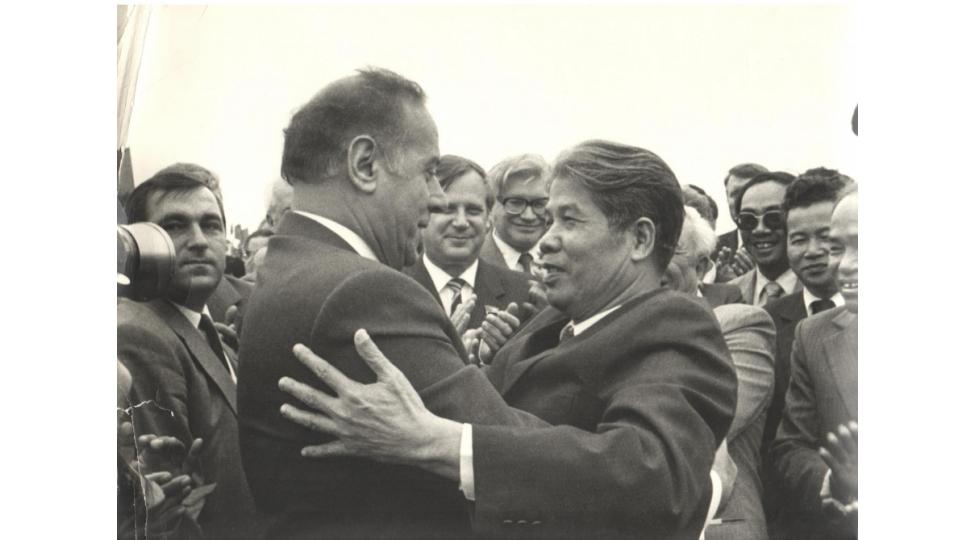
Thus, even at an early stage, relations between Azerbaijan and Vietnam acquired quite concrete content: Azerbaijani experience and professional knowledge helped develop one of the most important sectors of the Vietnamese economy.
A new architecture
This historical continuity matters today as well. Azerbaijani-Vietnamese relations have a solid foundation of mutual trust. However, the preservation of historical memory in itself does not guarantee the further development of ties. A necessary condition is the ability to adapt traditional cooperation to new political and economic realities. It is precisely this process that has been clearly traceable in recent years.
The state visit of President Ilham Aliyev to Vietnam in 2014 and the official visit of President Truong Tan Sang to Azerbaijan in 2015 gave the relations additional institutional stability. The next fundamental step was the visit to Baku in May 2025 of To Lam, General Secretary of the Central Committee of the Communist Party of Vietnam, during which a Joint Statement on the establishment of a strategic partnership was adopted. President Ilham Aliyev characterizes it as a landmark document that has brought Azerbaijani-Vietnamese ties to a qualitatively new level.
In essence, this is about a transition from the traditional model of friendly relations to a more systemic interaction, implying the alignment of long-term interests and the expansion of cooperation across a whole range of areas. This historical continuity forms the political capital on the basis of which new areas of interaction are being built today. It is also important that both sides demonstrate an interest not merely in maintaining the level achieved, but in the consistent expansion of the partnership.
The institutional component is of fundamental importance in this respect. More than 30 documents signed between the countries, the work of the intergovernmental commission on trade, economic, scientific, and technical cooperation, the mechanisms of inter-ministerial consultations between the foreign ministries, inter-parliamentary contacts, and interaction between the ruling parties create the necessary channels for implementing joint initiatives. In this case, their content is especially important. The expansion of the agenda to include such areas as defense and cybersecurity indicates that the parties view their interaction in a broader context than traditional economic ties.

At the same time, the head of the Azerbaijani state draws attention to the fact that ties between Baku and Hanoi are not limited solely to the bilateral agenda: "Along with the bilateral dialogue between our countries, close interaction has also been established on international platforms, in particular at the UN, the Non-Aligned Movement, CICA, and within the framework of other international organizations. Azerbaijan is deeply grateful to Vietnam for its support on the issue of our country's territorial integrity, sovereignty, and the inviolability of its internationally recognized borders, as well as for its firm and fair position as a non-permanent member of the UN Security Council during the 44-day Patriotic War.
All of this undoubtedly attests to the fact that the long-standing political dialogue between Baku and Hanoi is steadily deepening, based on the principles of equality and consideration of mutual interests."
Thus, the political dimension of Azerbaijani-Vietnamese relations rests on several interconnected factors at once: historical closeness, sustainable interstate mechanisms, support on international platforms, and a readiness to expand cooperation in new areas. All of this creates a favorable basis for the next stage — transforming political trust into measurable economic results.
Broad potential
It is precisely the economic dimension that today is becoming one of the main criteria for the practical effectiveness of the strategic partnership. Despite the considerable geographical distance, Azerbaijan and Vietnam possess complementary capabilities that make it possible to view their interaction not only within the framework of bilateral trade, but also in the context of broader Eurasian economic processes.
Over recent decades, Vietnam has strengthened its position as one of the dynamic manufacturing and trading centers of Southeast Asia. Azerbaijan, in turn, is consistently developing its industrial infrastructure, strengthening its energy positions, and expanding its transport and logistics capabilities, acting as an important link between East and West, North and South.
In such a configuration, geographical remoteness ceases to be an insurmountable obstacle. On the contrary, the development of international transport routes creates additional prerequisites for the convergence of economies, while the differences in their production and resource structures open up opportunities for mutually beneficial exchange.
At the same time, current trade volumes do not yet correspond to the scale of potential interaction. For two states with a fairly broad economic base and an interest in diversifying external ties, there is room for a substantial increase in mutual deliveries and an expansion of the range of goods.
President Ilham Aliyev directly points to this gap between the results achieved and the available opportunities: "Azerbaijani-Vietnamese trade and economic relations are developing steadily. In 2025, the volume of trade turnover between the two countries amounted to more than 150 million US dollars. At the same time, this figure does not yet reflect the real possibilities: both sides have great potential for a substantial increase in mutual trade."
What matters here is not so much the trade turnover figure itself, but the assessment of its prospects. Given political will and the necessary institutional mechanisms, the further development of trade should be accompanied by the expansion of business contacts, the search for new partners, and the formation of long-term projects. In other words, the task consists not only in increasing quantitative indicators, but also in changing the quality of economic interaction.
One of the most promising areas remains energy. Historically, it was precisely the oil industry that became the foundation of Azerbaijani-Vietnamese cooperation, and today it is once again becoming relevant, but now under the conditions of a substantially changed global energy market.
"The oil sector, historically the foundation of our partnership since the times of the Soviet Union, retains the status of a key area of interaction. Of particular importance in this context is the deepening of contacts between the State Oil Company of the Republic of Azerbaijan (SOCAR) and the Vietnam National Oil and Gas Group, PetroVietnam. The Memorandum of Understanding signed in 2025 provides for cooperation in such areas as the exploration and development of oil and gas fields, the provision of technical services, and the training of specialists," is how Ilham Aliyev speaks about this.
As can be seen, this is no longer only about continuing a historical tradition, but also about the possibility of combining accumulated experience, technological competencies, and production resources. Of particular importance is the fact that energy interaction is not limited exclusively to traditional hydrocarbon areas. Amid the global energy transition, both countries are interested in seeking new sources of growth and expanding investment cooperation in the field of renewable energy.

That is precisely why the interest of Vietnamese business in the Azerbaijani market acquires additional significance. An example is the activity of ROX Group, which is showing interest in implementing projects in the spheres of construction and infrastructure development, as well as solar and wind energy. In September of this year, within the framework of the Second Azerbaijan International Investment Forum, the relevant cooperation documents were signed with this company. The President of Azerbaijan specifically highlights these projects, viewing them as one of the practical results of the expansion of economic contacts.
An important trend can be traced here: the economic partnership is gradually acquiring a more diversified character. Whereas historically its foundation was interaction in the oil industry, now renewable energy, infrastructure construction, and investment projects are being added to it. For Azerbaijan, this corresponds to the course toward expanding the non-oil sector and attracting international capital, while for Vietnamese companies it opens up opportunities to enter new markets.
At the same time, the prospects for cooperation are not confined to industry and energy. Significant potential exists in agriculture, the services sector, transport infrastructure, and logistics. It is precisely the combination of these areas that is capable of ensuring a more sustainable structure of bilateral economic ties.
The Middle Corridor as a connecting link
The transport and logistics dimension of the partnership deserves separate attention. Amid the restructuring of international trade routes, the importance of states capable of ensuring reliable and efficient transport connectivity between various regions is increasing substantially. For Azerbaijan, this area has long been one of the priorities of its economic and foreign policy.
Azerbaijan's location at the intersection of the East–West and North–South transport routes makes it possible to view the country not only as a transit territory, but also as an important logistics hub capable of ensuring the movement of cargo, the development of related services, and the creation of additional economic value.
For Vietnam, which is oriented toward international trade and the expansion of its export geography, the use of Azerbaijani transport infrastructure could become one of the instruments for strengthening ties with European markets. In this respect, the Middle Corridor, which provides an alternative transport link between Asia and Europe, acquires a special role.
The dynamics already observed indicate that this area is gradually moving from the category of prospective opportunities into the practical plane. In January–September of this year, the volume of transit shipments along the routes connecting the two countries increased nearly sixfold compared with the same period of the previous year, exceeding 8,000 tons. Even if for now we are talking about relatively small volumes on the scale of international trade, such a substantial growth rate is telling from the standpoint of forming new logistics links. It demonstrates the existence of interest in using Azerbaijan's transport potential and creates a basis for a further increase in cargo flow.

President Ilham Aliyev views this area as one of the significant factors in expanding bilateral interaction: "Positive dynamics are also observed in the field of transit transportation. In January–September 2026, its volume increased nearly sixfold compared with the same period of 2025 and amounted to more than 8,000 tons.
Azerbaijan's transport and logistics infrastructure can be effectively used for transporting cargo from Vietnam to Europe and in the opposite direction — along the Middle Corridor and the North–South transport corridor. This will not only strengthen our country's role in international transport corridors, but will also serve to create economic added value and new opportunities for cooperation, as well as make a weighty contribution to the expansion of bilateral ties."
It is noteworthy that in this case we are talking about two transport directions at once. The Middle Corridor opens up opportunities for developing cargo transportation between East Asia and Europe, while the North–South route expands Azerbaijan's logistics geography and creates additional options for transport interaction.
For Baku, the development of such ties means not only an increase in transit indicators. It is also an opportunity to strengthen the country's role in international supply chains, expand the range of logistics services, and attract additional investment in transport infrastructure. For Hanoi, it means gaining access to new routes and broader sales markets.
At the same time, further growth in cargo flow will require coordinated work by the relevant agencies, transport operators, and businesses, as well as the formation of sustainable commercial mechanisms. It is precisely the regularity of shipments, the predictability of delivery times, and the competitiveness of logistics services that will determine how quickly the current positive dynamics can grow into a long-term area of economic cooperation.
In a broader sense, the development of transport links between Azerbaijan and Vietnam demonstrates how a bilateral partnership can extend beyond the immediate geography of the two states. In effect, this is about connecting the economic spaces of Southeast Asia, the South Caucasus, and Europe. And in this configuration, Azerbaijan is capable of acting not merely as a participant in trade processes, but as one of the key connecting links.
A new stage
Today, relations between Azerbaijan and Vietnam are in that phase where historical legacy and political trust create opportunities for far more large-scale interaction.
President Ilham Aliyev emphasizes: "Our countries have sufficient resources to substantially increase trade turnover and successfully implement large-scale joint initiatives in energy, industry, agriculture, transport, and logistics — in short, in practically all leading fields. I am confident that systematic joint work will make it possible to achieve weighty practical results in the shortest possible time."
As can be seen, the adoption of the Joint Statement on strategic partnership has become an important political benchmark; however, its real significance will be determined by how consistently the parties are able to realize the opportunities embedded in it.
In this respect, the upcoming visit of the President of Azerbaijan to Vietnam is of special significance. It opens up the possibility not only of confirming mutual interest in deepening relations, but also of defining concrete mechanisms for further cooperation.
At the same time, the prospects of the partnership should be viewed much more broadly than individual agreements and projects. Azerbaijan and Vietnam have opportunities to expand cooperation in energy, industry, agriculture, construction, renewable energy sources, transport, and logistics. An important condition will be the more active involvement of the private sector, since it is precisely business contacts that are capable of turning political agreements into sustainable economic ties.
Speaking about his expectations from the trip, President Ilham Aliyev outlined precisely such a prospect: "Today, Vietnam is a dynamically developing state of Southeast Asia, while Azerbaijan is a key logistics and energy hub of the South Caucasus. By joining efforts, we will be able to enter new markets, implement joint projects, and create additional opportunities for business and investment. Undoubtedly, our cooperation possesses enormous creative potential capable of bringing tangible benefits to our countries and peoples."
These words in fact reflect the strategic logic of the current stage of relations. Azerbaijan and Vietnam view each other not only as friendly states with a shared history, but also as partners capable of providing mutual access to new economic opportunities. For Baku, this means expanding its presence in Southeast Asia and strengthening ties with one of the world's dynamically developing regions. For Hanoi, it means additional opportunities for cooperation in the South Caucasus, access to European markets, and the use of Azerbaijan's transport and energy potential.
The distinctive feature of this partnership lies in the combination of three components: historical trust, coinciding economic interests, and mutual interest in expanding international ties. It is precisely such a combination that makes it possible to count on the long-term nature of cooperation. And if previously Azerbaijan and Vietnam were linked above all by a shared history and friendship, now they are increasingly united by a vision of future opportunities.