Albanian-Udi community: Yerevan's position on the Albanian heritage harms peace in the region
The Albanian-Udi Christian religious community of Azerbaijan has issued a statement.
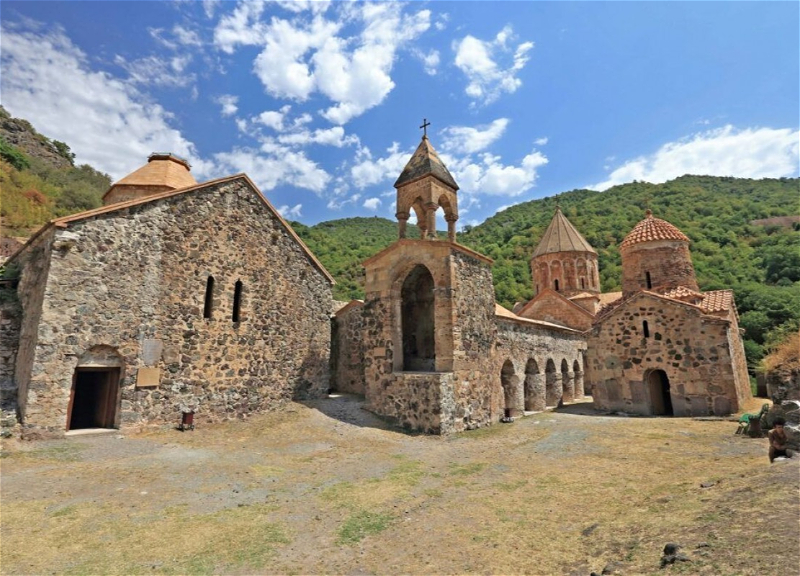
The statement says that the members of the Albanian-Udi Christian religious community, which is the successor to the Albanian (Caucasian) Apostolic Independent Church, strongly condemn the revanchist reaction in Armenian society and in Armenia's political circles to the trip by representatives of the diplomatic corps accredited in Azerbaijan to Karabakh and East Zangezur, in particular the visit to the Ganjasar and Khudavang temples, which belong to the Albanian historical and cultural heritage.
"We believe that the presentation by the Armenian side, including by Armenian lobbying circles that have still not abandoned war propaganda, as well as by Armenian Prime Minister Nikol Pashinyan and other high-ranking officials who declare their commitment to the peace agenda, of such historical monuments of Azerbaijan as Ganjasar and Khudavang as Armenian heritage is not only a denial and falsification of historical facts, but also creates a threat to the fragile peace process taking shape in the region. The targeted campaign being waged in Armenia against the trip of the representatives of the diplomatic corps shows that this country's political and religious circles are insincere in their aspiration for peace and are still intolerant of Azerbaijan's legitimate rights," the statement says.
The community states that Caucasian Albania is an inseparable part of Azerbaijani statehood, and that Armenia's policy of denying the historical and cultural heritage of Caucasian Albania is unacceptable:
"Such provocative activity by Armenia is a manifestation of false national exceptionalism, a fake history and an element of racism. Such an intolerant, hostile attitude toward Caucasian Albania, especially toward its religious and cultural heritage, clearly shows that Armenia is afraid of the truth. The Albanian Church, as the first apostolic church of the Caucasus, has traveled a long historical path and has left an indelible mark on the religious and cultural life not only of Azerbaijan, but of the entire Caucasus. All attacks on a heritage that created a great culture and had its own alphabet will fail. It is impossible to deny the facts."
The statement draws attention to the fact that in 313 the Albanian king Urnayr adopted Christianity as the state religion, which is known from history: "The history of the Khudavang monastery, which is one of the magnificent examples of Azerbaijani architecture, goes back to the 6th–7th centuries. How can history be changed, how can it be falsified? It is an indisputable truth that the Ganjasar temple was built in 1216–1238 on the orders of the Albanian prince Hasan Jalal Dovla and in 1240 received the blessing of the Albanian patriarch Nerses. The significance of the Ganjasar temple and its special value for us lie in the fact that it was the seat of the Albanian Catholicosate. Princes and clergymen from the Hasan Jalal dynasty, including Hasan Jalal Allahverdi bey, were buried on the territory of the monastery. Unfortunately, after various pressures and influences, by a decision of the tsarist Synod in 1836 the activity of the Albanian Apostolic Church was terminated, and the Armenian Gregorian Church attempted to appropriate part of its material and spiritual heritage. As a result, in Azerbaijan, and especially in Karabakh, historical Albanian temples were Gregorianized, and along with our historical monuments, archival materials and documents were either destroyed or falsified. Attempts at Armenianization and appropriation, by means of all kinds of falsifications, of the historical and cultural heritage of Caucasian Albania, which is an inseparable part of Azerbaijani statehood, have over the past hundred years turned into Armenia's state policy.
As a result of this, on the territory of present-day Armenia and on the previously occupied territories of Azerbaijan, not a single Albanian temple has been preserved in its original historical form."
The statement says that appropriating the historical and cultural heritage of Caucasian Albania in order to create a fake history for oneself means acting against both the past and the future, and undermining the foundations of good-neighborliness and peaceful coexistence:
"The continuation of that same policy today and its support by Armenia's leadership are unacceptable. History should be studied, written and presented as it is. We, the first Christians of this land, resolutely reject the Armenians' attempts to appropriate our historical and religious-cultural heritage. Historical reality proves that the historical-political and cultural-religious heritage of Caucasian Albania today belongs to the Azerbaijani state and the Azerbaijani people, where representatives of various ethnic groups, religions and beliefs have lived for centuries in conditions of tolerance. Today we, as a Christian community that preserves its language, religion, customs and traditions, will continue to cherish the sacred heritage of our ancestors and will continue the struggle against Armenian falsifications. Today we, the Udis, just as we hold services in the churches of Gabala and Oghuz, also freely conduct religious rites and ceremonies in the ancient Albanian temples in the territories liberated from occupation, including in the religious temples of Ganjasar, Agoglan, Khudavang, Amaras and others."
Source: APA