After 200 years, AI has deciphered Napoleon's military message
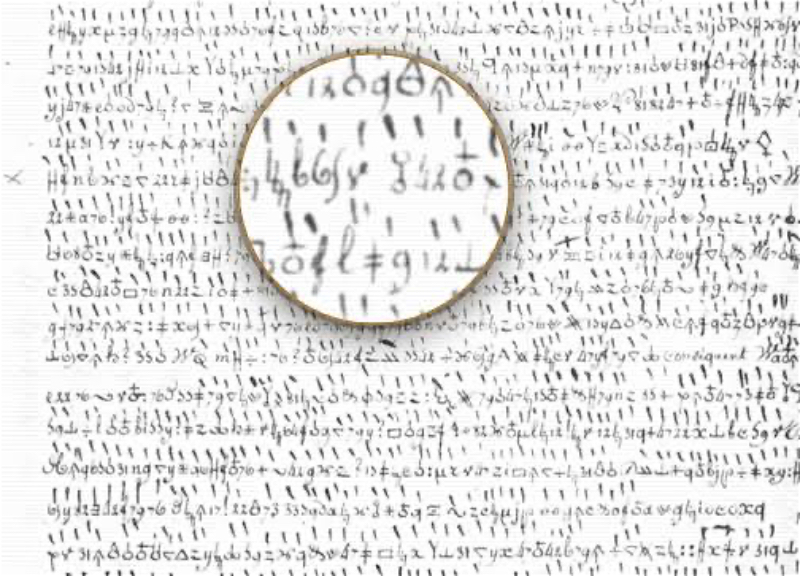
Artificial intelligence has helped decipher, for the first time in more than two centuries, a secret military message composed during the Napoleonic Wars.
The document dates back to 1809 and was prepared not by Napoleon Bonaparte himself, but at the headquarters of Eugène de Beauharnais, Viceroy of Italy, on the orders of the French emperor.
The encrypted message was intended for French General Auguste de Marmont, who commanded troops in Dalmatia. Carter Church, an engineer at the American cybersecurity company SentinelOne, reported that he used the GPT-6 Astra artificial intelligence model to decipher the document.
According to Church, it took the system about six hours to analyze the encrypted letter. Initially, the artificial intelligence had to process an image of the document measuring 1,202 by 1,836 pixels, recognize the hand-drawn symbols, and determine which of the approximately 175 signs represented the same symbol. After that, the system proceeded directly to analyzing the cipher.
In the course of its work, the artificial intelligence independently carried out several stages of research: it transcribed the image, analyzed the principle of the homophonic substitution cipher, wrote the code necessary for decryption, and compared the resulting information with historical sources.
Various researchers had tried for decades to reconstruct the contents of the document, but a complete decipherment of the message had not previously been published.
It turned out that the letter contained information about the positions of French, Bavarian, and Polish troops. It concerned the military situation in Europe in the spring of 1809, when Austria was preparing for a confrontation with France, while a significant part of the French army was still in Spain.
Marmont's position was particularly vulnerable: his troops in Dalmatia could be cut off in the event of an Austrian offensive. For that reason, on March 16 Napoleon instructed Eugène de Beauharnais to convey to the general information about the location of the main French and allied units. The message was to be composed in encrypted form and delivered by a trusted officer.
The deciphered text speaks of preparations for an offensive against Austria and of troop numbers. In particular, it states that Russian troops were being sent against Austria, and that the army from Friuli numbered about 80,000 men. It also mentions the Dalmatian corps and reserves being formed in the rear.
By comparing information about troop numbers, commanders' ranks, and the location of units with historical data, Church dated the content of the message to the end of March 1809 — approximately two weeks before the start of the Austrian offensive.
Thus, the deciphered document made it possible to obtain new information about the military preparations of France and its allies on the eve of one of the key stages of the 1809 campaign.