
Voice of the nation and living history: Day of the Azerbaijani language and alphabet

Everyone in whose soul lives boundless love for their Motherland and their people considers it their sacred duty to take pride in, preserve, and develop their native language.
Every year on August 1, Azerbaijan celebrates a significant holiday — the Day of the Azerbaijani Alphabet and the Azerbaijani Language. The native language is not merely a means of communication but an essential part of national identity, the foundation of spiritual heritage, and the unshakable basis of solidarity among millions of Azerbaijanis around the world. The Azerbaijani language captivates with its unique beauty, refinement, and remarkable melodiousness.
Formed on ancient Azerbaijani soil on the basis of Oghuz and Kipchak tribal languages, it has traversed a rich historical path. The supra-dialectal form of the language has been preserved in precious monuments of folk folklore, among which the epic “Kitabi Dede Gorgud” occupies a special place. It was in the Azerbaijani language that great writers and poets created their immortal masterpieces, which became jewels of world literature. The first to elevate the native language to the level of a state language was the outstanding ruler and poet Shah Ismail Khatai, who laid the foundations of a unified Azerbaijani state.
Azerbaijani writing has also undergone changes over the centuries. From ancient times until the second half of the 7th century, the Old Turkic script was used, followed by Arabic script with the addition of specific signs characteristic of Turkic languages. The first projects for a transition to the Latin alphabet began to appear in the mid-19th century thanks to the educators of that time. During the period of the Azerbaijan Democratic Republic, the Turkic language received official status as the state language, and a special commission for the development of a new alphabet was established under the Ministry of Education. In the Soviet years, the issue of the language’s status remained complex: in 1922 the Latin alphabet was approved, which from 1925 was officially used alongside Arabic, but in November 1939 a new Cyrillic alphabet was introduced in the Azerbaijan SSR.
As for the language, in Soviet Azerbaijan until the second half of the 20th century the Azerbaijani language did not have any status, and only on August 21, 1956, was a law adopted adding an amendment to the 1937 Constitution of the Azerbaijan SSR, officially declaring the Azerbaijani language the state language in the republic.
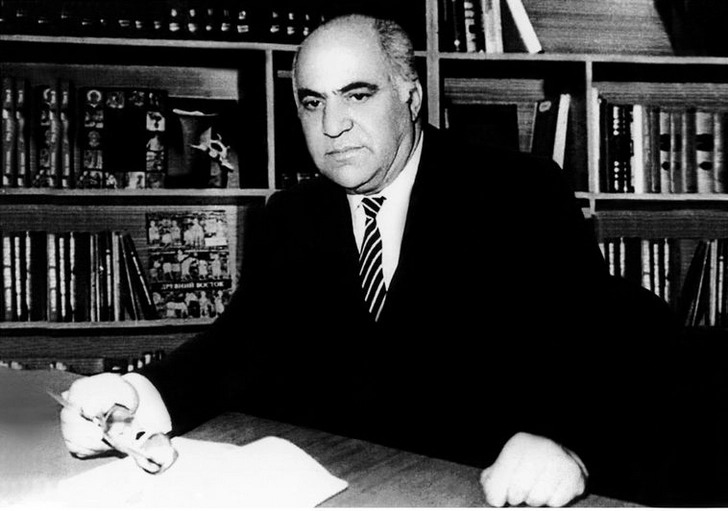
Prominent scholars made contributions to the scientific understanding and systematization of the language. Among them, a special place is occupied by the renowned linguist and Turkologist Afad Gurbanov — the author of the modern Azerbaijani alphabet and the founder of the scientific school of onomastics.
Having devoted more than 50 years of his life to domestic science and education, he created fundamental works that played a vital role in the development of philology. With the awakening of national self-awareness and the restoration of Azerbaijan’s independence, prominent representatives of the intelligentsia initiated the return to Latin script and the final consolidation of the status of the state language.
The preservation and comprehensive development of the Azerbaijani language was elevated to the rank of key state priorities by Azerbaijan’s national leader Heydar Aliyev. Thanks to his firm political will and historic decrees, the Azerbaijani alphabet gained new life, finally transitioning to the Latin script. This not only strengthened the status of the native language but also brought Azerbaijan closer to other Turkic peoples. Today, this strategic course is successfully continued by President Ilham Aliyev. Showing special care for the national heritage, the head of state takes consistent steps to ensure that, in the conditions of globalization and the information age, the Azerbaijani language preserves its purity, develops, and remains one of the main symbols of the country’s independence. By developing and preserving the native language, society strengthens its culture and passes on centuries-old traditions to future generations. The Azerbaijani language today continues to serve as a bridge uniting compatriots around the world, a servant of the high ideal of unity, prosperity, and national pride.