Farhad Mammadov — Hraparak: on Russia, Armenia, and the new realities of the South Caucasus
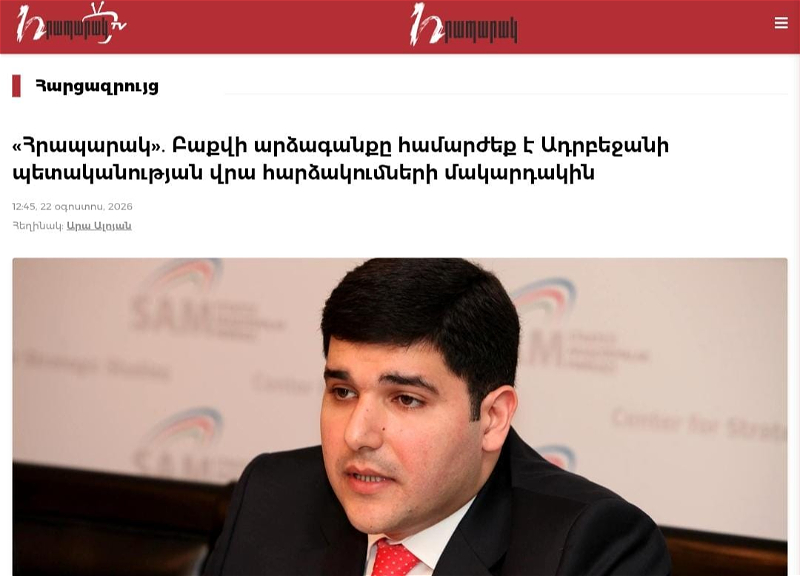
The head of the Center for South Caucasus Studies, Farhad Mammadov, gave an interview to the Armenian outlet Hraparak, in which he commented on the current state of Azerbaijani-Russian relations, the reasons for the tensions that periodically arise between Baku and Moscow, as well as the latest high-profile statements by Russian journalists directed at Azerbaijan.
In the conversation, the expert also touched on the prospects for energy cooperation between Azerbaijan and Armenia, the situation around the Metsamor nuclear power plant, and Armenia's possible connection to regional energy projects.
1news.az presents the interview with Farhad Mammadov.
The Moscow-Baku "line" is heating up again. Azerbaijan has issued a search warrant for three Russian journalists, including Chadayev, an adviser to the Russian transport minister, who, incidentally, has already resigned. Why do Azerbaijani-Russian relations periodically deteriorate? One should not simply say that it is because of anti-Azerbaijani sentiments.
Relations between Azerbaijan and Russia entered a period of crisis at the end of 2024, when an Azerbaijani civilian aircraft was shot down by the Russian armed forces. Only by the beginning of this year did the foreign ministries of Azerbaijan and Russia note in a joint statement that the aircraft crisis had been settled.
Recently, the president of Russia called the president of Azerbaijan, and the foreign minister of Azerbaijan made an official visit to Moscow. That is, contacts are being carried out between Azerbaijan and Russia at the highest and high levels. Of course, Russian officials speak in the vein that relations can be returned to their previous level.
However, in Baku there are no plans to reconsider the decisions taken on closing Russia's humanitarian infrastructure in Azerbaijan. Today, Baku views relations with Russia in a pragmatic context.
As for the decision of the Prosecutor General's Office of Azerbaijan regarding three citizens of Russia, it can be said that a legal assessment was given to the open calls by Russian citizens to overthrow the constitutional order of the Republic of Azerbaijan. In Russia, many acknowledged that these journalists crossed every conceivable bound of decency. It remains to be hoped that after this incident, people in Russia's information space will be aware of what they are doing before making such statements regarding a sovereign state, which the Republic of Azerbaijan is.
The Ministry of Foreign Affairs of Azerbaijan sent a letter of protest and summoned the Russian ambassador to the ministry. Moscow objected that the opinion of private individuals is not Russia's official position. Isn't Baku being more emotional?
The Foreign Ministry of Azerbaijan summoned Russia's ambassador and expressed a protest, stating that henceforth such statements will have legal consequences. This is important in order to prevent similar problems in the future. Regarding Baku's emotionality, I can say that the level of emotionality corresponds to the level of attacks on the statehood of the Republic of Azerbaijan. And this applies not only to Russia, but to all countries where actions are taken and decisions are made against the Republic of Azerbaijan.
The Azerbaijani leader stated that Armenia is facing an energy crisis after the closure of the Metsamor nuclear power plant, and then offered assistance in the form of an alternative source. There is an opinion that this is also a demonstrative gesture against Russia, considering that Russia has exclusive influence and participation in this field in Armenia.
The Metsamor nuclear power plant operates on the territory of Armenia and is managed by the Russian company Rosatom. According to official indicators, individual units of the plant have a service life after which they may be considered to pose a threat. The government of Armenia plans to decide within the coming year on the future contractor for the nuclear power plant; modular plants are also being discussed with the United States. The choice remains with the government of Armenia as to how, within what time frame, and with whom they plan to make decisions on the Metsamor nuclear power plant. The operation of a nuclear power plant in a seismically active location and directly at the borders of Azerbaijan is assessed in Baku as a potential risk.
The president of Azerbaijan noted in his speech the risk of an energy crisis in the event of the closure of the Metsamor nuclear power plant and proposed ways out through cooperation in the energy sphere. Power transmission lines can be built in the shortest possible time and Armenia can be connected to the region's energy exchange system and to electric power sector projects.