Return to Bishkek: why Putin's telegram to Kocharyan changes nothing in the South Caucasus
On August 31, it so happened that three events fell on a single day, and this juxtaposition says more than each of them separately.
In the morning, the Kremlin press service reported on a telegram that Vladimir Putin had sent to Robert Kocharyan — birthday greetings, words about the former Armenian president's contribution to the development of friendly, allied ties between the two countries, and wishes of good health, cheerfulness of spirit, and fortitude in the face of the trials confronting him and members of his family.
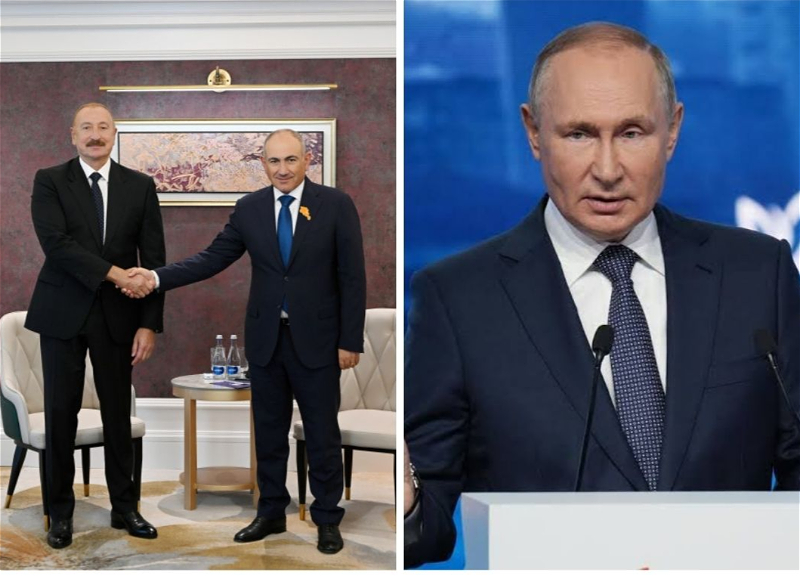
At the same time, in Bishkek, on the sidelines of the SCO summit, Ilham Aliyev met with Nikol Pashinyan. And the next day, on September 1, in that same Bishkek, a meeting with Putin himself awaits Pashinyan.
All three, it would seem, are in the same political space, yet the telegram passed by it without touching anyone.
The trials mentioned in Putin's message should be identified precisely. On August 27, a court in Yerevan placed Kocharyan under arrest for two months — money laundering on an especially large scale, abuse of official powers, taking a bribe. The hearing lasted seven hours, during which the politician was hospitalized and the proceedings continued without him. Days earlier, his elder son Sedrak was arrested, and searches were carried out at the home of the younger one, member of parliament Levon. On August 25, Pashinyan stated that he had personally ordered the detention.
All of this is a matter for the Armenian investigation and the Armenian court, and there is no reason to assess it from Baku.
Azerbaijan has its own account to settle with Robert Kocharyan and Serzh Sargsyan, and it has not been drawn up under articles concerning property.
This account has been stated publicly and more than once. On November 23, 2020, two weeks after Armenia's capitulation, the President of Azerbaijan came to liberated Aghdam and spoke in front of the destroyed Juma Mosque, in which the occupiers had kept livestock. Addressing both former Armenian presidents directly, he said that they had gone down on their knees before Azerbaijan, that it was they who had brought the city and all the occupied lands to their present state and destroyed that mosque, that during the war they had fled and hidden, never once venturing into the combat zone, and he asked why they were hiding like mice. It was then that the definition was also voiced: war criminals, Khojaly murderers. In the summer of the following year, at the flag-raising ceremony in Kalbajar, he repeated it.
Behind these words stands something entirely material: Khojaly, thirty years of occupation, Aghdam, Fuzuli and other cities and villages wiped off the face of the earth, a million refugees and internally displaced persons. Both built political careers on this — first as leaders of a separatist entity, then as presidents of Armenia.
That is why Baku's position does not depend on which article is written into the Yerevan indictment. Kocharyan must sit in prison. The same road for Sargsyan. Under exactly which case they will be brought there is a secondary question, and Moscow's attempts to signal patronage over them will not change this.
Now it is worth returning to the telegram itself and looking at its genre.
This is not a statement by the foreign ministry, not a comment by a press secretary, not the summoning of an ambassador. Birthday greetings oblige one to nothing, require no response from Yerevan, and formally do not constitute interference in the internal affairs of a neighboring state. The choice of precisely this instrument is the content of the message: to indicate whom you consider your own while risking nothing in the process.
There simply are no other instruments left.
For thirty years, the Russian presence in the South Caucasus rested on the lack of a settlement — as long as Baku and Yerevan were not talking to each other, someone was needed between them.
That, too, began in Bishkek. In May 1994, on the initiative of the CIS Interparliamentary Assembly, the parliament of Kyrgyzstan, the Federal Assembly and the Russian Foreign Ministry, a protocol was agreed there that became the basis for the ceasefire from May 12. The fire was halted, but the conflict was not resolved — it was frozen, and in that frozen form it ensured the mediator's indispensability for thirty years.
The Azerbaijani copy of the protocol was signed separately, with amendments, three days later in Baku. That is how the entire construct was arranged: the parties signed not with each other, but through a third party.
In that same city, thirty-two years later, Aliyev and Pashinyan discussed supplies of Azerbaijani petroleum products to Armenia, the transit of grain through Azerbaijani territory, the work of the border delimitation commissions, and practical steps on the TRIPP route. On August 8 of last year, in Washington, a Joint Declaration was signed and the agreed text of a peace treaty was initialed. There is no longer any third party in this construct.
There is nothing to mediate. Still less to divide: both sides have learned to do without a translator from a third party.
What remained was influence inside Armenia itself, but that too has exhausted itself. On June 7 of this year, the forces that promised a revision of the course lost the elections. Both governments received their mandate for normalization from their own voters, and that is the only foundation that cannot be bought from the outside with telegrams.
So the wish for fortitude will remain a wish.
It changes nothing for the Armenian court, nor for Baku's account, nor for what was discussed in Bishkek.
Moscow has indicated whom it considers its own. Azerbaijan has known this for thirty years without any telegram.
Read on the topic:
Moscow has pulled out an old map
Ali Shirvanshir