A protest has been sent to The Guardian over Karabakh-related distortions in the film "Black Garden"
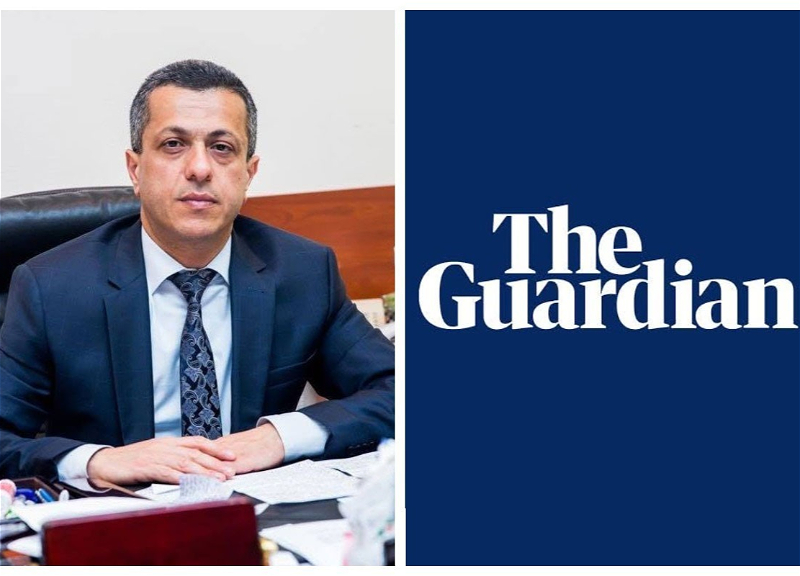
The head of the Azerbaijani Public Association "Human Rights Promotion Center," Professor Amir Aliyev, has sent a letter to the international media outlet The Guardian.
As APA reports, Amir Aliyev sent the letter in response to The Guardian's recent piece about Alexis Pazoumian's documentary film "Black Garden."
Amir Aliyev stated that, in covering the history of the conflict, what Azerbaijanis went through cannot be left unaddressed. According to him, the voices of people expelled from their native lands, as well as the victims of the Khojaly massacre and those who survived, must be heard.
He called on The Guardian to also provide these people with an opportunity to express their position, as well as to take into account facts and viewpoints that were not reflected in the outlet's piece.
Amir Aliyev's letter, addressed to the editor of The Guardian, states:
"The Guardian's piece about Alexis Pazoumian's documentary film 'Black Garden' raises serious concerns. The piece does not mention important facts, including Armenia's occupation of internationally recognized territories of Azerbaijan and the forced displacement of more than one million Azerbaijanis."
Our main concern is that the review published on August 31, 2026, on The Guardian's website goes beyond a discussion of the film and presents The Guardian's own account of the conflict. In the review, the Karabakh region of Azerbaijan is referred to as "Nagorno-Karabakh" and describes an alleged "long-standing territorial dispute" during which "a population consisting predominantly of Armenians confronted numerous military campaigns by the Azerbaijani army."
The film presents one point of view. However, when a major international media outlet sets out the historical context in its own name, that context must be accurate. Karabakh was and remains an internationally recognized territory of Azerbaijan. The European Court of Human Rights, in its 2015 judgment in the case of "Chiragov and Others v. Armenia," established that Armenia exercised effective control over the said territories.
In four resolutions adopted by the UN Security Council in 1993, the territorial integrity of Azerbaijan was reaffirmed and a demand was made for the withdrawal of occupying forces from the occupied territories of Azerbaijan.
In accordance with The Guardian's commitment to the principles of fair and accurate journalism, we ask you to publish this letter in the Letters section and to provide space for the voices of Azerbaijanis who experienced forced displacement and violence, including the victims of the Khojaly tragedy and those who survived and whose voices likewise deserve to be heard.
We also call on The Guardian to consider fact-based documentary films by Azerbaijani directors in order to ensure that the viewpoints of both sides are represented.
We welcome the opportunity for the author to contact us directly and are ready to provide documented research as well as first-hand testimony. At a time when Azerbaijan and Armenia are moving toward reconciliation, balanced approaches are especially important.
Thank you for your attention."