OTS, the Middle Corridor and the Caspian: how a new system of Eurasian connections is taking shape
Geography is a practically unchanging quantity, but the significance of individual points on the map can change radically.
What was perceived yesterday as a periphery can, with the appearance of new roads, ports, energy routes and trade links, turn into a major hub of international communication. In Eurasia, one such space today is the region encompassing Central Asia, the Caspian, the South Caucasus and Turkey.
Several processes converge here at once. Central Asia is seeking to expand its outlets to external markets, bypassing the traditional route through Russia; Turkey is strengthening its position as a transport and energy bridge between Asia and Europe; and Azerbaijan is consistently developing infrastructure linking the eastern shore of the Caspian with the Caucasus and further with Turkey and the European direction. Against this backdrop, the significance of the Organization of Turkic States (OTS) is gradually moving beyond the framework of political and humanitarian cooperation. A shared geography is beginning to acquire quite practical content.
The Caspian as part of a new transport connectivity
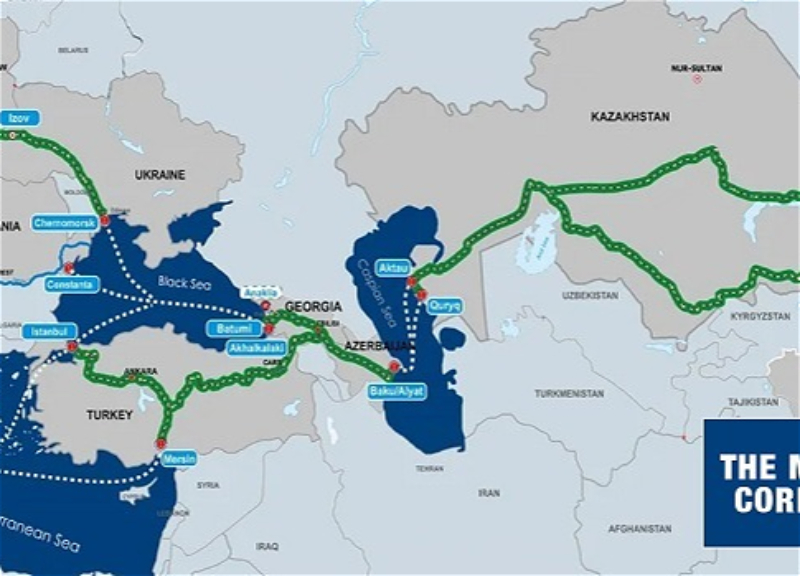
One of the main elements of this system is the Middle Corridor — the Trans-Caspian International Transport Route, connecting China with Europe via Central Asia, the Caspian, Azerbaijan, Georgia and Turkey. In this construct, the Caspian Sea no longer looks like an obstacle between two regions. On the contrary, it is becoming a necessary link in the route connecting the states of Central Asia with international markets.
Azerbaijan occupies a special position in this system. Railway, road and sea routes connecting the Caspian coast with Turkey pass through its territory. The Baku-Tbilisi-Kars railway line, which is part of the Middle Corridor, has, after modernization, acquired a throughput capacity of up to 5 million tons of cargo per year. The Alat International Sea Trade Port is today designed for 15 million tons of cargo per year, while its capacity is planned to be increased to 25 million tons.
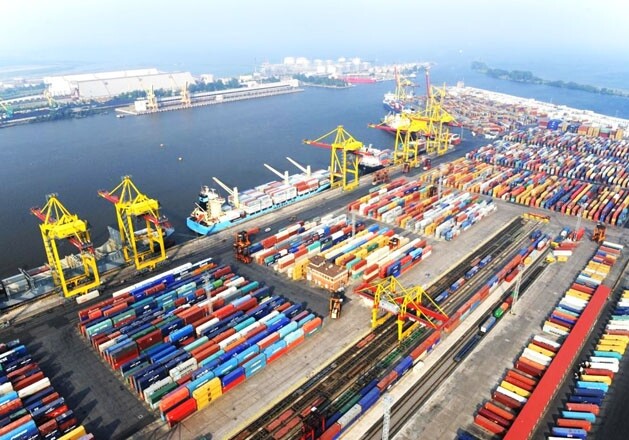
The result of this work is already reflected in real cargo flows. According to the Ministry of Digital Development and Transport of Azerbaijan, in January-July 2026 transit shipments through the country exceeded 9.1 million tons — 11.6% more than in the same period last year. At the same time, transit along the East-West direction grew by 16.5%. The container turnover of the Alat port increased by 20% in the first seven months of the year, reaching 72,370 TEU.
These indicators are important not so much in themselves as as evidence of a change in the region's role. The more cargo passes along the route, the higher the requirements for the synchronization of ports, railways, customs procedures and digital systems. Therefore the OTS is already dealing with quite specific issues of transport integration, such as removing barriers, digitalizing procedures, and introducing electronic permits and electronic international consignment notes, e-CMR.
Energy and transport are becoming a single system
However, the significance of these routes is not limited to the movement of goods. The same geography is gradually shaping energy connectivity, in which Azerbaijan also occupies a central position.
Speaking the other day before the participants of the fifth meeting of the secretaries of the security councils of the OTS states in Baku, Ilham Aliyev linked these two directions: "Today, without energy security and transport connectivity, it is in principle impossible to speak of security in general." The president emphasized that the OTS countries possess significant natural resources that are important not only for their own economies but also for a broader international space.
This interconnection is clearly visible in practice. Azerbaijan remains a major supplier of energy resources to external markets and at the same time ensures the transit of resources from the eastern coast of the Caspian. Oil from Central Asia is already being transported through the territory of Azerbaijan to international markets. In June 2026, Ilham Aliyev noted that the country provides "critically important transit opportunities" to partners on the eastern shore of the Caspian and expressed the hope that in the future natural gas would also pass through Azerbaijan under a similar scheme.
At the same time, Azerbaijan's own energy exports are developing. In 2025, the country exported about 25 billion cubic meters of gas, roughly half of this volume going to European Union countries. At the same time, the gas transport infrastructure is already operating at high capacity, which makes the further expansion of supplies a question not only of the resource base but also of new infrastructure capabilities.
Another direction is green energy. Within the OTS, cooperation is developing between Azerbaijan, Kazakhstan and Uzbekistan in the field of the generation and transmission of electricity from renewable sources. In December 2025, the OTS energy ministers also singled out projects for a "green" energy corridor between Central Asia, Azerbaijan and Europe among the directions of strategic cooperation.
Thus, transport and energy are gradually ceasing to exist as two parallel directions. Transport routes ensure the movement of resources and goods, energy infrastructure supports economic activity, and the reliability of both components is becoming part of the region's overall stability.
Azerbaijan as a connecting link
It is precisely in this system that the significance of Azerbaijan's geographical position is especially noticeable. But geography in itself does not create a transit advantage — it must constantly be turned into infrastructure by investing in railways, the seaport, highways and shipping. The country's merchant fleet numbers more than 50 vessels, which additionally strengthens its ability to ensure the Caspian section of transit routes.
Therefore, Ilham Aliyev's words that Azerbaijan's geographical position implies its special role in transport and energy security projects have a quite concrete material basis behind them. In a broader sense, this concerns the formation of a new Eurasian connectivity: for the states of Central Asia it means expanded opportunities for access to world markets, for Azerbaijan the strengthening of its role as a transit and energy hub, for Turkey the further intensification of ties with Central Asia, and for Europe the appearance of additional supply and trade routes.
The Caspian Sea no longer divides its shores — it cements them. By laying routes from Central Asia to European borders through its territory, Azerbaijan is strengthening its role as one of the key hubs of continental trade. For the OTS, these changes carry within them a transition from declarations of intent to material interdependence. In Eurasia's new architectural space, those associations will survive and become strong whose transport arteries and energy networks prove sturdier than any geopolitical storms.
Ali Mammadov