The land remembers everything: the environmental price of occupation and the revival of Karabakh
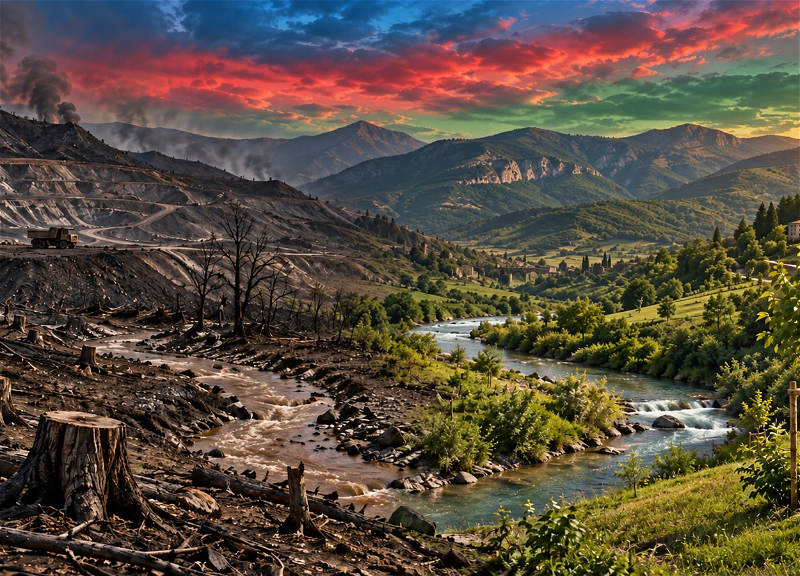
The land remembers everything — it remembers the dense crowns of relict forests, mercilessly pierced by the saws of the occupiers, the mirror-like surface of rivers poisoned by toxic effluents, the silence of gold-bearing mountains torn apart in a mad race for profit.
What took place over the course of three decades on the sovereign territories of Azerbaijan was not merely a consequence of a protracted conflict — it was methodical, calculated, and barbaric ecocide.
Today, when the environmental agenda has become one of the main global challenges, the scale of the tragedy of Karabakh and East Zangezur appears before the world community in its true, frightening light.
This is a chronicle of predatory plunder, documented by satellite images, reports of international experts, and the charred ruins of burned villages. But now it is also a story of revival: the land, once condemned to destruction by the aggressors, is being reborn at the hands of its true owners.
A chronicle of environmental terror
The large-scale destruction of landscapes, the felling of green areas, the pollution of water arteries, and the predatory exploitation of mineral resources — all of this consists of indisputable and documented facts of the deliberate destruction of Azerbaijan's nature. And all these crimes were committed by Armenia.
It is precisely this country that bears the entire burden of responsibility for the monstrous ecocide on the lands of Azerbaijan — both during the years of occupation and in the post-conflict period, when the Armenian military and the Armenians illegally settled here, including foreign ones, were forced to leave the liberated territories.
After the liberation from occupation, the full scale of the environmental and economic crimes appeared before the world in all its frightening obviousness.
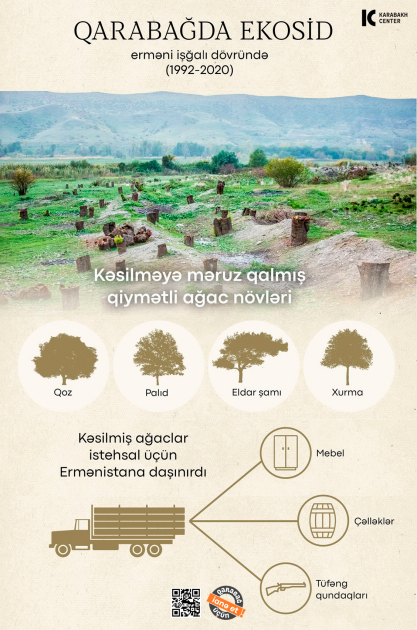
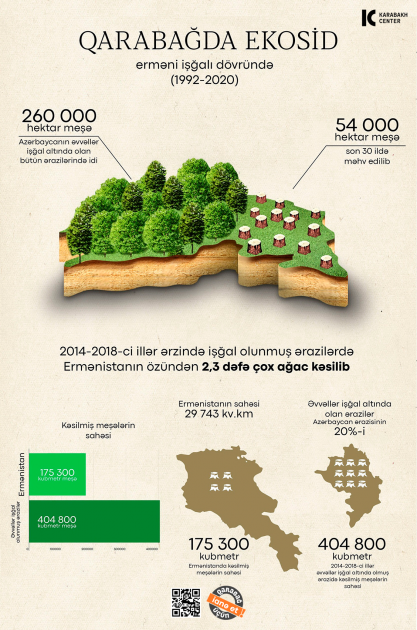
The destruction of forest wealth took on an unprecedented character. Across all the previously occupied territories of Azerbaijan there were about 260,000 hectares of forest, but the forest cover was rapidly shrinking over the past 30 years. Satellite images recorded the systematic destruction of entire tracts. Valuable tree species under special protection were cut down, and the valuable timber was exported to Armenia for the production of furniture and… rifle stocks.
The result is tragic — many unique species of trees found themselves on the verge of extinction. The nature reserves on the liberated lands, with a total area of 43,000 hectares, where before the occupation many species of flora and fauna from Azerbaijan's Red Book were under state protection, were devastated.
President of Azerbaijan Ilham Aliyev stated this at yesterday's meeting devoted to the development of the mining and metallurgical industry: "Suffice it to say that during the period of occupation, 60,000 hectares of forest fund in the Kalbajar, Lachin, and Zangilan districts were destroyed, plundered, cut down, and sold by the Armenian state…"
No less devastating was the impact on the region's water arteries. Just one example is the Sarsang reservoir. Using it as a lever of humanitarian and environmental blackmail, the occupiers for years deprived the Azerbaijani population of the border districts and the lowland part of Karabakh of water. The dam's emergency, abandoned condition turned it into a permanent source of man-made danger, capable at any moment of provoking a catastrophe of enormous scale, which was also recorded by international organizations.
The agony of scorched earth
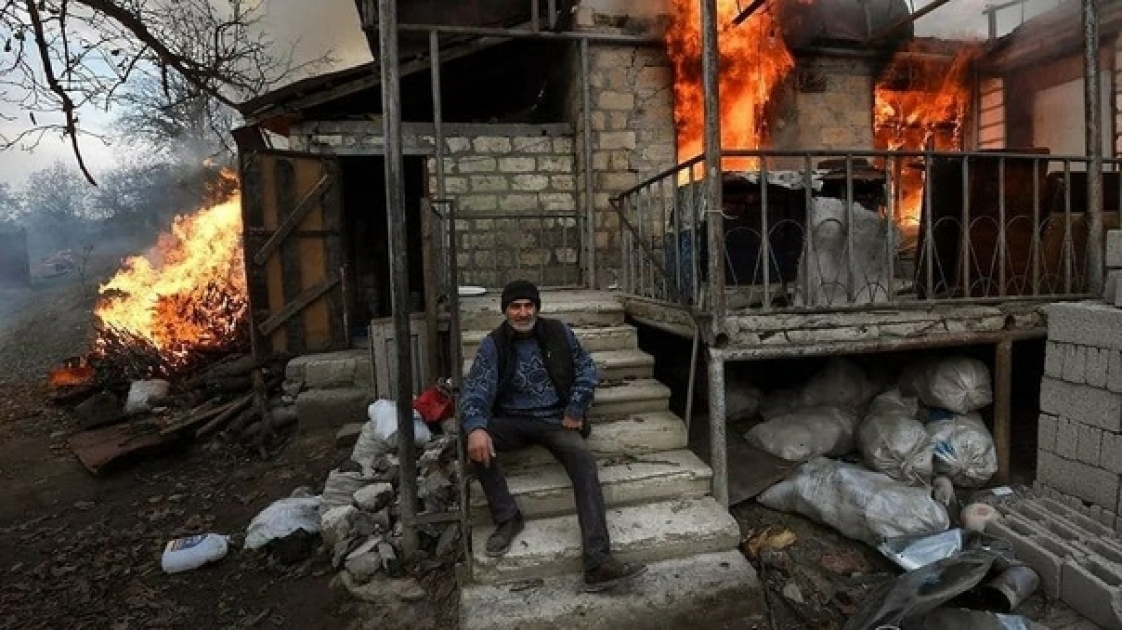
Deliberate arson of land, forests, homes, and infrastructure in Karabakh and the adjacent districts took on catastrophic proportions immediately after the signing on November 10, 2020, of the trilateral Statement on the cessation of hostilities. The document provided for the return, by December 1, of the Kalbajar, Aghdam, and Lachin districts to the full control of Azerbaijan. The illegal settlers were given time to pack their belongings and depart in a civilized manner. Instead, they staged a grandiose act of vandalism.
Practically every family, before leaving, slaughtered its livestock, destroyed beehives, and set fire to its own home along with the adjacent groves. In November, the Kalbajar and Lachin districts were drowning in the black smoke of fires.
President Ilham Aliyev recalled this: "…already after the Second Karabakh War, the forests were burned during the period when the Armenian armed forces were supposed to leave the Kalbajar and Lachin districts, for which they were given a period of two to three weeks. Everyone remembers well that they both destroyed trees and did not forget about the plumbing fixtures. Apparently, for them there were two most important issues: first — to completely destroy the nature of Azerbaijan, second — to take with them the most valuable plumbing fixtures. Probably, this is for them the main relic of that period of occupation."
This unprecedented parade of savagery and looting was broadcast by leading world media outlets, including Reuters, BBC, Strait Times, Euronews, France24, and RBC. The footage of black smoke over green valleys became a symbol of the impotent malice of the departing occupiers.

Transnational looting
Over the decades of occupation, Karabakh turned into a zone of illegal enrichment. Gray-market business flourished here, involving both structures of the separatist junta and major international players.
Of particular interest was the mining industry: the liberated lands contain more than 160 deposits of valuable metals, including 5 gold, 7 mercury, and 2 copper deposits, as well as reserves of lead, zinc, coal, and valuable types of stone.
President of Azerbaijan Ilham Aliyev spoke about this directly at the meeting: "Unfortunately, the development of the mining industry in Azerbaijan has not reached the proper level for both objective and subjective reasons. The objective reasons lie in the fact that many of our deposits discovered in Soviet times were located in the occupied regions, and the Armenian state continued its policy of occupation, including in the plundering of the natural resources of the Azerbaijani people and state."
The head of state particularly emphasized: "Among other things, our natural resources were also plundered — deposits of gold, copper, molybdenum. Of course, during the occupation the Armenian state engaged only in plunder."
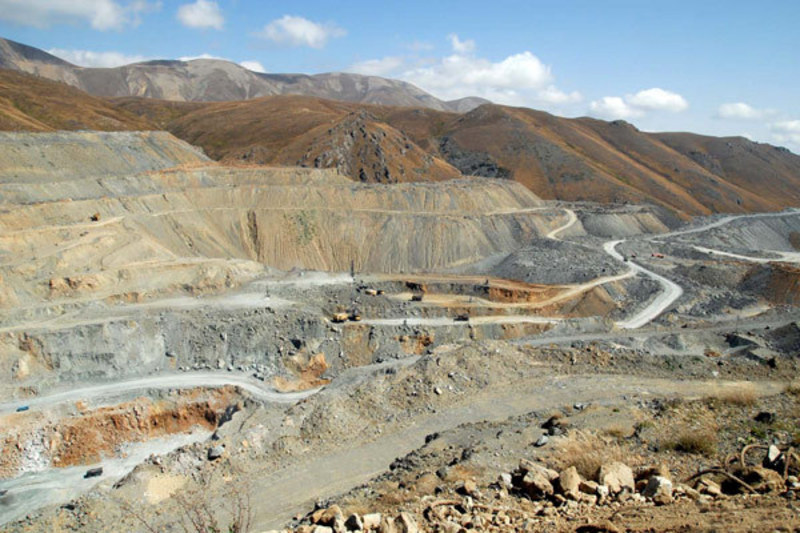

Curious statistics vividly illustrate the scale of the looting: whereas before 2002 the official extraction of gold in Armenia itself did not exceed two tons, after that the threshold jumped to 3.2 tons and higher — exclusively due to the predatory exploitation of Azerbaijan's mineral resources.
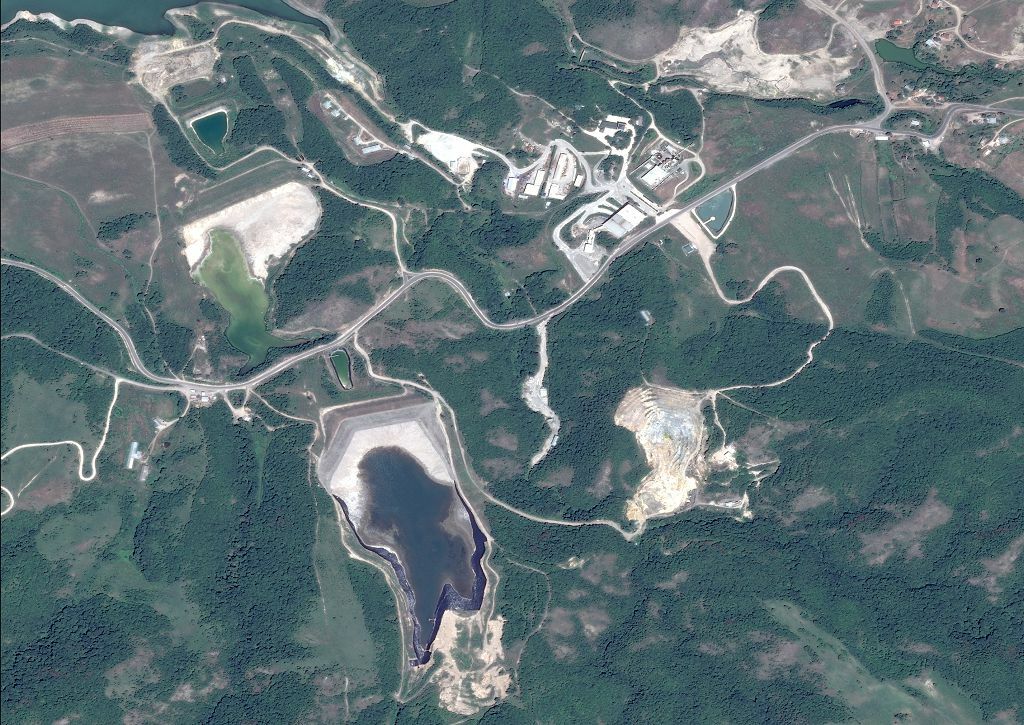
The mining industry usually creates heavily polluted tailings dumps, which require special treatment. The tailings dumps in the previously occupied territories contained millions of tons of waste saturated with heavy metals and other hazardous substances. There are also satellite images of the tailings dump formed as a result of the exploitation of the Gizilbulag copper-gold mine in the area of the village of Heyvaly (Kalbajar district); the expansion of the tailings dump as a result of the exploitation of the Demirli copper-molybdenum deposit was recorded, as well as deforestation within the framework of mining activity in the area of the village of Chardagly (Terter district).
.jpg)
An irrefutable fact of environmental and legal irresponsibility was the activity of the company Base Metals (a subsidiary of the Armenian Vallex Group), which for years provided up to a third of the separatists' income through the depletion of Azerbaijan's copper-molybdenum and gold mines.
The trail of Swiss capital looked even larger in scale. A citizen of Switzerland, head of the company Goldstar and co-founder of the watch brand Frank Muller, Vartan Sirmakes planned to build a plant in Armenia for smelting bank ingots — of course, using gold illegally pumped out of the Azerbaijani deposits "Soyudlu" and "Vejnali" in the Kalbajar and Zangilan districts. The plundered gold went to Swiss exchanges, settling in the accounts of foreign dealers. Later, after the illegal arrival in Karabakh of the Russian oligarch Ruben Vardanyan, a predatory struggle began over the redistribution of the shadow flows… Today Vardanyan is serving his lawful punishment in a Baku prison, while Sirmakes has been put on the international wanted list by the Prosecutor General's Office of Azerbaijan.
The plunder did not stop even after the end of hostilities. Baku's intention to conduct environmental monitoring in the plundered territories ran into stubborn resistance. This led to the historic 138-day peaceful protest action by Azerbaijani activists on the Lachin-Khankendi road, which lasted from December 12, 2022, to April 28, 2023. The "Stop Ecocide!" action made the world hear the voice of the pain of Azerbaijani nature and ended with the establishment by the State Border Service of Azerbaijan of a checkpoint on sovereign territory — on the border with Armenia, at the beginning of the Lachin-Khankendi road.

A new concept
Today Azerbaijan faces the large-scale task of restoring and technologically modernizing the liberated economic districts. One of the state's unconditional priorities has become the development of the mining and metallurgical industry on the principles of the strictest environmental standards. The State Program for 2027–2030, signed in April, assigns a key role to the liberated territories.
President of Azerbaijan Ilham Aliyev outlined specific benchmarks: "To resolve these issues within the framework of the State Program, we will apply very specific mechanisms. First of all, this concerns the earliest possible commissioning of deposits located in the territories liberated from occupation. These are, above all, the gold, copper, and molybdenum deposits in the Kalbajar, Aghdara, and Zangilan districts. In the Aghdara district, work has already begun. I hope that in the near future work will begin in Kalbajar and Zangilan, and thus the development of the already identified deposits will begin."
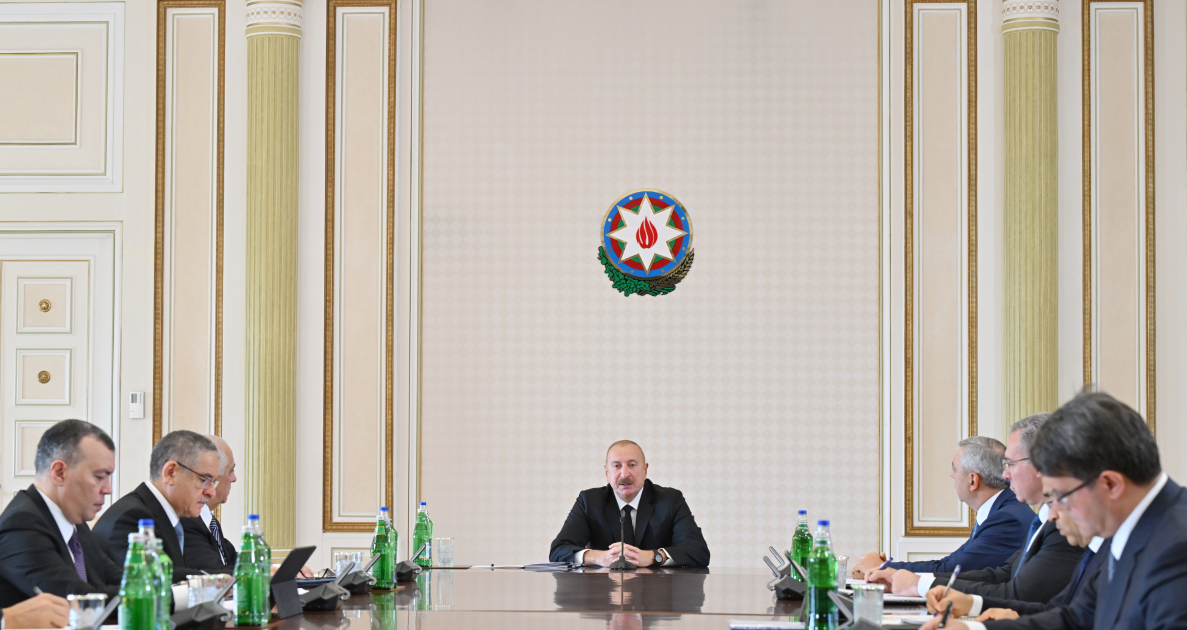
The head of state particularly emphasized the need for an innovative approach to assessing natural wealth: "At the same time, we must fully analyze the existing deposits and, using modern geological methods, completely clarify the reserves there. In Soviet times, certain figures were cited. But about 40 years have passed since then. The data is outdated, and besides, today there are new technologies that no one in Soviet times could even have imagined. The second direction. Considering that there are large natural resources in this region, such resources are presumably also present in other parts of these districts, as well as in neighboring districts. To this end, exploration and geological survey work will be carried out. A start has already been made. I say once again: there are the latest technologies."
***
Thus, the land that for decades bled from barbaric plunder, felled forests, and poisoned rivers has today turned into a giant construction site of the future. The era of devastation and fires has been replaced by an era of creation, where every kilometer of liberated territory receives a second wind thanks to a clear state strategy and deep respect for native nature.
Karabakh and East Zangezur are no longer a testing ground for criminal machinations and ecocide — the liberated lands are becoming a symbol of the triumph of life, justice, and the unfading strength of spirit of the Azerbaijani people.