
The historical vector of Victory: from the November 1992 congress to Azerbaijan's full sovereignty
The history of states knows no accidental triumphs.
Great victories that change the geopolitical map of a region and restore a people's national dignity never ripen overnight. At their core there always lies a clear point of reference — the moment when a nation standing at the edge of the abyss makes a conscious choice in favor of its own salvation. For modern Azerbaijan, such a turning point, one may say, was the founding congress of the New Azerbaijan Party (NAP) in Nakhchivan. It was there that the foundation was laid for the model of statehood that decades later led us to the full restoration of territorial integrity and the final assertion of sovereignty throughout the entire territory of the country.
Lessons of the 1990s: The price of state desertion
To fully appreciate the scale of today's successes, it is necessary to look without illusions at the catastrophe of the early 1990s. Those were times when Azerbaijani statehood was in fact falling apart under the burden of ineptitude, parochial egoism and the crimes of the authorities of that period. The PFA-Musavat tandem not only demonstrated complete incompetence in state governance — it brought the country to the brink of civil war and total military catastrophe in Karabakh.
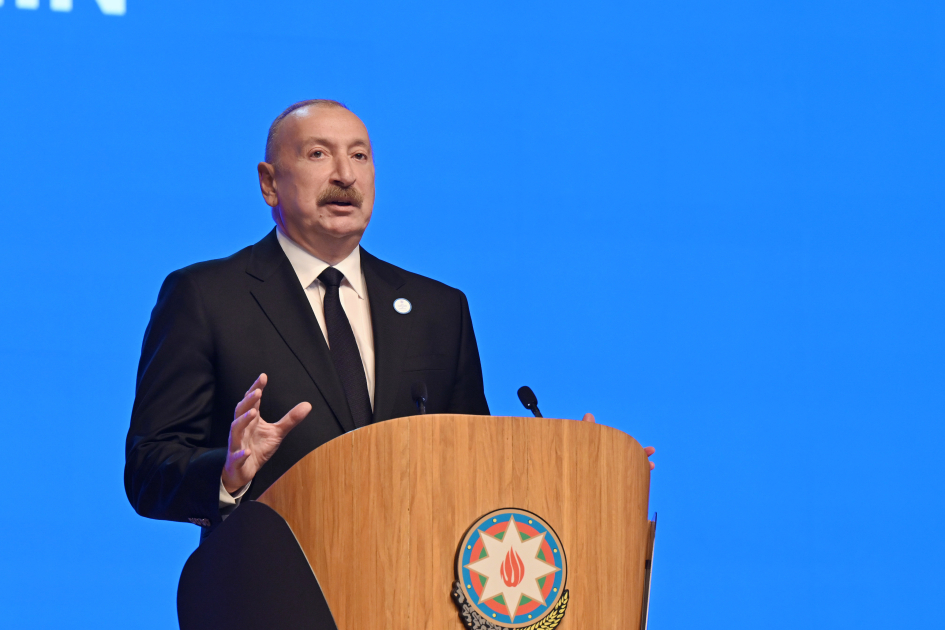
The main indicator of the political insignificance of that period was the catastrophic degradation of the institution of supreme power. Historical analysis demonstrates a paradoxical yet logical detail: after Heydar Aliyev left his leadership posts in the 1980s, the republic found itself in the hands of figures who possessed neither statesmanlike thinking nor elementary courage. Speaking at the VIII congress of the NAP held in Baku the day before, President Ilham Aliyev drew attention to a highly telling factual touch:
“In fact, if one looks at the period after Heydar Aliyev — I mean the 1980s — everyone clearly sees that the subsequent leaders of Azerbaijan were unable to comprehend their official duties, displayed weakness, cowardice and desertion. Suffice it to say that of the four leaders who headed Azerbaijan after Heydar Aliyev, both in the Soviet period and in the period of independence, three fled from Baku. In effect, they abandoned to the mercy of fate a country and a people that were at war and had been subjected to Armenian aggression, and fled from Baku. (…) This is a shameful page of history.”
Chaos in the economy, hyperinflation, an empty treasury and international isolation were accompanied by the outright flight of those who had taken upon themselves responsibility for the nation. The inept foreign policy of the PFA-Musavat tandem led to a situation in which Azerbaijan, which had become the victim of military aggression, was portrayed in the eyes of the world community almost as an aggressor, with this absurdity entrenched by the discriminatory Section 907 amendment.
Continuity and evolution: The course of Heydar Aliyev
The only salvation for the country in 1993 was the return of national leader Heydar Aliyev to the leadership of the state — a return that came about not as a result of behind-the-scenes arrangements, but at the unyielding demand of the Azerbaijani people.
It was Heydar Aliyev who formulated the basic philosophy of Azerbaijani statehood: the absolute priority of independence, resting on a self-sufficient economy, diplomatic flexibility and the systematic creation of a powerful military potential.
The decades that have passed have proved that Heydar Aliyev's strategy is not a frozen dogma, but a dynamically developing, constantly modernized system. The international situation, global challenges and the regional balance of power changed, which required the correction of tactical and certain strategic tasks. However, the general line has remained and remains monolithic.
“Today Azerbaijan is a country that commands great respect on the international arena. Many well-known experts and analysts already rank Azerbaijan in the category of middle powers. There are numerous parameters for this. We have fully secured economic independence. Today we are a highly authoritative member of the international community, our destiny is in our own hands. Over these years we have achieved the solution of any tasks we set for ourselves,” Ilham Aliyev stated at the NAP congress.
The philosophy of strength and reliance on one's own resources
The fundamental lesson of our most recent history is that in the modern world only those states survive and win that rely exclusively on their own strength. At a time when a million of our fellow citizens were suffering with the status of refugees and internally displaced persons, no one extended us a helping hand. Azerbaijan had to build its economic and army infrastructure under conditions of open pressure and injustice.
The implementation of grandiose energy and transport projects, the timely reduction of external debt to 5.6% of GDP — among the lowest in the world — the systematic equipping of the Armed Forces with modern technology and the training of a highly professional army are all elements of a single design. As a result, Azerbaijan approached the decisive historical moment fully independent of external centers of power. President Ilham Aliyev formulated Azerbaijan's foreign policy strategy as follows: “We are building and must continue to build our foreign policy in such a way that no one interferes in our affairs. We do not need anyone's help, just as we do not need anyone's patronage.”
The historic Victory of 2020 and the anti-terror measures of 2023, which fully restored our sovereignty, became the natural and logical outcome of the path begun in November 1992. The New Azerbaijan Party, created as a popular movement around Heydar Aliyev, traveled the path from the vanguard of saving the state to the main political pillar of a sovereign, strong and victorious Azerbaijan. At the heart of this transformation lay the ability of the political leadership to preserve unchanged the main essence, which consists in uncompromising loyalty to national interests and reliance on the will of its own people.
Ali Mammadov