"Everyone except Azerbaijan": UEFA has published a plan written for the event of defeat in its fight with FIFA
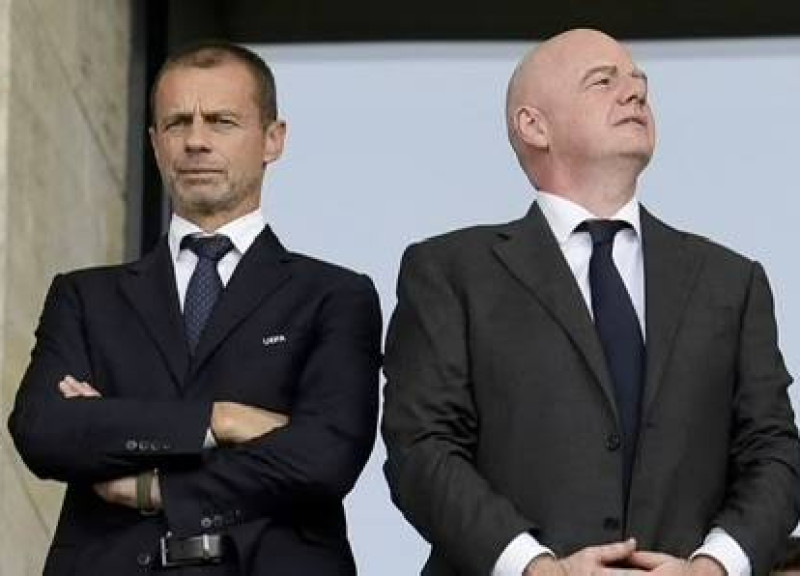
The European confederation has named the Association of Football Federations of Azerbaijan as the only one of the 55 that did not back its course on FIFA reform. And the course itself, published in full for the first time, looks as though the fight for the presidency has already been lost, and the point now is for the post to mean very little.
The key line of UEFA's statement of Oct. 8 reads like this: the European confederation and all the national associations, with the exception of the Association of Football Federations of Azerbaijan, have agreed on a clear direction for FIFA reform. The wording appears on UEFA's official site in exactly that form, naming the single dissenting federation.
It is a rare case of an organization itself, voluntarily and in writing, recording that its position is not unanimous. And naming the one that stayed out.
But far more interesting is what, exactly, Azerbaijan did not agree with.
A document written for the event of defeat
Attached to the statement is the package of FIFA reform proposals adopted in Berlin. It is being published in full for the first time: individual points have been heard before, but only now can they be seen assembled into a system. And that system speaks for itself.
The FIFA president, according to the document, is to chair the Council and represent the organization in the world, without performing management functions. The general secretary is appointed and supervised by the bureau. The international calendar and the composition of tournaments cannot be changed without unanimity in the bureau. The ethics, disciplinary and audit bodies are taken out from under the president's influence. Major decisions go through a mandatory chain: consultation, bureau, Council, decision.
Read that again, bearing in mind that the elections are in March.
For two months the conflict was about who would be FIFA president. From July 30, a boycott that never took place. From Aug. 10, letters from three confederations. From Aug. 20, talk of a vote of no confidence, for which the FIFA statutes provide no mechanism. From September, a demand to hand out the reserves to the federations. Not one of these lines led to a resignation.
And now comes a document that effectively takes the fight for the post out of the brackets. If the president's powers come down to chairing and representing, then the question of whose name will be on the ballot loses half its weight. This is not a plan for winning on Nov. 18 or in March. It is a plan for the event that victory comes neither on Nov. 18 nor in March.
A separate point in the document states that FIFA's resources cannot be used for personal or electoral purposes. A point that needs no comment.
A unity worth waiting for
Now about the formula "everyone except AFFA."
On the same day UEFA published its statement, the Associated Press reported that Azerbaijan and Latvia had promised Infantino their support, and stated outright: UEFA is not a single bloc. By the same agency's count, the incumbent FIFA president already has about 90 promised votes, against the 106 required and before a single challenger's name had become known.
So the formula "everyone except one" is what UEFA is declaring today, not what will be confirmed in March. The difference between those two things is the substance of the whole story of the past two months.
It has worked this way before. On July 30 UEFA announced that all 55 of its members had unanimously approved a withdrawal from FIFA tournaments. In the month the boycott was in force, not one European federation pulled out of a single tournament, neither those who demanded Infantino's resignation loudest nor those who preferred to keep quiet. On Aug. 27 the boycott was suspended without ever having begun. Unanimity on paper and behavior in practice turned out to be different quantities.
A roll-call vote differs from a collective statement precisely in that you cannot keep quiet along with the rest.
Ceferin stays
The same release announced that Aleksander Ceferin will after all run for a new term at the head of UEFA, in his words after a unanimous request from the associations that he reconsider his earlier decision. The election will be held on April 22, 2027, at the Congress in Astana.
For comparison: in February 2024 Ceferin said he would not stand for re-election in 2027. On Aug. 24, 2026, declining to fight for the FIFA presidency, he explained it by saying that his persuasiveness is considerably greater when he has no interest in the post.
A challenger has appeared, but not from UEFA
On Oct. 8, Ramon Vega announced his intention to run for FIFA president: a former defender for the Swiss national team and London's Tottenham, and a compatriot of Infantino. In his words, the current leadership has demoralized the game, and football is in intensive care.
In 2019 Vega already tried to stand and failed to collect the five nomination letters the statutes require: there were more than five sympathetic federations, by his account, but they feared the consequences. He has no UEFA backing, and he has not been named as the European confederation's single candidate.
The next meeting of the 55 national associations will be held before Nov. 17, a day before nominations close. UEFA today has no name it could put up against Infantino.
What the facts leave
Victory requires 106 votes out of 211. The vote is in March 2027 in Morocco. The incumbent president's opponents have a reform package, a criminal complaint being prepared in Switzerland, a request for documents in an American court, and not a single agreed candidate.
Since the end of July 1news.az has written consistently that a confederation's statement does not equal the position of its members, and that the vote will be cast not by six confederations but by 211 associations, one by one. On Oct. 8 UEFA recorded this itself, in its own document, naming a specific federation. Though only one.
AFFA had no comment on UEFA's statement at the time of publication.