The Baku vector of Eurasian diplomacy: a new point of support for Europe and Asia

Azerbaijan is strengthening its position in international politics, moving from the role of a regional partner to more active participation in organizing dialogue between different geopolitical spaces.
For Azerbaijan, the European Political Community is becoming not merely a venue for diplomatic contacts, but a space in which the interests of European security, energy, transport interconnectivity and regional peace intersect.
On November 12, Dublin will host the ninth summit of the European Political Community (EPC), which will bring together about 50 heads of state and government of European countries. The theme of the meeting — “Europe — strong, secure and interconnected” — reflects the key challenges facing the continent: ensuring economic competitiveness, developing innovation, strengthening transport links, access to energy resources, security and defense.
However, for Azerbaijan the significance of the Dublin meeting goes far beyond its official agenda. The summit is taking place at a time when European countries are reconsidering their approaches to energy security, transport logistics and international cooperation, while the South Caucasus is gradually acquiring new importance in the emerging system of regional ties. Under these conditions, relations with Baku are becoming important in several directions at once.
A special political dimension is added to this process by the decision to hold the twelfth EPC summit in Azerbaijan in May 2028. Thus, Dublin becomes not only another venue for discussing European problems, but also an important stage on the way to the meeting that Baku is to host.

The main question is no longer only what economic and political interests link Azerbaijan with Europe, but also what role the country is able to play in shaping a broader international dialogue.
Without institutional barriers
The European Political Community was established in October 2022 in Prague. The initiative envisaged the creation of a pan-European format that would bring together member states of the European Union and countries outside it to discuss common political and strategic issues.
The fundamental feature of the EPC lies in its informal and consultative nature. It is not an international organization with independent supranational institutions and binding decision-making mechanisms, but a platform for direct communication between heads of state and government. Its task is to expand political consultations, strengthen mutual understanding and create conditions for cooperation on issues of security, the economy, energy and regional stability.
It is precisely the flexibility of the format that determines its relevance. Europe already has numerous international organizations responsible for various areas of cooperation. Therefore, the additional value of the EPC lies in the opportunity to bring together states with different political positions to discuss issues that cannot be effectively resolved within narrow institutional frameworks.
This approach also corresponds to Azerbaijan’s position. Baku advocates open political dialogue and mutual consultations, and does not regard the creation of a new international bureaucratic structure as a necessary condition for cooperation. For Baku, the EPC is important above all as a space for the direct representation of national interests at the level of European leaders. Here it is possible to discuss issues of regional security, energy partnership, transport communications and relations with neighboring states, without being limited to the framework of individual bilateral formats.
Since its founding, the community’s agenda has consistently expanded. Energy security, migration, transport, economic development, innovation and defense have become permanent topics of the meetings. The Dublin summit continues this line, combining economic competitiveness and security with the development of interconnectivity.
For Azerbaijan it is fundamentally important that these issues directly coincide with the main directions of its foreign and economic policy.
Multifaceted cooperation
The interest of European states in Azerbaijan has a concrete economic and geopolitical basis. It is connected with the country’s energy resources, its transit capabilities, its position at the crossroads of transport routes between Europe and Asia, as well as its role in regional processes in the South Caucasus.
In recent years, this interdependence has been reflected in the expansion of contacts at the highest level. An important factor has been the strengthening of Azerbaijan’s international standing and the personal diplomatic contacts of President Ilham Aliyev with the leaders of European states and institutions.
The dynamics of meetings at international venues is telling. A number of bilateral talks held by the Azerbaijani leader in Davos, Munich and other international centers took place at the request of European partners. Such practice testifies to the demand for direct dialogue with Baku and to the fact that Azerbaijan is viewed as an independent participant in the discussion of regional and international issues.
Further evidence of these dynamics has been the visits of high-ranking representatives of the European Union to Azerbaijan. In 2025, the country was visited by EU High Representative for Foreign Affairs and Security Policy Kaja Kallas and Commissioner for Enlargement Marta Kos. In March of this year, visits were made by President of the European Council António Costa and European Commissioner for Energy and Housing Dan Jørgensen. The talks with President Ilham Aliyev covered areas of direct importance for the further development of relations.
However, diplomatic contacts alone do not exhaust the content of the partnership. Its most substantive foundation is energy. In this context it is appropriate to recall the conclusion in July 2022 of the Memorandum of Understanding on a Strategic Partnership in the Field of Energy, signed by President of Azerbaijan Ilham Aliyev and President of the European Commission Ursula von der Leyen. The document gave additional impetus to cooperation at a time when European states began to pay particular attention to diversifying sources and routes of energy supplies.
The Southern Gas Corridor has become an important instrument for expanding Azerbaijan’s presence on the European energy market. Today the country exports natural gas to 16 states, including 10 EU member countries. The expansion of the geography of supplies demonstrates that the Azerbaijani direction has become part of a broader system of European energy security.
At the same time, cooperation is gradually moving beyond the traditional gas sector. An important place is occupied by renewable energy. The wind energy potential of the Caspian Sea, solar power plants, projects for transmitting “green” energy from Central Asia and the prospect of laying an electric cable along the bottom of the Black Sea are forming new areas of interaction with European markets.
It is notable that international interest in these projects is also manifested at the level of specialized intergovernmental mechanisms. In March 2026, Baku hosted the 12th ministerial meeting within the framework of the Advisory Council on the Southern Gas Corridor and the 4th ministerial meeting within the framework of the Advisory Council on Green Energy. The meeting was attended by 27 countries, including Azerbaijan and European states, 11 international financial institutions and organizations, as well as 49 energy companies. This is important not only from the point of view of specific energy projects. Baku is becoming a platform where long-term approaches to shaping energy links between Europe, the Caspian region and Central Asia are discussed.
Thus, the energy partnership is acquiring broader content: from natural gas supplies to the development of cross-border infrastructure, renewable energy and new forms of regional interdependence.
Transport infrastructure as a geopolitical resource
The second direction enhancing Azerbaijan’s importance for Europe is transport interconnectivity. Changes in world trade, the need to diversify logistics routes and increased requirements for the resilience of supply chains have made alternative transport corridors one of the priorities of international economic policy.
In this context, the Middle Corridor, connecting China and Central Asia via the Caspian Sea, Azerbaijan and the South Caucasus with Turkey and European markets, acquires particular importance.
The country’s geographical position, the Baku International Sea Trade Port, and railway and road infrastructure create the basis for the development of this route. Azerbaijan acts not merely as a transit territory, but as one of the key hubs ensuring interaction between various transport systems.
However, geography alone does not guarantee the competitiveness of the route. To fully unlock the potential of the Middle Corridor, it is necessary to expand infrastructure capacity, speed up border procedures, digitalize customs systems, harmonize tariff policy and increase the efficiency of interaction between participants in transportation. It is precisely these practical tasks that will determine how sustainable and attractive the route becomes in the long term.
The development of the Baku port, railway communications and cooperation on the Nakhchivan railway link are important not only for internal transport connections. They are capable of expanding economic contacts between Europe, the South Caucasus and Central Asia.
An important indicator of the practical content of the partnership is also Azerbaijan’s participation in the European Global Gateway initiative. The volume of investments mobilized in the country within the framework of this initiative has exceeded 130 million euros.
The combination of energy and transport capabilities forms a special model of cooperation. Europe gains additional opportunities for diversifying supplies and routes, while Azerbaijan strengthens its role in international economic ties.
In this sense, the agenda of the Dublin summit is highly indicative: energy security, the competitiveness of the economy and transport interconnectivity can no longer be viewed as isolated areas.
Peace as a condition for economic interconnectivity
Security remains one of the central issues on the agenda of the European Political Community. The Russian-Ukrainian war, hybrid and cyber threats, the protection of critical infrastructure and the resilience of state institutions form the common problematic of European political dialogue.
For Azerbaijan, the most important regional dimension of this agenda is the establishment of sustainable peace in the South Caucasus. The peace process between Baku and Yerevan creates the preconditions for the region’s transition to a new model of interaction. The sustainability of this process will depend on the consistent implementation of the agreements reached, the strengthening of mutual trust and the development of practical cooperation.
At the same time, the stability of the South Caucasus is directly linked to the prospects for the development of the Middle Corridor, the expansion of trade, the attraction of investments and the formation of new transport communications between Europe and Asia. In this context, the address by President Ilham Aliyev via video link at the eighth EPC summit, held in Yerevan on May 4, 2026, deserves particular attention.
The very participation of the President of Azerbaijan in a high-level event held on the territory of Armenia became a remarkable episode in the context of the ongoing peace process. The head of state touched upon the issues of Azerbaijani-Armenian normalization, emphasized the significance of the progress achieved and announced the acceptance of the proposal to hold the next summit in Azerbaijan in 2028. The broader political meaning of what is happening is also important. With the signing of a peace agreement, the South Caucasus will be transformed from a space of prolonged confrontation into a region of economic interaction. For Azerbaijan this means both the strengthening of security and the creation of conditions for implementing new transport, energy and investment priorities.
That is precisely why peace in the South Caucasus should be viewed not as a separate diplomatic topic, but as a necessary component of a long-term strategy for regional development.
Azerbaijan and the EPC: the experience of 2022–2026
The history of Azerbaijan’s participation in the summits of the European Political Community shows that Baku approaches this platform pragmatically. In the period from 2022 to 2026, this approach manifested itself in several key episodes.
Prague, Czech Republic, October 2022
Within the framework of the meeting, four-party talks were held between President Ilham Aliyev, Prime Minister of Armenia Nikol Pashinyan, President of France Emmanuel Macron and the then President of the European Council Charles Michel. Following the meeting, the parties confirmed their commitment to the UN Charter and the 1991 Alma-Ata Declaration. The confirmation by the Armenian side of Azerbaijan’s territorial integrity was of particular importance. No less important was the issue of the EU monitoring mission. Initial plans provided for the possibility of extending its activities to both sides of the Armenian-Azerbaijani border. However, after objections from Baku, the mission was deployed exclusively on the territory of Armenia.
The Prague meeting demonstrated that the EPC can be used to discuss issues of direct importance for territorial integrity, sovereignty and security.
Bulboaca, Moldova, June 2023
President Ilham Aliyev personally took part in the meeting, which was chaired by President of Moldova Maia Sandu.
On the sidelines of the summit, bilateral and multilateral talks were held. The main topics were the normalization of relations between Azerbaijan and Armenia, the delimitation of borders and the opening of transport communications.
Thus, the EPC platform continued to perform the function of direct political dialogue on issues of regional settlement.
Granada, Spain, October 2023
President Ilham Aliyev declined to participate in this meeting. The decision was connected with unfounded critical statements addressed to Azerbaijan following the anti-terrorist measures of September 2023, as a result of which the country’s sovereignty over all of its territory was restored.
Baku regarded the approach of a number of participants in the meeting as one-sided and biased. This episode demonstrated that participation in an international platform is not an end in itself. For Azerbaijan, the possibility of substantive dialogue and consideration of its legitimate interests are of fundamental importance.
Oxford, United Kingdom, July 2024
President Ilham Aliyev spoke at a roundtable devoted to energy and transport links. The head of state drew attention to the recognition of Azerbaijan by the European Commission as a reliable energy partner. He emphasized the responsibility that such a status entails and confirmed the goal of increasing annual gas supplies to the European Union.
It was also noted that the necessary resource and infrastructure capabilities exist for the implementation of this task.
Budapest, Hungary, November 2024
The President of Azerbaijan did not take part in this event in person due to other important commitments.
Tirana, Albania, May 2025
At meetings with President of the European Commission Ursula von der Leyen and President of the European Council António Costa, Azerbaijan was characterized as an important and reliable partner of the EU. The country’s role in the development of the Middle Corridor was separately emphasized.
It was precisely in Tirana that the prospect of holding the next summit in Armenia in May 2026 was discussed. The EU leadership inquired about President Ilham Aliyev’s opinion regarding this initiative, and the head of state supported it.
In the course of subsequent contacts, a mutual agreement was reached to support the candidacies of Armenia and Azerbaijan for hosting the summits in 2026 and 2028, respectively.
Copenhagen, Denmark, October 2025
President Ilham Aliyev took part in the opening of the plenary session of the summit during a working visit. Against the backdrop of the continuing normalization process, Baku supported Armenia’s initiative to hold the next meeting in Yerevan. In turn, the Armenian side supported Azerbaijan’s candidacy for hosting the summit in 2028.
This mutual step acquired independent political significance. It showed the ability of the parties to support initiatives aimed at developing international dialogue.
Yerevan, Armenia, May 2026
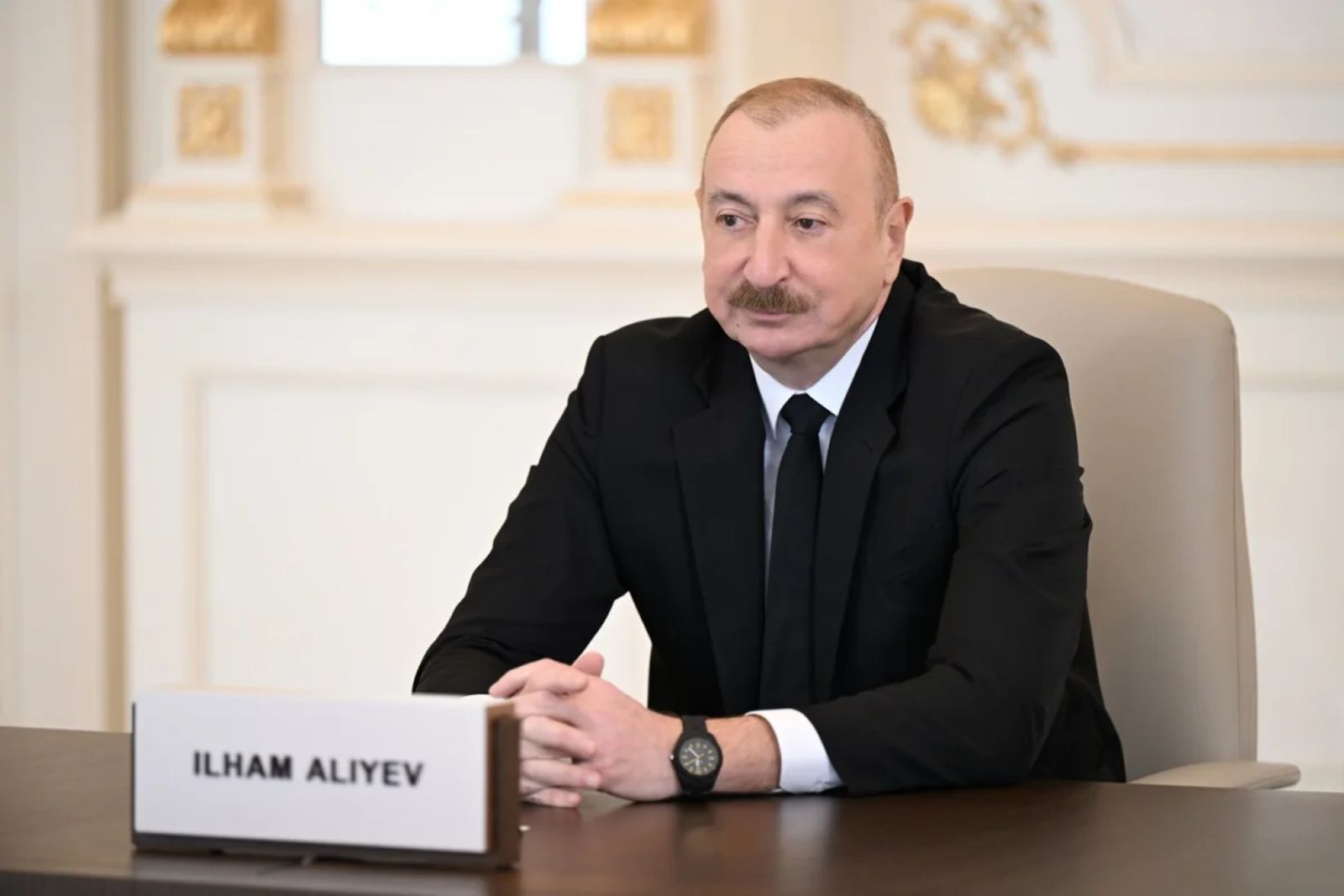
President Ilham Aliyev addressed the participants of the meeting via video link. In his speech, the head of state confirmed Azerbaijan’s support for holding the summit in Armenia and announced the decision to hold the next meeting in Baku in May 2028.
Prime Minister Nikol Pashinyan also noted that the two countries had supported each other’s candidacies and expressed the hope of taking part in the summit in Azerbaijan. President Ilham Aliyev, along with the issue of organizing the future meeting, again addressed the topic of territorial integrity and the peace process, emphasizing the need for a consistent and equitable approach to the relevant principles of international law.
An analysis of these eight meetings makes it possible to identify several main directions.
First, Azerbaijan used the EPC to promote its position on territorial integrity and to discuss the parameters of normalization of relations with Armenia.
Second, Baku demonstrated a selective approach to participation in the summits: from the personal presence of the head of state to a remote address or refusal to participate — depending on the specific political situation.
Third, energy and transport cooperation gradually became an independent direction of political dialogue with European institutions.
Finally, reaching the agreement on holding the summit in Baku in 2028 became the result of the expansion of political contacts and mutual support for the candidacies of the two South Caucasus states.
Taken together, these episodes show that for Azerbaijan the EPC is not a formal venue for international presence; it is an instrument of multilateral diplomacy whose effectiveness is determined by the concrete content of negotiations.
Baku-2028
The decision to hold the twelfth summit of the European Political Community in Azerbaijan in May 2028 is of particular importance. President Ilham Aliyev, speaking at the Yerevan summit in May of this year, noted that Azerbaijan’s candidacy had been accepted. This decision was a continuation of the agreement reached within the framework of previous meetings. The political significance of the upcoming event lies above all in the change of Azerbaijan’s role within the format itself.
Until now, Baku has participated in the discussion of pan-European problems, presenting its own position and developing contacts with European leaders. In 2028, the Azerbaijani capital will have to receive representatives of states and international institutions, determine the organizational parameters of the meeting and provide a venue for discussing the common political agenda.
This is already a different level of involvement. Hosting the summit will make it possible to take Azerbaijan’s relations with European states beyond predominantly energy and transport issues. Broader topics will come to the fore — security, regional stability, political consultations, economic cooperation and the prospects for the development of the European space.
A special role in the preparation for this event is played by the current summit in Dublin. Azerbaijan is given the opportunity to assess the current priorities of the participants, the nature of political discussions and the mechanisms of interaction between states.
The experience of Dublin may be used in forming the Baku agenda, which should take into account both the common interests of European countries and issues of direct importance for Azerbaijan and the South Caucasus.
At the same time, the 2028 summit is important not only from the point of view of international representation. It creates an opportunity to demonstrate the practical results of regional cooperation, including progress in Azerbaijani-Armenian normalization, the development of transport communications and the expansion of economic ties.
In the event of consistent advancement of the peace process, Baku will be able to receive EPC participants in the conditions of a new regional reality, in which the South Caucasus is viewed not through the prism of conflicts, but as a space of economic opportunities.
At the crossroads of geopolitical spaces
Holding the EPC summit in Baku acquires additional significance against the background of the expansion of Azerbaijan’s international activity in several directions at once.
The country’s foreign policy is not limited to the European vector. The development of relations with Central Asia, the Islamic world and the CIS states forms a broader geography of international cooperation.
The development of the Asian direction is especially indicative. On October 15 of this year, Baku hosted the seventh summit of the Conference on Interaction and Confidence Building Measures in Asia (CICA). Following the meeting, with the support of the participating states, Azerbaijan’s chairmanship of the organization was extended until 2028. The significance of this decision goes beyond diplomatic representation. CICA covers a wide range of issues, including security, economic interaction, transport interconnectivity, digitalization and sustainable development. The chairmanship allows Azerbaijan to participate more actively in shaping the agenda of Asian cooperation and to develop contacts with the states of the continent.
No less important a direction is the Islamic world. In 2027, Baku will host the sixteenth summit of the Organization of Islamic Cooperation, and Azerbaijan will chair the organization. This will create additional opportunities for political coordination, the development of economic and humanitarian ties between member states, as well as the promotion of joint international initiatives.
Another important element of the foreign policy strategy is Central Asia. At the seventh Consultative Meeting of the Heads of State of Central Asia on November 16, 2025 in Tashkent, a decision was taken on Azerbaijan’s accession to the platform as a full participant. And already at the eighth meeting on October 8 of this year in Turkmenbashi it was announced that Azerbaijan would chair this format for the first time in 2027.
These decisions reflect the deepening of political and economic interaction between Azerbaijan and the states of Central Asia. Of particular importance here are transport routes across the Caspian Sea, energy cooperation, trade and the development of interregional infrastructure.
Thus, in the coming years Azerbaijan will simultaneously participate in the European political agenda, develop cooperation with Asian states, chair CICA and the Organization of Islamic Cooperation, and occupy a new position in the consultative format of Central Asia.
What matters is not so much the list of international events itself as their interconnection. Europe is interested in reliable energy supplies and alternative transport routes. Central Asia seeks to expand ties with world markets. The Islamic world is interested in strengthening political and economic coordination. Asian states regard issues of security, trust and interconnectivity as the most important conditions for sustainable development.
Azerbaijan interacts with all of these directions, and many of them intersect within the framework of specific projects and initiatives.
It is here that Baku’s broader diplomatic perspective is manifested. The country gains the opportunity not only to develop relations with individual states, but also to act as a platform for reconciling the interests of various international participants. The realization of this perspective requires not only geographical position and diplomatic activity, but also the ability to ensure conditions for substantive, consistent and mutually acceptable dialogue.
Diplomacy as a strategy of interconnectivity
The agenda of the ninth summit of the European Political Community and Azerbaijan’s international activity in recent years demonstrate an obvious coincidence of interests in a number of key areas.
Europe needs reliable sources of energy resources, diversified transport routes, sustainable supply chains and a stable external environment. Azerbaijan has the capabilities to participate in solving these tasks thanks to its energy infrastructure, transit potential and the development of regional cooperation.
The Southern Gas Corridor strengthens energy ties with Europe. The Middle Corridor expands transport interconnectivity between Europe and Asia. Renewable energy projects create prospects for a new stage of economic partnership. Finally, the advancement of peace in the South Caucasus is capable of creating additional conditions for trade, investment and regional integration.
But to reduce Azerbaijan’s significance solely to its resources and geographical position would be insufficient. The diplomatic dimension is becoming no less important. Participation in the EPC, the chairmanship of CICA, the upcoming leadership of the OIC and of the consultative format of Central Asia, and the holding of major international meetings in Baku are shaping a new configuration of the country’s foreign policy opportunities.
At the same time, the key condition for turning these opportunities into a long-term result remains their substantive content. International platforms acquire real value when they make it possible to reach agreements, strengthen trust and launch practical projects.
Thus, the EPC summit in Baku in 2028 will become not merely a demonstration of the country’s organizational capabilities, but an opportunity to strengthen its role in shaping the international agenda and developing dialogue between various geopolitical centers. Its deeper meaning lies in the possibility of bringing Azerbaijan to the center of a broad political conversation about the future of Europe, the security of Eurasia and the prospects for regional cooperation.
In this respect, the Dublin summit becomes an important point of reference. The path from Dublin to Baku is not merely a sequence of two international meetings. It is a reflection of Azerbaijan’s changing role: from a state representing its interests at multilateral venues to a country capable of creating a space for negotiations between various political and geopolitical centers. And it is precisely the ability to transform this diplomatic presence into real agreements, trust and cooperation that will determine the true significance of the new stage of Baku’s international activity.