"Koschei's needle": the main challenge of Armenian-Azerbaijani reconciliation
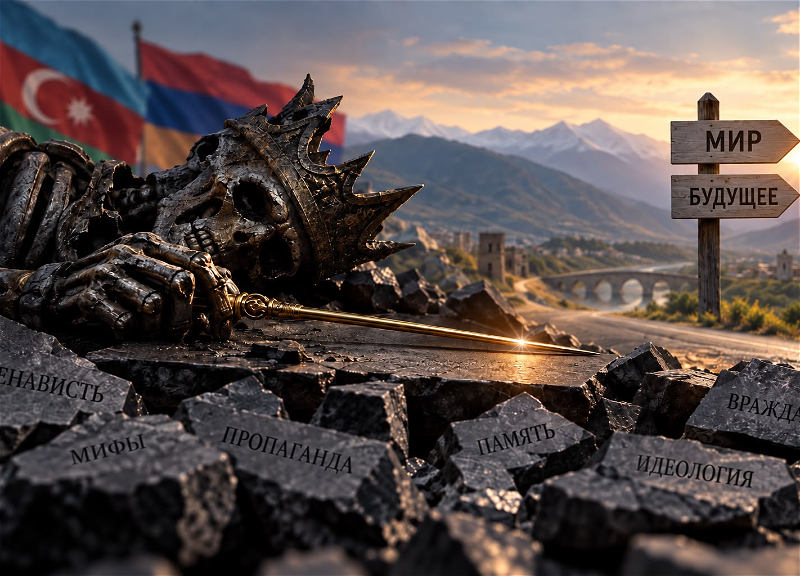
Three years after the events of September 2023, the South Caucasus is already living in a different political reality. But the end of the war and even the signing of a peace agreement do not yet mean the final overcoming of the conflict. Ramiz Yunus, professor of political science at Khazar International University, reflects on why the main test for Armenian-Azerbaijani reconciliation is becoming not diplomacy, but historical memory, ideology, and the readiness of societies to renounce the image of an eternal enemy.
***
Three years ago, on September 19, 2023, Azerbaijan launched an anti-terrorist operation against Armenia's armed formations in Karabakh. The operation lasted 23 hours and 43 minutes and ended on September 20 with a ceasefire and the capitulation of the separatist forces. It was then that the final point was placed in an armed conflict that had continued for decades.
Today, three years later, the significance of those events can no longer be viewed solely through the prism of military history.
September 19, 2023, became not only the day one war ended, but the beginning of a completely new political era in the South Caucasus.
After Azerbaijan restored full control over its internationally recognized territory, the very subject of the previous conflict disappeared. Gone was the reality around which an enormous political, diplomatic, and informational construct had been built for decades. Gone, too, was the objective need for structures created to settle precisely this conflict.
A telling example is the OSCE Minsk Group. Following the joint appeal by Armenia and Azerbaijan on September 1, 2025, the OSCE decided to close the Minsk Process and its related structures, and on November 30, 2025, their closure was completed.
It would seem that everything is simple.
There is no former conflict — so there is no need for the former mechanism for its settlement, but this is precisely where the most interesting part begins.
Because a war can be ended by a military operation, the political reality can be changed, an international structure can be closed, and a peace treaty can be signed, but there is one thing that cannot be changed by a single government decision or a single signature under an international document.
That is human consciousness.
That is why I am convinced: the main problem of the Armenian-Azerbaijani peace process today lies no longer only in the sphere of diplomacy, borders, communications, or legal wording.
It lies much deeper: in ideology, in historical memory, in the image of the neighbor that has been shaped in the consciousness of society for decades, and, to put it quite bluntly, it is precisely here that the very "needle of Koschei" is located, without the destruction of which it is impossible to be finally rid of the old conflict.
Let us recall how quickly political rhetoric changes when political reality changes.
In August 2019, speaking in Khankendi, Prime Minister Nikol Pashinyan declared: "Karabakh is Armenia, and that's it." This is not someone's retelling of his position by one of his opponents — it is the officially published text of the Armenian prime minister's own speech.
Several years passed.
After the events of 2023, the Armenian leadership began to proceed from recognition of Azerbaijan's territorial integrity, and as early as February 2024 Pashinyan directly said that Armenia and Azerbaijan recognize each other's territorial integrity on the basis of the 1991 Alma-Ata Declaration. And in 2025 he was already speaking of both countries' recognition of sovereignty, territorial integrity, and the inviolability of internationally recognized borders.
Political reality changed, and along with it political rhetoric changed. But here the main question arises: is this enough, and can public consciousness be changed as quickly as a foreign policy course changes?
Here I would not rush to answer.
Because political expediency is one thing, and strategic rethinking is quite another.
A politician can make a political turnaround, a state can change its foreign policy course, and a government can recognize what only yesterday it categorically denied.
But society does not change on command, especially a society that has twice gone through war, lost thousands of people, lived for decades in an atmosphere of mutual hatred, and received an entirely specific picture of its own history and image of the neighboring people.
That is precisely why I am certain: such crises in the process of Armenian-Azerbaijani normalization will arise more than once.
Yesterday there was one crisis, today another, and tomorrow a third will arise, and this by no means signifies that the peace process has stopped. On the contrary, it means that it has reached a far more complex level.
As long as the matter concerned territory, borders, communications, international structures, and political statements, the dispute was primarily between states.
Now a conversation about society is gradually beginning, and this is far more difficult, because territory can be liberated, a border can be demarcated, an international structure can be closed, and a document can be signed, but how do you remove from a person's head the image of the neighbor as an eternal enemy?
That is the main question.
The recent story with the visits of foreign diplomats to Karabakh and East Zangezur showed how painfully the very new reality of Azerbaijan is perceived in certain Armenian circles. I wrote about this in detail in my article "The Litmus Test of Peace," and I do not want to repeat its arguments.
But the current crisis is interesting precisely from another angle, since it shows that as the peace agenda advances we are approaching that very red line beyond which diplomatic expediency ends and ideology begins.
And here that very "needle of Koschei" arises, and the constitutional question in Armenia is only one of its elements.
Azerbaijan considers it necessary to remove from the Armenian constitutional system any provisions that may be regarded as territorial claims. The Armenian side, in turn, asserts that Armenia's Constitution itself contains no direct or indirect mention of Karabakh, pointing to the particular nature of the preamble's reference to the Declaration of Independence.
But if we set aside the legal dispute, there is a fact that cannot be denied: Armenia's 1990 Declaration of Independence directly refers to the joint decision of December 1, 1989, on the "reunification" of the Armenian SSR and the Nagorno-Karabakh Autonomous Region. And the Constitution of Armenia itself, in its preamble, proclaims as the foundation of statehood the national aspirations enshrined in the Declaration of Independence.
Therefore the question here is far broader than a single legal dispute.
Even if tomorrow all the necessary amendments are made and a peace treaty is signed, this still does not mean the automatic disappearance of the ideological environment that for decades shaped Armenian society's attitude toward Azerbaijan and Turkey.
And here we come to the most painful thing: to historical memory, to school textbooks, to public symbols, to monuments, to heroes, and to whom the state and society consider worthy of remembrance.
A monument, after all, is not just bronze or stone; it is a statement by the state and society to the future generation, and it is an answer to the question: whom do we propose that a young person consider a hero?
That is precisely why the story of the monument to Garegin Nzhdeh, who as an accomplice of the Third Reich was sentenced to life imprisonment, has significance far beyond a single monument.
In 2016, the monument to Nzhdeh was unveiled in the center of Yerevan. The ceremony was attended by Armenia's then-president Serzh Sargsyan, who laid flowers at the monument. Yerevan's official city resource to this day calls Nzhdeh a national ideologist and directly writes that the monument not only preserves his memory but also "passes his ideas on to generations," fostering the national spirit.
And here arises a question that cannot be bypassed.
How is it possible simultaneously to build peace with a neighboring people and to preserve, in the very center of the capital, public symbols of the past associated with an ideology of national exceptionalism and confrontation with neighbors?
This is a question not only for today's authorities; it is a question for society, because the peace process requires not only new political statements, but a new attitude toward the past.
I deliberately do not want to turn this article into yet another biographical discussion about Nzhdeh. There are historians and specialists for that. But one cannot ignore the fact that his activity and his ideological legacy are still the subject of the most serious disputes throughout the world, including the question of his relations with Nazi Germany during the years of the Second World War.
And all the more, one cannot ignore the fact that modern Armenia itself continues to publicly immortalize him as a national ideologist.
This is no longer history; this is the present, and therefore the future as well.
But Garegin Nzhdeh is only one symbol of a much broader problem.
In Yerevan there are also other monuments, memorials, and places of remembrance associated with people who committed terrorist acts against representatives of Azerbaijan and Turkey, and here again the same question arises: what exactly are we passing on to the next generation? History or a cult of the past? Memory or hatred? National pride or national exceptionalism?
These are fundamentally different things.
Any people has the right to remember its history, to honor its dead, to preserve its national identity, but not one of these rights requires turning a neighboring people into an eternal enemy, and it is precisely here that the line runs between healthy historical memory and the ideology of conflict.
One can remember one's own tragedies without turning them into a license for hatred toward the children of the next generation. One can respect one's own heroes without making the enemy an eternal historical category, and one can love one's country without cultivating contempt for another.
But if Armenia truly wants to move from a state of "after the war" to a state of stable peace, sooner or later it will have to answer precisely these questions.
Not to Azerbaijan, not to Turkey, not to the West, not to Russia, but to itself, because the political history of recent years has already shown one simple thing: reality is stronger than political myths.
For many years a political construct existed around Karabakh, and it collapsed. For many years an international construct existed around the Minsk Group, and it, too, passed into history. In September 2025, the OSCE officially closed the Minsk Process at the joint request of Armenia and Azerbaijan.
But ideological constructs do not disappear along with international organizations, and therefore today it is not enough simply to say: "Karabakh is Azerbaijan."
These words must one day become not only a government's political formula, but also part of a new reality accepted by society, and this is far more difficult.
Because it is one thing to follow political expediency, and quite another to strategically rethink the causes that led to the current state of Armenian-Azerbaijani relations.
One can recognize Azerbaijan's territorial integrity because the changed balance of forces demands it, and one can recognize it because one has truly understood: the former policy was a dead end.
One can sign a peace treaty because there is no other way out, and one can sign it as the beginning of a new historical era, and between these two approaches there is an enormous difference.
That is precisely why I do not think that today's peace process should be measured only by the number of signed documents, since there is a far more important indicator.
Is the attitude of the societies toward each other changing, is the image of the eternal enemy disappearing, is the language of school textbooks changing, is the attitude toward the symbols of the past changing, and is violence ceasing to be glorified?
Are children in Azerbaijan and Armenia beginning to perceive each other not as a continuation of their grandfathers' war, but as neighbors who will have to live side by side?
Only then will it be possible to speak of a real turning point, and until then we will have only political normalization, and that is not yet historical reconciliation, and therein lies the main paradox of the present moment.
Azerbaijan won the war, and now the entire South Caucasus faces a far more difficult task — to win the peace, and for that a strong army, diplomacy, and international agreements are not enough.
A new political culture is needed, a new historical culture, and it is necessary to learn to distinguish memory from revenge, patriotism from hatred, national identity from national exceptionalism.
Because peace between states may begin with the signatures of presidents, but peace between peoples begins in an entirely different place: it is in a person's head.
That is precisely why I would not perceive yet another crisis as proof that the peace process has failed; on the contrary, each such crisis shows exactly where the old mines lie, and the current crisis has revealed one of the deepest.
We have come up against the ideological component of the conflict, that very "needle of Koschei," and if political leaders truly want the new page of history not to turn out to be a temporary pause between two wars, this needle will sooner or later have to be found.
Because it is possible to destroy the separatist project, close the Minsk Group, sign a peace treaty, open borders and transport communications, but if the image of the neighbor as a historical enemy continues to live in the consciousness of the new generation, then the conflict simply changes its form.
That is precisely why real peace begins where the reproduction of hatred ends.
War ends on the battlefield, and peace begins in people's heads, and here I would like to conclude with the words of Albert Einstein, who said: "Peace cannot be kept by force; it can only be achieved by understanding."
But understanding is not the forgetting of one's own history; it is the ability to look at it without hatred, and perhaps it is precisely this that both Azerbaijan and Armenia must learn today.