Sadyr Japarov strengthens partnership with Azerbaijan — a new chapter in relations
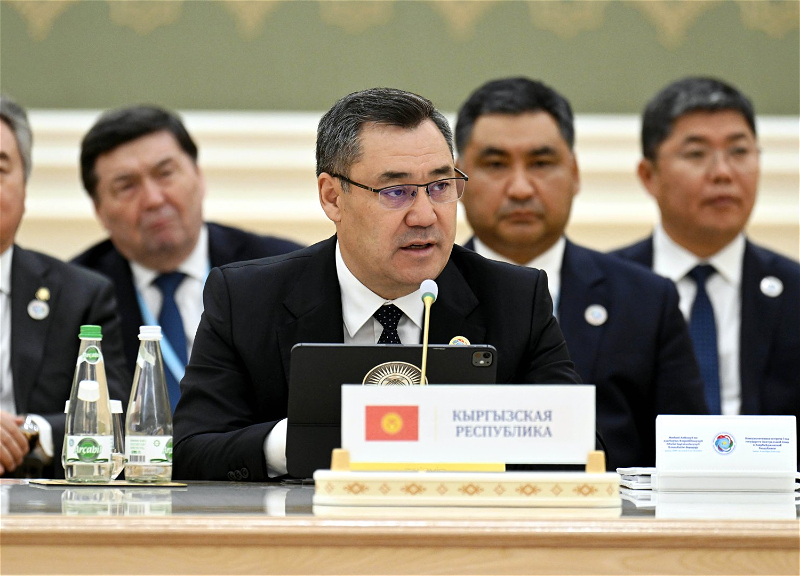
Kyrgyz President Sadyr Japarov took part on October 8 in the eighth Consultative Meeting of the Heads of State of Central Asia and Azerbaijan, which is being held at the "Avaza" complex in Turkmenistan.
The presidents of Azerbaijan, Kazakhstan, Tajikistan, and Uzbekistan also took part in the summit.
Sadyr Japarov's speech at the meeting shows that Bishkek views cooperation with Azerbaijan not only in a political format, but also as an opportunity to expand practical ties in trade, industry, transportation, the digital economy, and tourism. At the same time, a number of initiatives are directly linked to the task of strengthening economic ties between Central Asia and the South Caucasus.
One of the key proposals of the Kyrgyz side was the creation of a unified electronic trading platform for Central Asia and Azerbaijan.
"In this regard, we propose creating a unified electronic trading platform for Central Asia and Azerbaijan. This will allow consumers and businesses to gain broader access to goods produced in the countries of the region," Sadyr Japarov said.
According to him, the development of electronic commerce should be accompanied by the expansion of industrial cooperation. Kyrgyzstan proposes that the governments of the countries of the region identify specific mutually beneficial projects in the field of agricultural processing, light industry, the production of construction materials, and logistics, indicating the participants, sources of financing, and implementation timelines.
Such an approach could create a basis for the transition from growth in mutual trade to more sustainable production cooperation. If such projects are implemented, Azerbaijan and Kyrgyzstan could gain additional opportunities to promote each other's products, and enterprises in Central Asia could gain access through Azerbaijani infrastructure to the markets of the South Caucasus and beyond.
The transportation component remains one of the most important elements of the emerging regional linkage. Sadyr Japarov proposed that the countries' transportation agencies, together with carriers, develop practical solutions on unified freight tariffs, schedule coordination, reduction of downtime, and digital cargo tracking.
"Our benchmark should be measurable results: lower delivery costs and reduced travel time. At the same time, each country must have the opportunity to fully participate in regional transportation projects and receive economic returns from them," the President of Kyrgyzstan emphasized.
In this context, the China-Kyrgyzstan-Uzbekistan railway project takes on particular importance. Its further integration with routes through Central Asia, the Caspian Sea, and Azerbaijan could form an additional land-sea link between China, the countries of the region, and the markets of the South Caucasus. For Kyrgyzstan, this creates an opportunity to expand its options for reaching foreign markets, and for Azerbaijan, to strengthen its role as a transportation link between Central Asia and broader international routes.
Trade dynamics also show that the economic ties of the two countries already have a notable basis for further expansion. In 2025, trade turnover between Azerbaijan and Kyrgyzstan amounted to $77.17 million, increasing approximately 1.9 times compared to 2024. At the same time, Azerbaijan's imports from Kyrgyzstan reached $53.75 million, while Azerbaijan's exports to Kyrgyzstan amounted to $23.42 million. In January–July 2026, the situation changed. Azerbaijan's exports to Kyrgyzstan amounted to $30.03 million, exceeding the figure for all of 2025 by 28.2 percent, while imports from Kyrgyzstan amounted to $4.03 million. As a result, Azerbaijan's positive trade balance for this period reached about $26 million. Such dynamics create conditions for a further increase in mutual deliveries and an expansion of the range of goods.
An additional pillar for investment cooperation remains the Azerbaijan-Kyrgyz Development Fund. In July 2026, its capital was increased from $100 million to $200 million. In parallel, three joint projects were launched and eight more initiatives were started, creating a financial basis for a further transition to larger production projects.
Tourism occupies a separate place in bilateral relations. In July, the five-star "Baku Resort & Spa," built by the Azerbaijani side, was opened in the village of Kara-Oi on Issyk-Kul. The project occupies more than 17 hectares, includes 111 rooms and 10 cottages, is designed for 330 guests, and provides for the creation of 255 jobs at the initial stage. Such projects form not only tourism infrastructure, but also additional channels for the development of human and business ties.
Against this background, cooperation between Azerbaijan and Kyrgyzstan is gradually going beyond individual projects. The political foundation of relations also contributes to this. Earlier, a Treaty on Allied Relations was signed between the two countries. Kyrgyzstan's Ambassador to Azerbaijan Maksat Mamytkanov noted that after the state visit of Azerbaijani President Ilham Aliyev to Kyrgyzstan, relations were raised to a higher level of interstate interaction, and cooperation is expected to be more active in all areas.
Prospects for further rapprochement could develop in several directions. One of them could be an increase in mutual trade through an expansion of the range of deliveries and the emergence of new production projects. Another option is associated with the gradual formation of a unified digital and logistics environment, including electronic commerce, digital documents, cargo tracking, and the harmonization of tariffs.
Another possible scenario envisages closer integration of Kyrgyzstan's transportation projects with routes through the Caspian Sea and Azerbaijan. In that case, the China-Kyrgyzstan-Uzbekistan railway could be considered one of the elements of a broader regional transportation system connecting Central Asia with Azerbaijan and further with international markets.
At the same time, the development of cooperation could also proceed through investment and tourism components. The increase in the capital of the Azerbaijan-Kyrgyz Development Fund could provide financing for new projects, while the joint promotion of tourist routes could strengthen contacts between the citizens of the two countries. Environmental cooperation remains a separate area, including the rational use of natural resources and the preservation of glaciers and mountain ecosystems.