Suitcases of cash and resolutions against peace: what the European Parliament's double bottom conceals
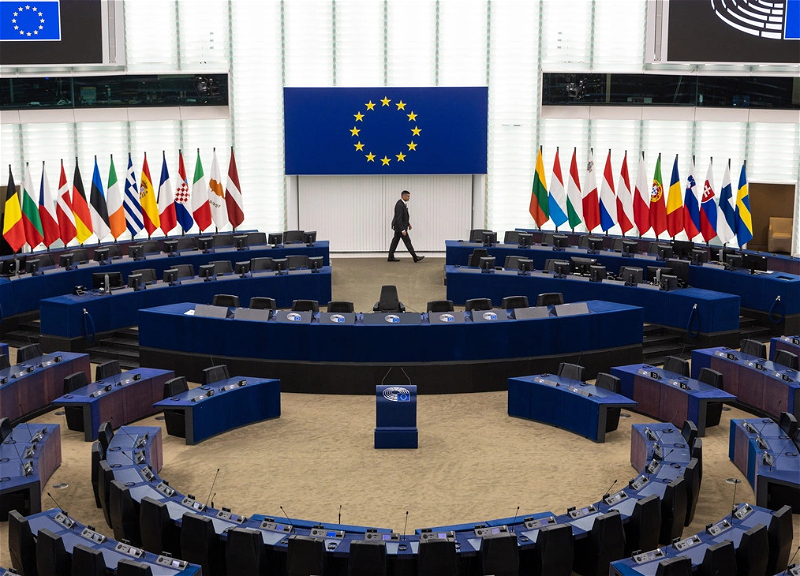
The European Parliament is once again teaching Azerbaijan democracy, yet it cannot explain where the suitcases of cash found in its own members' homes came from.
On October 8, members of the European Parliament once again voted in favor of an anti-Azerbaijani resolution based on false and falsified information. For Baku there is nothing surprising in this — it has long been a customary ritual for the European Parliament.
From May 2021, six months after the end of the Second Karabakh War, until April 30, 2026, the European Parliament adopted 14 resolutions against Azerbaijan. «Just imagine: 14 resolutions in five years — this is a kind of obsession,» — the words of President Ilham Aliyev precisely characterize the biased line of this structure.
Instead of supporting the peace process, the European Parliament resorts time and again to attempts at political pressure, demonstrating selectivity in its assessments. Apparently, it is very difficult for European parliamentarians to come to terms with the new realities in the region, with the fact that Azerbaijan has restored its territorial integrity and sovereignty, put an end to separatism and brought war criminals to justice.
It has reached the point where the European Parliament no longer confines itself to assessments, claiming the right to determine the powers of the state bodies of a sovereign country, to give instructions to its courts and law enforcement agencies, and to put forward political conditions for bilateral relations. At the same time, the very institution that so eagerly hands out political assessments to others has repeatedly found itself at the center of scandals that call into question the transparency of its own work.

It is enough to recall the corruption scandals of recent years. In December 2022, «Qatargate» erupted. Belgian investigators took up suspicions of corruption, money laundering and participation in a criminal organization linked to attempts by foreign players to influence the parliament's decisions. One of those involved was Vice President Eva Kaili.
Ilham Aliyev has previously spoken about how the story ended: «Suitcases with millions of dollars were seized from the vice president's home, but all of it was hushed up. As if it never happened. Her name is known, she is a deputy from Greece. How many years have passed since then? Have any measures been taken against her? No! Was she brought to justice? No! Was she arrested? No! She was released.»
This example is far from an exception; illegal actions have acquired in the European Parliament almost the character of a trend. In 2023, immunity was lifted from former deputies Marc Tarabella and Andrea Cozzolino — the first on suspicion of receiving money in exchange for supporting the required positions, the second of participating in an arrangement to defend the interests of third countries.
But even this lesson was not learned. In March 2025, Belgian police carried out searches in a bribery case linked to lobbying for the interests of China's Huawei. It involved money, gifts and paid trips in exchange for political positions. Charges were brought against five people, who were accused of active corruption, participation in a criminal organization and money laundering.
The Azerbaijani leader calls things by their names directly: «The European Parliament is a den of corrupt officials.»
How convincing are the moral lectures of a body that itself has to answer challenges related to transparency, honesty and the independence of decision-making? Instead of making categorical demands of others, the European Parliament would do better to show consistency in applying its own standards and to build reliable safeguards against corruption and illegal lobbying.
The border of silence
These examples fit into a disturbing series of scandals connected with what is happening today in the European space and on which European parliamentarians could focus — for example, xenophobia, Islamophobia, migration problems, police violence. One need not look far for examples: literally yesterday, police in an SUV rammed a protest of schoolchildren, against whom both water cannons and tear gas were used. For the European rapporteurs, all of this seems not to exist. Human rights are «remembered» in the European Parliament when the subject turns to Azerbaijan.
The particular cynicism lies in where the border of silence runs. For some reason, during the occupation of Azerbaijan's territories, the European Parliament did not recall the rights of more than a million Azerbaijani refugees and internally displaced persons who were subjected to ethnic cleansing and acts of genocide. Yet it too often recalls the leaders of the separatist junta and war criminals convicted in Azerbaijan. The logic by which the MEPs propose to consider them «political prisoners» and to demand their «unconditional release» is unclear.
No organization has the right to claim anything about «immunity» from prosecution. The MEPs who lived through «Qatargate» should know this better than anyone.
A blow to peace
It is also surprising that the European Parliament adopts its resolutions at a time when Azerbaijan and Armenia are taking real steps toward peace. That is, instead of supporting the peace process, the European Parliament prefers to sabotage it, voting for documents that inspire revanchists, fuel separatist thinking and undermine the peace process. Behind such initiatives lie aspirations to create once again a hotbed of political and military tension.
There is another flagrant contradiction. The European Parliament calls on the Milli Majlis to restore cooperation, which Baku suspended in May across all areas in response to the EP's anti-Azerbaijani line. The paradox of the situation is that with one hand the MEPs call for dialogue, and with the other they sign yet another resolution. That is not how trust is restored. For that, a change of approaches is needed, a rejection of confrontational rhetoric and recognition of the equal nature of the parties' interaction.
The EP's claim to the role of a neutral arbiter has long since burst like a soap bubble — an institution whose main figures work for lobbying groups rather than for their voters, promote paid-for initiatives and come under investigation has no moral right to issue diagnoses to others. Millions of European voters who entrusted their votes to deputies have the right to expect from them objectivity and adherence to principle, not initiatives dictated by biased calculations.
Baku's answer to this is simple. The European Parliament may adopt its fiftieth or hundredth paper. Azerbaijan has no obligations toward it and will not turn off the path it has chosen.