The Aliyev doctrine: How Azerbaijan protects its secular identity from politicized religion

The website of The Saratoga Foundation, an American analytical organization dealing with foreign policy, international security, and geopolitics, has published an article by Vasif Huseynov, head of the Western studies department at the Center of Analysis of International Relations and Multiculturalism.
1news.az presents a translation of this article in full:
"Over the past month, Azerbaijan has been tested on a front that attracts far less attention in Western capitals than its energy diplomacy or the peace process with Armenia. On September 21, the Cabinet of Ministers adopted Resolution No. 309, banning in public schools items of clothing that contradict the unified school dress code and the principle of secular education, and on October 6 the government approved similar clothing requirements for teachers. These measures provoked limited protests inside the country and a louder reaction abroad, including a demonstration outside the Azerbaijani consulate in Istanbul on October 3.
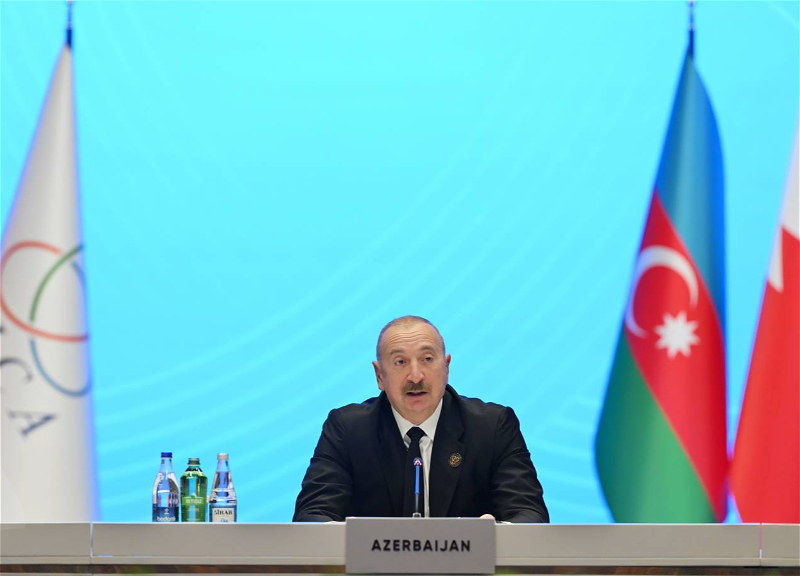
President Ilham Aliyev has already framed this issue in strategic terms. Speaking on October 2 at the VIII Congress of the ruling New Azerbaijan Party, he called ideological security as vital as physical security, noting that the country must defend itself from subversive provocations first and foremost through education, and stressed that Azerbaijan must build its foreign policy in such a way that no one interferes in its internal affairs.
This reflects the essence of what is now taking shape as the "Aliyev doctrine": a state is truly independent only when it relies on its own resources, engages with every center of power without subordinating itself to any of them, and neither practices nor tolerates interference in the internal affairs of others. Applied to religion, this doctrine means that the state guarantees freedom of worship but will not allow faith to become an instrument for advancing someone else's political projects or a tool for dismantling the constitutional order.
Secularism as the foundation of statehood
Secularism in Azerbaijan is not merely an administrative preference. It is one of the fundamental pillars of its statehood. The Constitution defines the republic as a secular state, separates religion from the state, and establishes that the country's education system is secular in character.
These principles were not imposed from outside. In 1918, the Azerbaijan Democratic Republic became the first democracy in the Muslim world and the first country of the Muslim East to grant women the right to vote, which became a major milestone on the path toward gender equality and women's participation in public life. This legacy is vividly represented in Baku's public spaces, including the monument "To the Liberated Woman," depicting a woman removing her veil.
Secularism is also a practical necessity. About 96 percent of Azerbaijanis identify as Muslims (divided between Shiite and Sunni communities), alongside historically rooted Jewish and Christian minorities. In such a society, a neutral state keeps interfaith differences from turning into political fault lines. Iraq, Lebanon, and Syria clearly show what happens when confession becomes the organizing principle of politics: the state falls apart, and external patrons establish themselves within it.
The debate over school uniforms
The events surrounding the amendments to Azerbaijan's school dress code should be viewed precisely from this angle. These restrictions are not directed against any particular religion. They reflect Azerbaijan's long-standing secular traditions and are aimed at maintaining a unified dress code and the secular foundations of education. They also correspond to the country's multicultural traditions, preserving a neutral educational environment in which students of different religious and ethnic affiliations are equal.
Although individual protests did take place, they represented a relatively small minority, with some demonstrators possibly receiving support from abroad. More surprising than the domestic reaction was the reaction abroad, where the Istanbul rally was accompanied by a campaign on Turkish social media. However, Turkey's ruling Justice and Development Party (AKP) quickly stated that the groups speaking out against Azerbaijan have no ties whatsoever to the party or the government. Azerbaijan and Turkey remain close allies, bound by strong historical, cultural, and fraternal ties, and this issue is not expected to affect their allied bilateral relations. Teachers and students have already begun to comply with the new rules, and the situation remains stable. Thus, the government has no compelling reason to revise the amendments at this stage.
Iranian interference inside Azerbaijan
Baku's firm position on this issue is based on experience. Since gaining independence, certain external actors, above all Iran, have sought to spread their religious-political model northward — not only by financing mosques and madrasas, but also by cultivating loyalty to Iran's Supreme Leader among Azerbaijani believers. Ayatollah Ali Khamenei maintained a personal representative in Baku from 1996, whose residence was located in one of the city's mosques until the authorities sealed the premises in 2021. By 2017, official data cited in the local press showed that 22 of the country's 150 Shiite madrasas were under Iranian control, while media close to the government accused Iranian intelligence of recruiting Azerbaijani pilgrims in Karbala for anti-government propaganda.
Meanwhile, Iranian clerical and military figures have repeatedly intervened in Azerbaijan's internal debates. When a previous attempt to regulate school uniforms sparked a protest in front of the Ministry of Education in December 2010, Grand Ayatollah Jafar Sobhani wrote a letter from Qom to President Aliyev demanding the measure be repealed. In 2011, leaders of the banned Islamic Party of Azerbaijan stood trial for calling for the overthrow of the secular government, while their associates were accused of leading an unregistered religious group funded through the Iranian Cultural Center in Baku. That same week, Azerbaijan summoned Iran's ambassador after the chief of the General Staff of Iran's armed forces publicly accused the Azerbaijani government of acting contrary to Islamic principles.
The seminaries of Qom also served as a recruitment base. The Iran-backed Huseyniyyun group was founded in Qom in 2016 by an Azerbaijani cleric among Azerbaijani madrasa students, who underwent military training and were sent to fight in Syria. Its name — "Islamic Resistance in Azerbaijan" — was reportedly chosen by Qassem Soleimani, the former commander of the Quds Force of the Islamic Revolutionary Guard Corps (IRGC), modeled on Hezbollah, and its leader was received by Ayatollah Khamenei in 2017. The group openly rejects Azerbaijan's secular government.
Ideological indoctrination has repeatedly escalated into violence. In November 2015, a special operation by security forces in Baku's Nardaran settlement against the Muslim Unity Movement ended in deadly clashes when the radical group attacked police officers. According to the authorities, the movement armed its supporters and sought to overthrow the constitutional order and establish a "religious state under Sharia law," while officials stated that its leader was attempting to import the values of a foreign state.
In addition, in July 2018, an attack by a radical on the head of the executive authority of Ganja was followed by the killing of two police officers. The government stated that the suspect had spent eight months in Iran and fought in Syria, seeking to establish an Islamic state. In early 2023, after an armed man stormed the Azerbaijani embassy in Tehran, dozens of people were detained inside Azerbaijan on charges of spying for Iran as part of a network suspected of using religion to spread pro-Iranian propaganda. A few weeks later, the authorities linked the attempted assassination of parliament member Fazil Mustafa, a harsh critic of Iran, to an Iran-run network that allegedly planned to establish a religious state and financed its activities through drug trafficking.
The threat is not confined to one confession. For example, in January 2026, the State Security Service arrested three people linked to the Islamic State — Khorasan group over a planned attack on the Israeli embassy in Baku. Whether Shiite or Sunni in orientation, movements seeking to politicize religion view Azerbaijan's secular model as an obstacle that must be removed.
Iranian networks test Azerbaijan
These debates are unfolding against the backdrop of the most unstable regional context in decades. During the recent Third Gulf War in and around Iran, drones launched from Iranian territory struck the Azerbaijani exclave of Nakhchivan on March 5 — an attack President Aliyev called an act of terrorism, referring to the 2023 attack on Azerbaijan's embassy in Tehran.
A weakened Iran has fewer conventional capabilities, which makes its low-cost tools more valuable: seminaries training Azerbaijani students, informal funding channels, clerical networks capable of turning local grievances into a "common cause," and, above all, Azerbaijani-language media often oriented northward.
President Aliyev placed this threat at the center of his October 2 speech. "Why is a resource in the Azerbaijani language being created in a foreign state? To help us?" he asked. "No, to stage provocations against us, to mislead our people, and to poison the minds of our youth." Without naming a specific country, he warned that "right next to us, day and night, provocations in the Azerbaijani language are raining down on us," and concluded that protecting the ideological space is "as vital as physical security."
The debate over school uniforms clearly demonstrated what President Aliyev had in mind. On October 14, Azerbaijan's Audiovisual Council announced that the Iranian television channel Sahar TV had shown footage of an event in Diyarbakir (Turkey) and presented it as a campaign in Azerbaijan in support of wearing the hijab. The Council called this deliberate disinformation and confirmed that the channel had been blacklisted for systematically biased coverage of events in Azerbaijan. Baku's patience with such outlets has long been exhausted. As far back as 2012, Azerbaijani officials asked Tehran to halt Sahar TV's broadcasts, and in July of this year Azerbaijan's Media Development Agency banned the activities of Sahar TV and the Mehr news agency in the country, citing activities contrary to sovereignty, the constitutional order, and national security.
Nevertheless, the doctrine is not a recipe for confrontation. Aliyev continues to maintain channels of communication with Iranian President Masoud Pezeshkian, including a telephone conversation in January, and the latter thanked Azerbaijan for the humanitarian aid provided during the war. Pragmatic diplomacy abroad and firm defense of the ideological space at home are two sides of the same policy.
Outlook
Given these developments, why does all this matter? Azerbaijan is a secular state with a Shiite majority on Iran's northern border. Its success refutes the claim that Shiite identity and theocratic governance are inseparable, which is precisely what draws such hostile attention from Tehran. A stable, secular Azerbaijan is also an anchor element of the Middle Corridor, and these connectivity projects are now developing rapidly across the South Caucasus, although some Iranian officials feel discomfort about this.
Finally, the "Aliyev doctrine" rests on a simple proposition: Azerbaijan's religious tolerance is a product of its secularism, not a contradiction of it. Defending this secular order from outside interference is not a departure from the country's traditions, but their direct continuation."