A meteor shower will pass through the sky over Baku: When and how to observe it?
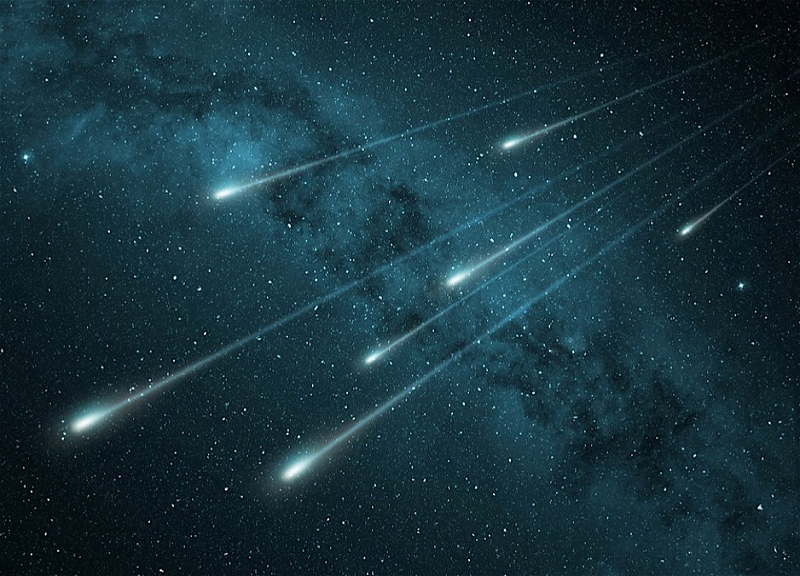
From September 5 to 21, 2026, the ε-Perseid meteor shower will be active, reaching its peak activity on September 9.
The Department of Astrophysics of the Faculty of Physics at Baku State University reports that the September ε-Perseids are distinguished by their high speed. Their velocity upon entering the atmosphere is approximately 64–65 km/s. The radiant of the meteor shower is located in the constellation Perseus, near the star ε Persei.
This meteor shower should not be confused with the August Perseids. While the source of the August Perseids is comet 109P/Swift–Tuttle, the parent body of the September ε-Perseids has still not been precisely determined.
Observations and orbital calculations indicate that these meteors were probably formed from an as-yet-undiscovered comet moving along a long-period retrograde orbit. An analysis of the significant increase in activity recorded in 2013 also points to a cometary origin of the meteors; however, no corresponding parent body could be found among the known comets.
When observed from Baku, the meteor shower will appear at approximately 19:32 above the eastern part of the horizon and will remain active until morning. The most favorable time for observation will be the night of September 9, especially the period after midnight and the hours before dawn. At that time, the radiant of the meteor shower will be sufficiently high above the horizon.
Under favorable weather conditions, about 4 meteors per hour can be observed. The peak activity of the meteor shower will fall during a period close to the new moon phase. Therefore, moonlight will hardly interfere with observations, which will significantly improve the conditions for conducting them.
Note that no telescope is required to observe the meteors. It is best to observe the meteor shower with the naked eye, choosing a place away from city lights. It is also recommended to look not directly at the radiant, but at an area of the sky located approximately 30–40 degrees away from it.