After the restoration of sovereignty: Azerbaijan's new state agenda
President Ilham Aliyev's address at the VIII Congress of the New Azerbaijan Party marked an important milestone in the country's modern history.
The head of state emphasized that the current congress is being held for the first time after the complete restoration of Azerbaijan's territorial integrity and sovereignty. This point is significant not only as a statement of a historical outcome, but also in a much broader context. Once the goal that for decades defined one of the key directions of national policy has been achieved, the question of how the country's future state agenda will be shaped comes to the fore.
Until 2020, one of the state's main tasks remained the restoration of the country's territorial integrity. The victory in the 44-day Patriotic War fundamentally changed the strategic situation, and the events of September 2023 completed the process of fully restoring Azerbaijan's sovereignty over the entire territory of the country.
At the same time, it is fundamentally important that the new reality was not granted to Azerbaijan by external forces and did not result from someone else's political decisions. As President Ilham Aliyev emphasized, Azerbaijan independently put an end to the occupation and shaped new realities in the region. The state's ability to achieve its national goals through its own efforts is today one of the country's main political assets.
Thus, Azerbaijan has moved from the stage of achieving a historical goal to the stage of consolidating the results achieved. It is this reality that shapes the new logic of the state's development.
Victory in itself cannot be the final point of a state strategy. Its political significance is determined by the extent to which the achieved result is capable of being transformed into sustainable development, long-term security, economic activity and the return of people to the liberated territories. In other words, today the question is no longer to whom this land belongs — that question has been settled once and for all. The main task is what content the restored sovereignty will be filled with.
In his address, the President outlined the basic principles of the political course that remain unchanged: independence, statehood, economic self-sufficiency, strong military potential and the maximum use of one's own capabilities.
At the same time, according to the head of state, in accordance with the demands of the times, tactical and even certain strategic goals may change. In essence, it is this thesis that contains the formula of the country's new stage of development. After the restoration of sovereignty, the need for a strong state does not disappear — what changes is the content of the tasks that this strength must serve to accomplish.
Under the new conditions, military potential acquires particular significance primarily as a guarantee of long-term security. The President noted that strengthening military might remains one of the state's key tasks even after the end of the conflict.
There is an important political logic in this. Peace and security do not mean renouncing the ability to defend oneself. On the contrary, the experience of recent decades has shown that lasting peace is possible primarily when a state possesses sufficient political, economic and military resources to protect its own sovereignty.
Therefore, maintaining a strong army after the end of the active phase of the conflict should be regarded not merely as a continuation of the previous agenda, but as one of the main instruments for preventing new threats. In this case, strength becomes not an alternative to peace, but one of the guarantees of its durability.
At the same time, the center of gravity of state policy is gradually shifting toward creation.
The restoration of Karabakh and East Zangezur, the construction of infrastructure, the creation of new settlements and the return of former internally displaced persons to their native lands are turning sovereignty from a political and legal concept into an everyday practical reality.
Today this process is measured not only by the scale of construction work, but also by concrete results. As the President noted, tens of thousands of people already live, work and study in Karabakh and East Zangezur, former internally displaced persons are returning to restored towns and villages, and the pace of the Great Return will increase.
This is where the fundamental difference of the current stage manifests itself: the liberated territory must not merely be marked on the map as part of the state — it must once again become a full-fledged space of life.
A territory is finally integrated into the country's unified economic and social space when schools, roads, enterprises, jobs and ordinary human life are restored there. Therefore, the significance of the Great Return goes far beyond a resettlement program. This is the next stage of state building after the restoration of territorial integrity.
The economic aspect is no less important.
The principle of relying on one's own capabilities, emphasized by the President, testifies to the fact that political sovereignty must be reinforced by economic sustainability. A state capable of financing large-scale reconstruction works, infrastructure projects and social programs with its own resources gains considerably broader opportunities for making independent decisions.
In the modern world, sovereignty has long not been limited to having a flag, borders and state institutions. Real sovereignty presupposes the ability to independently determine national priorities, ensure security, finance development and conduct foreign policy without dependence on someone else's patronage.
Thus, today Azerbaijan faces a qualitatively new task. If the previous historical stage was associated with the restoration of justice and territorial integrity, the current stage must transform the Victory achieved into a long-term system of security, development and creation.
Today, Azerbaijan no longer needs to prove its right to sovereignty — this right has been secured by the state's political will and by the results achieved on the ground. Now the task is to make this sovereignty irreversible — politically, economically, demographically and strategically.
It is precisely the practical implementation of the principles outlined in the President's address that will determine the main directions of Azerbaijan's development model at the new historical stage.
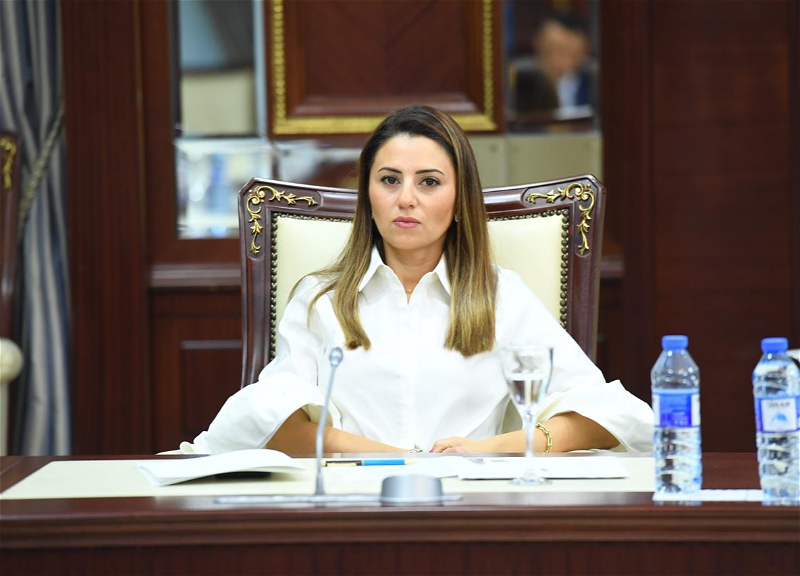
Sevinj Fataliyeva, member of the Milli Majlis